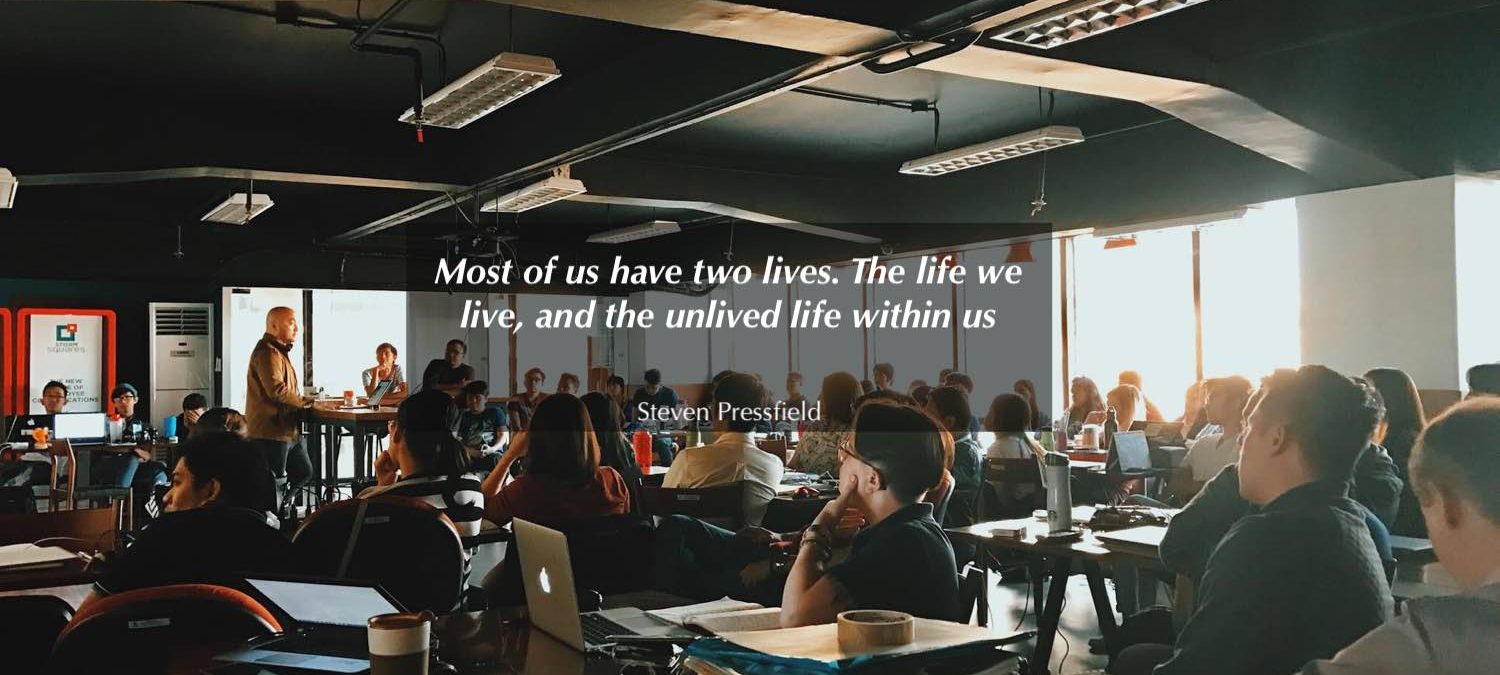
Get Off The Corporate Assembly Line!

Do you remember the last time you did truly great work? I bet your output was made possible because you were fired up and inspired, and you threw your entire being into the project. I bet you thought about the project during non-work hours, in fact, I bet you had trouble sleeping because your mind was so buzzed thinking about possibilities regarding your project. It was work which was consuming, inspiring, and meaningful. There was a point to it.

It was work you believed in.

Now, how long ago was it when you felt this way? A lot of my friends in the corporate world haven’t felt this way for a long time. Oh, they might feel this way for the first few months of a new job, but when reality sets in, the humdrums return with a vengeance.

Why?

One reason is autonomy. Or lack thereof. I find that I can do far greater work in projects I know I have the autonomy to fully influence. In big corporations, such blanketed autonomy is rare. You have an idea for your project? Then you have to sell it to your boss first, then perhaps more bosses. The larger the idea, the more signatures you have to collect.The more radical and revolutionary your idea is, the more difficult it is to secure signatures. This is why in large corporations, to be effective you really have to be a politician. You have to collect the signatures to get things done.

Another reason is that majority of companies are built for efficiency.  The owner equation is simple: I want my company to produce goods and services at the least cost. The fastest way that is achieved? Using the assembly line.

“Assembly line” jobs are more commonplace than you think. The “copy-paste” job I described in my very first post exists in large numbers, albeit perhaps not as blatant.

Take a look at your job description. Are you given enough freedom to pursue something that’s meaningful to you?

Come to think of it, the very fact that you have a job description points to the whole conundrum. The purpose of the job description is to limit your role – its to make sure boundaries are set. Interestingly, I hear so many people say “I hate working with this guy – he doesn’t do work beyond his job description.” Then why have the job descriptions in the first place? Isn’t it ironic then that the people who succeed and are promoted in firms are the very people who go beyond what is in the job description?

Are you lost in the org chart?

Traditional corporations are structured by silos, by departments. The bigger the firm, the more sub-departments are created, the more limited a job becomes. This is why the biggest firms have people who cut and paste all day. This is when people get commoditized.

A person can be given a manual, sent to a training course or two, and few months on the job, and…boom! You have been assimilated. When a person can replace another person by sticking closely to the job description, I’d call that an assembly line.

Of course, there are exceptions. I’ve worked with several companies who give autonomy to their employees and treat them as partners. I’ve met several individuals who truly love what they are doing, do great work, and inspire people around them. Are these common? You know the answer.

YOU HAVE BEEN ASSIMILATED

Instead, we find people in the assembly line. People who hate Mondays and treat Fridays like the greatest thing since sliced bread. People who work merely for their paychecks and look for their kicks elsewhere. People who just go through the motions and find themselves on Facebook the whole day, because they can do the required work in just 1-2 hours. This is a tragedy.


7 WAYS TO ENSURE YOUR STARTUP IDEA DOESN’T SUCK, Part II

We’re talking about tips on startup business ideas. This is part two, you can view part one here.

4) RESEARCH

There are hardly any truly novel ideas anymore. That great idea you’ve always thought of? There’s a great chance someone out there has done it. Don’t fret, this is normal. In many cases, this actually means your idea has a market. Now, look deeper. Find out about how your competitor is doing it. How could you make the idea more remarkable?  What other gaps aren’t being met?

Two years ago, I thought about the idea of starting an executive search firm, partly because STORM, our HR technology firm, was always declining when we were asked by our clients if we did headhunting. A longtime HR practitioner, I employed headhunters before and knew it was a crowded market. At the same time, I thought it would be an interesting prospect to introduce something remarkable to an industry which hasn’t really changed much in decades. I spent an entire year gathering data about the industry, trying to identify a strategic gap. The Starbucks near our office made a fortune off of me interviewing over 50 headhunters, trying to find out more and more about this industry I was very much exposed already to as a client. We finally launched this year, armed with a unique strategy. Its been working so far, thankfully. (truthfully, I think waiting a year was too long, there is a point where research becomes the enemy)

5) STEALTH ISN’T HEALTHY

When we launched STORM in 2006, my attitude then was to “protect my turf,” hence I never talked about new ideas to anyone, paranoid they might get stolen. I was in “stealth” mode. I realize now that that was a complete waste of time. First, no one was out to steal my idea. Check out this article.

Talk about your ideas with people whose opinion you value. Seek out experts and talk to them. Tell them about your plans. The feedback you will collect will be invaluable. And no, even if you blare your idea out into a microphone in the middle of SM Megamall, no one will steal your idea. Trust me. Now stop being paranoid and get feedback. Feedback will perfect your idea, and will likely even lead you to better ideas. Now, I have regular coffee meetings with a few people per quarter, with the goal of just bouncing ideas around – I bounce ideas around with fellow entrepreneurs, and I bounce ideas around with vertical experts.

6) DON’T JUST COPY, AUGMENT

I think this is what Steve Jobs does best. Apart from the Apple 1, which was the first personal computer, none of his other products were firsts. The iPod wasn’t the first portable player. Microsoft actually had tablets almost a full decade before Apple came out with the iPad. The i-phone certainly wasn’t the first smartphone. Each of these Apple-made, market leading gadgets were augmented copies of their originals.

How could you make an existing product/service better? How could that innovation they use in one industry benefit yours? What global idea could be done better locally? Imagine and improve.

7) ITERATION > IDEATION

If you talk to VC’s and experienced investors, they will tell you that they invest in the team first, not the idea. In fact, be prepared for the likely possibility that as you develop your startup, your idea winds up in the waste basket, dethroned by a better one. Paypal started out as a Palm Pilot accessory. Groupon started out as a mere side project. It’s really how you will continuously iterate and improve on your idea that will determine your success as a startup. If there’s one thing that’s suicide for a startup, its idleness. Once you think of an idea, you almost immediately have to think of ways on how you can destroy it and build a better one.

There you have it, some of my suggestions on the startup idea process. Do remember that ideas, and the idea formulation process, can often get seductive. I know some friends who have a “good enough” idea on their hands, but don’t want to jump in because the idea isn’t “perfect” yet. Wasted time. Select an idea AS FAST AS YOU CAN, then find a WAY TO TRY IT OUT as fast as you can. The sooner you can gauge as to whether your idea is a good one or not, the faster it is that you can progress, or move on to a better idea.

7 WAYS TO ENSURE YOUR STARTUP IDEA DOESN’T SUCK, Part 1

Ok, while ideas ARE overrated, they are still important. Let’s talk about the process of evaluating, and ultimately choosing, which startup idea to commit to. This will be a long one, so I will cut it up into 2-3 posts. Remember, the criteria I will be using here will be for startups, not necessarily for lifestyle or small businesses. For a small business, sometimes all it takes is a good franchise and a good location. It’s a little more complicated for a startup with big dreams.

Let’s start with some career advice cliche.

1.Go after a passion

It’s cliche for a reason: its extremely important. A lot of entrepreneurs get into the game motivated by money, and that is fine. But it is only a deeper passion for the craft that will make your product truly remarkable. It is also passion that will help you stay in the game when the lean times come.

I immediately gobbled up Isaacsons’s Steve Jobs biography the minute it came out. What you get immediately is that Jobs wasn’t in it for just the money. I remember the part of the book where engineers were puzzled at Jobs’ insistence on getting the colors and design right for parts deep inside the computer they were building – parts the consumer would never even see. The whole book – and the whole history of Apple – is really about Steve’s overwhelming passion for the product, passion you could feel when you use Apple products.

What product can you talk about all day? What topic can you read dozens and dozens of books on?

What doesn’t feel like work?

(quick add: if you have a partner or 3, then consider common passions)

2. Consider Tech

Year after year, I get to interview fresh graduates coming out of the Universities. One thing I love asking business majors is what happens in their school’s usual “business simulation activity.” I ask the interviewee to try to remember ALL the concepts generated. I get the same sad company concept list year after year (this year not an exception) – almost 100% of groups do a retail concept, where a “new” food type or a new bag or a new snack is generated. Worse, schools usually hold a tiangge or ask students to put up a stall in Greenhills, thereby virtually guaranteeing that only retail concepts are created. The last 15 years, how many of these retail concepts have actually become household names? One? None?

If you want to make it big in retail, you need gobbles of money. Its a huge risk. With inventory. Oh, and your competitors are named Procter and Gamble, Unilever, and Universal Robina.

Didn’t people get the memo? That the Google algorithm was done in a garage? Didn’t people watch The Social Network? Tech is the one area where the playing field has been leveled, where innovation has become a commodity. Before, creating a tech product meant spending millions buying huge expensive servers and software licenses. Now you can talk to your programmer buddy and essentially create one basically for free. It’s an arena where tiny Chikka in the Philippines can build the world’s first mobile instant messenger and make a difference. There is NO reason why the next great tech company can’t come from the Philippines.

Consider tech.

If you are passionate with something else, you can think about how you can use tech to augment your product towards our new Star Trek era. Passionate about T-shirts? Maybe you can do something like this. How about food? Maybe you can build a local Yelp.

So what are you waiting for? Run and get your tech partner! That’s what I did back in ’06.

(Oh, and if there any school administrators/teachers around there who can influence curriculum – why not combine people from different majors when you do your business simulation activity? Think of what can happen if the business guys team up with the computer guys and the design guys. It will be amazing AND will simulate real life in a much better way.)  

3. Solve a Domain Problem

I was lucky enough to get a press pass and witness the first night of Startup Weekend when it was held in Fort a few weeks back. Great event. There were dozens of ideas, usually revolving around trends such as  location technology, new social networks, and online event aggregators. My problem with these ideas is this: how many people around the world are working on these ideas? Hundreds? Thousands?

My other problem is this: a lot of these ideas are features, not products. If Facebook, which everyone uses, decides to make your company idea in to a feature, then say goodbye to your firm. This problem is now what Foursquare is now facing.

My suggestion is you go zig when everyone else is zagging.

One practical way to do this is to tackle domain problems. If everyone else is busy building another Facebook (good luck with that),  why don’t you talk to 10-year veterans of certain domains. Talk to a great doctor. Ask him about the problems in that industry. Talk to a supply chain director. Talk to a high school principal. Heck, you might be one of these people. These are the people who have the needed experience to define problems very well – and the intuition to craft great potential solutions.

Talk to them about the sticky problems they face. Can creating a particular service help? Can technology help?

I tell you, you will be amazed at how much opportunity is actually available. Before doubt sets in, let me tell you now, you can make a difference.

More to come.

PS: If you are a “business” guy like me, you can form a great team already by partnering with a tech guy and a domain guy. Can’t wait to tackle forming teams!

Part II here!

Ambition + Innovation = Startup

If I buy a Jollibee franchise, would that be a startup? If I open a sideline internet cafe while I’m handling my day job – is this a startup?

There are several definitions thrown around now about what a startup is and isn’t. Here’s mine:

Ambition + Innovation = Startup

First, a startup is all about ambition. It doesn’t want to be another player in the market. It aims to be the BEST player in the market, or better yet, it aims to find entirely new blue ocean markets.

When I was still in Chikka Asia, one phrase thrown around a lot was “global domination.” This is a startup. Morphlabs, a local cloud computing firm recently  was granted 5 million dollars in funding (http://venturebeat.com/2011/09/06/morphlabs-5m-funding/) to do cloud computing for the international market. This is a startup.

What about that internet cafe you opened or that solitary coffee shop you founded and named after your daughter? (tipong Julie’s) Unless its a real goal for you to topple Netopia or Starbucks – nope, not a startup.  These are more lifestyle businesses.

So wait, wait, wait, what if i buy…20 Jollibee  and 20 Labandera franchises? Is that ambitious enough for you, Peter? Huh?! 

This brings me to the next criteria – innovation. A startup wants to create a dent in the universe. Nowadays, in order for you to do that, you need to innovate. Are you really making a dent, are you really changing things up, if you buy 20 Jollibee franchises? A true startup tries to destroy the status quo, not to preserve it. Your 20 Jollibee franchises helps Jollibee make a dent, not you. You know what a true startup entrepreneur in the food business would use that money for? He would use it to create a NEW Jollibee – which was precisely what happened when Edgar Sia II recently changed the landscape with Mang Inasal, forcing Jollibee to buy it for 3 billion. Mang Inasal – now that’s a startup story. And lest we forget, Jollibee, which forked over the 3 billion, and is now busy trying to take over the world, is another great startup story.

Actually, ambition and innovation now go hand-in-hand, very tightly. You want to rule a market? You have no choice but to innovate. Google stole Yahoo’s thunder by creating a better algorithm. Facebook killed MySpace and Friendster by delivering an entirely new and unique user experience. I remember eating in a Mang Inasal for the first time a few years ago, it was at the Starmall branch. The chicken wasn’t as good as some of the standard inasal shops around, but it wasn’t a huge drop, and I didn’t need to wait long for it. That was an industry first, fast-food chicken inasal.  But there was more. There was someone going around with unlimited rice strapped on. The furniture was different. There were these videos playing as well, not your typical music videos or an NBA game, but there was some guy having fun explaining the Mang Inasal concept. I remember thinking (in tagalog, but translated here), “someone put a lot of thought into how this would go together.”  And it did come together, and the experience was just different. Innovative.

Ambition + Innovation = Freaking Difficult

Of course. No one said it would be easy. People who put up startups are not after comfort. It deliberately tackles the biggest mountains head-on, armed with ingenuity, passion, tenacity, and by the sheer force of their will. Making dents in the universe isn’t easy. It’s not for everyone. But if you find yourself nodding as you read this, you are precisely the person I want to reach out to. Go for it. We need you.

Don’t get me wrong. Lifestyle and small business entrepreneurs are very much needed by our society and economy. I am all for them.

But if you are going to dream anyway, why not dream big?

Small steps ARE the giant leaps

It doesn’t need to be a giant leap. Perhaps you don’t need to quit your day job just yet. But start something. Enough of the Starbucks dreaming with your friends on that idea you wanted to do. Start doing it.

Small steps.

The small steps are the great ones. They allow you to digest the grand adventure you are undertaking into bite-sized pieces. They also allow you to generate much-needed momentum to take the bigger leaps.

 In 2004, I had my big idea. It was to create a benefits-based HR technology firm. I do remember multiple times when I decided to put these thoughts aside thinking, “ME?! Start a firm?”

However, it would gnaw at me periodically. I would have near-sleepless nights imagining and think to myself, “hey, this could work.”

I finally put my ideas on Powerpoint. In retrospect, this was crucial. Creating those slides was my first small step. I then proceeded to think about people whom I think could help me build the firm. I made a list of people whom I thought would be interested in the idea AND would complement my skill set – this was my next small step. I spent a number of weeknights having coffee-talks with each of these people, openly sharing about my idea, and asking for their opinions. In other words, I was recruiting.

Momentum was created, and soon, we were having brainstorming sessions in my house. Soon, I was signing SEC incorporation papers. Soon, we had a STORM email address. Soon, we started operations. Soon, we landed our first client. 3 years after, I took a deep breath and took the plunge – forever turning my back on the corporate career I had built. Soon, I was thinking about more startups.

Small steps leading to bigger steps.

What small steps could you take?