A Ride in the Pedicab: Thoughts on Startups and Juan

I arrived at Rockwell. Got dropped off at Estrella Street. Was going to walk to the Power Plant, but this elderly gentleman asked me if I wanted a ride on his bicycle car. I was happy to hop into the contraption, as it saved me from the walk. It was an interesting experience to ride in the bicycle car, while this pleasant fellow peddled along the street.

While he was treading along, a car nearly hit us at an intersection. The man’s bicycle couldn’t keep up with the flow of traffic, but he didn’t fret. He brushed the incident off his shoulders like a true boss. After the 5 min bike ride, I get out of his cart and asked him,

“Kuya, anong tawag ulit sa bike mo?”

He replied with a smile, “Pedicab!”

I said, “Ah tama! Pedicab.”

I forgot about the pedicab. I couldn’t recognize the vehicle when I was riding in it, even though I saw so many pedicabs when I was last here. During the ride on Estrella, I was so preoccupied with thoughts that the term, pedicab, completely slipped my mind.

I couldn’t stop thinking about how the pedicab driver was being left behind with his use of old technology. While I definitely benefited from the pedicab, I feared that it would be phased out and the jolly man, who was so eager to give me a ride, would eventually be out of a job as development in the country continued.

Where would the man end up? What would he be doing, if he weren’t a pedicab driver? Would anyone even give him a chance to work?

That short ride in the pedicab really got me thinking…the experience resonated with something I was reading.

Startup and Change the World

Earlier in the day, I was reading a passage from Startup and Change the World: Guide for Young Social Entrepreneurs by S. Dev Appanah and Sunit Shrestha.

In the section about Social Technopreneurship, Appanah highlights Professor Michael Porter’s words on innovation:

“Professor Michael Porter from the Harvard Business School argues that, ‘Innovation is the central issue in economic prosperity,’ innovation and technology can help the poor as much as the rich” (Appanah, 7).

Innovation will continue to change the world, and technology is driving that change.

I’m not a techie. I’m probably the polar opposite of a techie, but I do see the vast potential that technology can have on the poor and the development of this country.

While it’s only been a month since I’ve been exposed to tech startups in the Philippines, I can proclaim that the innovation of the Pinoy is outstanding. Pinoys can do so much with scarce resources, and many times, even better than those who have more resources available to them. The talent here is incredible. Countries like the US and Australia can attest to this statement, as big international firms are outsourcing the services of top Philippine talent.

Similarly, there is immense talent and innovation coming from the masses. Their creativity and resourcefulness in daily activities that may seem mundane is a demonstration of innovation at its finest. (You can check out this article I did for juice.ph last year, if you want to get an understanding of where I’m coming from.)

To all you game-changers, I’d like to make this plea: let’s NOT leave Juan behind in the process of innovation. We are a country of more than 90 million. Our greatest resource is our people. Together, we will build our nation.

As Professor Michael Porter points out, “Innovation and technology can help the poor as much as the rich.”

In order to move forward with every Juan, let’s be conscious of where that niche can be filled in a bright and developing Philippines.

Where do you fit?

On My Unexpected August 8 Night, an Inspirational Urvan, Edward Cullen, and Startups for Juan

I thought I’d be spending tonight hosting, chatting with entrepreneurs, and eating pizza at the Ayala-sponsored Juan Great Leap event at the UP Technohub. Instead, I found myself volunteering to help feed people in makeshift centers near Marikina River with some of my friends from my community.

As you would expect, the conditions were brutal. The first site we went to was a converted Church. The pews were arranged in squares, where each family would stay – a good number of them with their dogs. As a father of young children, my heart immediately went out to the small children and babies.

We then went to work.

I ended up with the porridge-distribution role. We had plastic cups ready, but it looked as if they’ve done this before – they lined up with their own containers. A few of them carried real cups and bowls, but most of them brought the makeshift-variety: empty yakisoba cups, or even used Mcdonald’s spaghetti-styros. While I poured the lugaw (it took 3-4 times with the ladel I had), I tried to engage in some small talk. Most of them smiled. Some kids wanted their cups full to the brim. Some made jokes with me. Some tried to help out.

We have a unique and resilient people. It’s easy to fall in love with them. 

If I had to evacuate my house, transfer my family to a crowded shelter, get all wet, and beg for food? I’d have thrown a hissy-fit, or go all Edward Cullen-emo and ask the heavens why?!.

The second site we went to, a converted basketball court, had harsher conditions. The people density was worse, and they were crammed in blue and yellow Pasig-City tents (which were not bad, it was just the density). Within minutes, the remainder of the food we brought was finished. (people, we have to continue to give and donate) There were some very heartening scenes though: a Manila Water truck pulling in to distribute free water, the most sincere thank-you’s you can ever imagine (highbrows who say giving people fish isn’t wise please find a rock and just go away), an individual Urvan coming in while we were leaving who brought even more food.

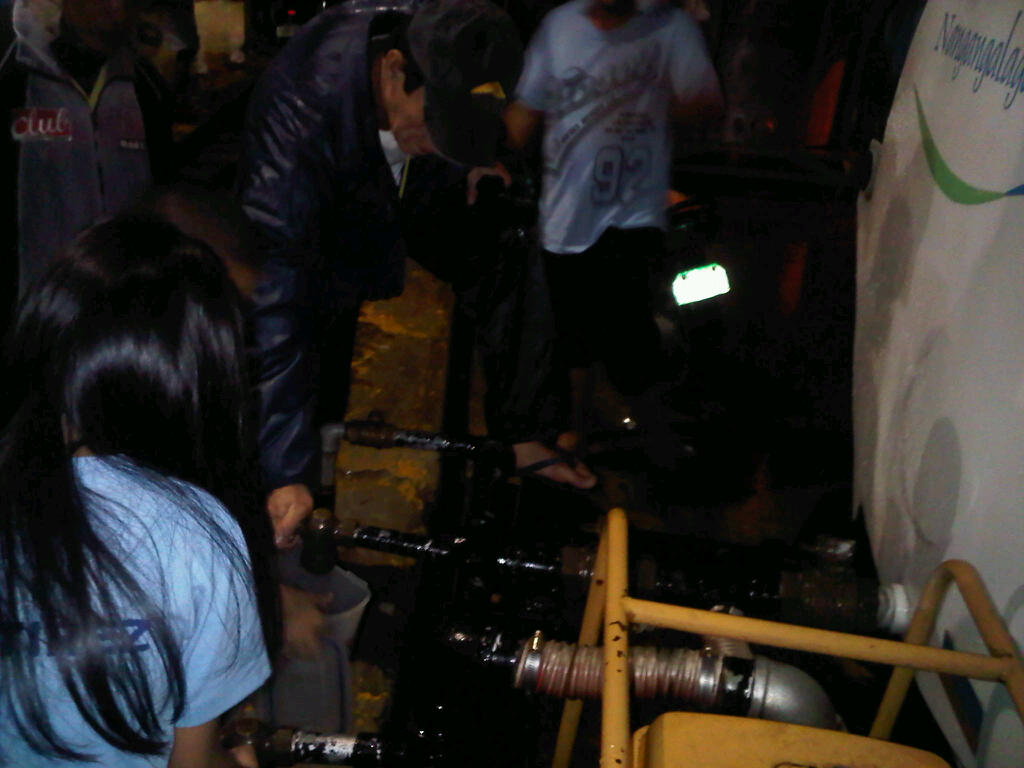
Manila Water truck arriving to offer free drinking water

That Urvan was especially inspirational for me. We came in a caravan of 5-6 cars. This was just one family, who probably said to  themselves: “Let’s go get some food, and then let’s go around and distribute it ourselves.” I found it amazing.

Even alone, you can make a difference. 

Upon arriving home and while taking probably the most guild-laden hot shower of my life, my thoughts were racing. 

What can I do? What can I do? What can I do? What can I do? 

For starters, I couldn’t wait to write and share this story.

I can plead with you – the entrepreneur and the would-be-entrepreneur – to put JUAN in your motivation equation, to extend the concept of family to include, not merely your kin and friends, but Juan as well. The impoverished Juan who gets marginalized, neglected, and often taken advantage of.

Let’s endeavor to make our startups work, not merely to make money, but to create jobs. (and not those zombie-jobs too)

Let’s endeavor to make our startups work, not merely for our freedom, but to help facilitate freedom from poverty. It’s a big hairy, problem. And even from just writing that line, it feels a bit contrived (maybe because it sounds like something a politician would say). It’s certainly a problem worth sinking our collective entrepreneurial chops into.

I’m especially inviting (challenging!) the very best of you – the most talented, the most brilliant, the most capable – to make a true difference.

Juan dela Cruz is certainly worth it. 

Here’s an idea. Why don’t we sit down and talk about it? I was thinking a startup event, but one which solely focuses solely on social, nation-building, entrepreneurship. A Social Entrepreneurship Conference or Pitch Night perhaps? I have a lot of ideas on how to do it, but I want to share the experience of building on it and collaborate.

Interested?

Then COMMENT below. Comment if you’re in. Comment if you’d love to help me arrange it. Comment if you know a venue. Comment if you can bring food or drinks. Comment if you’d want to sponsor it. Comment even on why you think it won’t work.

Comment. Act. Move. Leap. Just do.