
How to Avoid The Marshmallow Career

marshmallow_test

In a landmark study done in 1972 by Stanford psychologist Walter Mischel, hundreds of children were offered a marshmallow. However, each child was told that if they could resist eating the marshmallow for 15 minutes, they would receive a second marshmallow.

Decades after, it was found that the children who delayed gratification (around a third of the 600 students who participated), were described as more competent, had higher SAT scores, and went on to have better careers.

A few days ago an entrepreneurial friend of mine posted a quick “Pera o Passion?” poll on his Facebook page. The last I checked, “pera” was leading.  It was understandable, but I have to admit, I felt a bit disheartened.

Quick money is almost always un-strategic.

Let’s talk about this overused word for a minute. For me, to be “strategic” means that decisions are always made to support a much bigger picture. To be truly strategic almost always means to defer gratification. Think Amazon delaying becoming profitable for so many years (CEO Jeff Bezos was barbecued in the media in those days). They were burning hundreds of millions to acquire customers year after year because they were after the bigger picture (a much larger community). This long-term plan paid off. Amazon is now one of the world’s most admired and successful companies.

I think very few of us  really think about our careers strategically.

Instead, most people eat the marshmallow.

A friend of mine recently reached out to me about career advice. He was explaining that he wanted out of the industry he was in, that he would never go back to it. A few weeks later, a high paying job became available in a company he really admired. I noticed it was in the same industry he was in. In a recent email, he was asking me for tips on how to get into the that firm.

Huh?

He’s eating the marshmallow.

We fall for it early. After years of not earning anything, we finally attend job fairs and get dazzled by the offers we get. Sadly, most people still decide to go to the highest bidder, where the assembly line starts and is built to keep you in.

As we get older, we then feel it:

This money thing isn’t as cool as I thought it would be. 

I’m earning, but I’m not living. 

What field/job can I be truly happy?

or even

Hindi ko natutugunan ang aking pagmemeron.

Quarter life, or even mid-life crisis, at its full hurricane force.

If we ask the people who voted for “pera” in that earlier casual survey 20 years from now, I’m guessing the pendulum would shift to the other side.*

So what am I getting at?

Young people. I’m talking to you. Don’t fall into this trap. Take it from us (slightly) older folks. Think about your careers strategically.

Repeat after me. Big picture. Big picture. Big picture.

Here are some tips on how to avoid the marshmallow career:

1) Take Time to Understand YOUR Big Picture

I think this is where a big chunk of the problem lies. We lack self-awareness. We don’t invest enough time understanding who we are, what we like doing, what our natural gifts are, and what we want to be when we “grow up.”

As some great military people once said “knowing is half the battle.”

Take time to assess. Ask friends about what your strengths and weaknesses are. Take personality tests. Ask people about other careers.

Granted, this won’t be automatic, as “finding out who we are” can take a long process. But I think part of that problem is, we don’t really put enough investment in consciously trying.

Try. Perhaps asking this simple question can help start the process: who am I?

Also, think about YOUR big picture. Not your parent’s. Not anyone else’s.

2) Work Backwards

Once you have a reasonable idea of your Big Picture, do a Covey and try to Begin With The End In Mind.

begin

What career move can you do NOW that will inch you closer to your Big Picture?

Since this is an Startup Blog, here’s my quick tip on what next career steps you can do if you want to own a business someday:

A) Go fulltime and take the leap! Startups are all about learning through doing. Anything else is a bit of a  compromise. Try naming a great startup which was done part-time.

B) Work for a startup. Next best thing.

C) If A & B are too unpalatable, you could: 1) get into sales – it might not be that sexy to some, but selling is an extremely valuable skill to develop in any startup, 2) get into the industry you plan to develop your startup in, the smaller the firm, the better, 3) get into anything which expands your personal network in a hurry.

3) Just Say No

Okay, you’ve got your Big Picture. You’ve got some semblance of a plan on how to get there.

What are you going to do when Company X offers you a big package from out of the blue because your friend gave a good recommendation?

Think Amazon. Think strategic.

If something tempting comes and shows you all the shiny things you can have now if you break your plan, well, just think of all the SHINIER things you could accomplish sticking to the plan.

This is easier said than done, of course. But possible.

4) Pray

By far, my best career advisor has been God. My best career decision-making process has been Discernment. I’ve always maintained that it was He who really pushed me into an entrepreneurial path.

Here’s an interesting thing.

I belong to a Community  which really encourages its constituents to pray, talk to God, and surrender to His will. This group has a disproportionate amount of people who have taken leaps from their long-standing careers into what they truly want to do. A longtime banker who has become a pre-school teacher. An longtime FMCG executive who now works for a foundation. Another longtime marketer who put up her consulting practice. A longtime IT employee who’s put up multiple small businesses. There are more. All of which would tell you they had the courage to take the leap because of prayer.

You should see their faces when they explain how happy they are in their chosen fields. Passion is always evident.

As is the lack of it.

(know anyone who will benefit and resonate from this post? be a blessing and share!)

self-awareness

*The big assumption of course, is that we are earning enough to cover our basic needs. Maslow’s hierarchy in full effect. 

Matt Lapid’s Juan Great Leap – All The Way from California!

Matt Lapid is Juan Great Leap’s official first hire. I first got in touch with him when I opened my email account and got to read his very convincing cover letter. It’s quite apt that the hire happens two days before JGL’s first year anniversary. I thought I found a kindred spirit talking with Matt during the interview process: his passion was very evident, he was a God-fearing person, he had this genuine desire to give back, he writes, and he took this great big leap of faith.  Here’s Matt himself  with his story. – Peter

Hi there! My name is Matt Lapid. I am a Fil-Am, born and raised in the States. I’ve decided to take one great leap by working with Juan Great Leap. Pretty direct approach, right?

So this is my story. I graduated from college in 2010 with a BA in English Lit from UCI. I took a life-changing trip to the Philippines right after I graduated. I only planned to stay a few months to learn Tagalog, but I ended up staying for a whole year to help with Gawad Kalinga’s Center for Social Innovation. Work with GK CSI changed me. It opened my eyes to a Philippines in which change could happen and was happening right before my eyes. It was a total immersion that was a challenging experience for a Fil-Am who was in search of his identity and struggling to integrate into the Philippines, but it made me.

After missing my mom’s 60th birthday and my cousin’s wedding, I finally returned to the States. These were the realities of being away, but in spite of all the things I missed, I came back unlike my former self. I felt changed and made for something else, and it was evident in my first full-time job in the US.

As absurd as it may sound, I ended up working as a personal banker for a financial institution. I felt that I could really help people with a very relevant problem crippling Americans: money. While I was working, I felt a void in my heart. During my seventh month with the organization, they gave me the opportunity to become a licensed banker, in which I’d receive training and a sizable bonus. However, if I were to take that offer I’d have to commit to work with the company for another year. It seemed like an eternity for me. I knew how much a year’s worth of work could do in terms of social impact, and I just couldn’t make a change if I stayed, so I put my two weeks and left.

I ended up doing consultancy work for Human Nature USA, the US arm for Human Nature, a social enterprise that offers natural personal care products to help poor farmers in the Philippines. It seemed like the perfect fit for me. I could live out my dream of helping the Philippines while staying in the US with my family. That sense of purpose drove me, but reality sunk in. I was in a position in which I couldn’t sustain myself, and the passion and purpose that drove me collided with the realities of life. As much as I wanted to make my work with the organization work, it unfortunately didn’t.

So I deeply discerned about what I really wanted and what God was calling me to do, and I realized that the mission never changed. The mission was, and is, to make an impact on the poor in the Philippines through entrepreneurship, and for me that change starts in the Philippines and with Filipinos, not abroad.

But after two failed endeavors in social entrepreneurship, I really questioned a lot of things. Was I really supposed to be a social entrepreneur? After all, I graduated in English. Perhaps, it just wasn’t for me. I was scared to move.

With a friend’s recommendation, I discovered Juan Great Leap. I was immediately mesmerized by the wisdom and spirit this Peter Cauton was illuminating. Reading JGL’s posts gave me a sense of validation in what I was doing and where I was being led.

In his blog, entitled, “The One True Risk I faced in taking the Startup Leap,” Peter notes, “If you have that itch, there is no sense stalling. Take that leap now.” It was plain and simple. I’ve had this crazy itch and I knew it would persist. I was so anxious to move, but I just couldn’t because I was over thinking. JGL’s simple words validated everything for me. The vision was clear and all I needed to do was take that Juan Great Leap.

After reading through JGL’s blog, I immediately sent Peter my application attached with a CV full of crazy conviction, a side of me that I don’t readily share due to fear of rejection. Yet something intuitively told me that I could spill out my heart and soul in this correspondence, and, indeed, Peter replied! After that correspondence, I met Peter via Skype for a couple of hours. We scheduled another followup interview via Skype for the following week, but I booked my ticket a couple of days after. Though the future was still uncertain, I took my first leap in flying to the Philippines without that crippling fear of the unknown.

And now I am here in Manila taking the leap to urgently move for myself and others. It’s a big move but it’s Juan Great Leap that I have to take!

@ LAX airport…getting ready to take my Juan Great Leap!

Saturday Night Gimmick!

It’s a Saturday night. I’m a bit tired coming from a party. The kids are asleep. Pauline’s on TV. After a full week, I’m on my bed wanting to relax and have my me-time.

Three things to choose from: a book to read, NBA 2k13, or surfing the web.

I choose to surf the web.

What do I end up doing? Going to Linkedin to recruit for some startup openings we have.

One way to look at it: that’s pretty sad, man! 

Another way to look at it: I find work fun, and I’m not trying to escape it. 

Work on something you love. It’s becomes a virtuous circle.

Yep, that’s my foot!

Waiting breathlessly for a co-founder? Just start.

Off the top of my head, I could name 10 different people who cannot get their startup off the ground because of the lack of a co-founder.

During the open forum of the last JUAN GREAT MEET in Briggy, there was a flurry of co-founder related questions:

How do you find the right co-founder? Where do you find the right co-founder? Is it right to co-found companies with friends?

What struck me during the proceedings was when someone added to the discussion (I think it was Joey Gurango): okay, so why would you need a co-founder in the first place? 

You know, it’s very clear for me why a co-founder is better than going at it alone: you want have someone to be with in the trenches, someone to discuss things with, someone who will be strong in the areas you are weak in. Because of these very powerful reasons, it’s quite understandable to expect someone to wait for the “right one.”

But only up to a certain point.

If you’ve already spent a considerable amount of time exhausting your network, getting to know even more people, looking under every rock you see, and you just keep hitting a brick wall, then it might be time to throw in the towel and get some work done. At some point, the waiting just becomes counter-productive, so just try to start.

Yep, alone.

For some, this might be a scary thought, as the assumption all along was to form a team.  But perhaps this has become some sort of a crutch, and excuse for you to put off doing what needs to be done.

It doesn’t need to be complicated. Knowing you WILL go at it alone, ask yourself, okay, what’s that next thing that my startup needs to progress?

Are you a someone with an idea who’s been searching for a technical partner for a year already? Then the next crucial “step” (the one you’ve told yourself you can’t do without a technical partner) is to build a prototype, right?

Just start. Create detailed specs – how does your app work? Ask around and canvass for freelance programmers who might do it for a fee. Try to look for and recruit the best one. Begin raising the money that might be required.

Perhaps you don’t need a technical solution just yet. Perhaps you can test the market out by creating a powerpoint mock-up and just doing a “demo” of your product to dozens of potential customers. The info you’ll get is guaranteed to be uber-useful.

I know it might sound intimidating because that “next step” would typically be the precise reason why you’re looking for a partner – the skills required for this next step might not be within your comfort level. But this is what makes an entrepreneur an entrepreneur – she learns, adapts, and just makes things happen.

So stop waiting and start doing. The ironic thing is, once you just go ahead and decide to start, you’re sure to encounter and attract even more people who are interested in what you are doing. Sometimes, the best time to find a partner is when you’re not looking.

The Dangers of Reverse Momentum

I haven’t written in around 2 weeks.

Last week, I had an excuse – I was bedridden for much of the time. This week though, I could’ve hammered out some posts earlier, but I just inexplicably refused to do so – it was like I was allergic to the keyboard all of a sudden.

Since I hadn’t written in a long time, it was sort of easier to keep not writing – and it seemed like such a chore to start.

It was reverse momentum! The more I didn’t move, the more I didn’t want to move.

I realize there were so many other aspects in my life that I’ve felt this way about: going back to the gym after stopping for a while, finishing a book I had started, getting back into daily prayer, eating the right food again, sleeping early again, and so on. Sloth does one other deadly thing: it begets even more sloth.

Perhaps there’s an item RIGHT NOW that you KNOW you need to be doing, but can’t seem to muster the effort to do so because its been such a long time.

Some of the good habits we’ve developed WILL end up getting challenged by reverse momentum at some point. If we give in, there’s a danger we lose the virtue entirely. We need to be stronger.

The important thing is to take a deep breath, embrace the resolve that you’re NOT going to let it win, and just do it.

Wunderkind

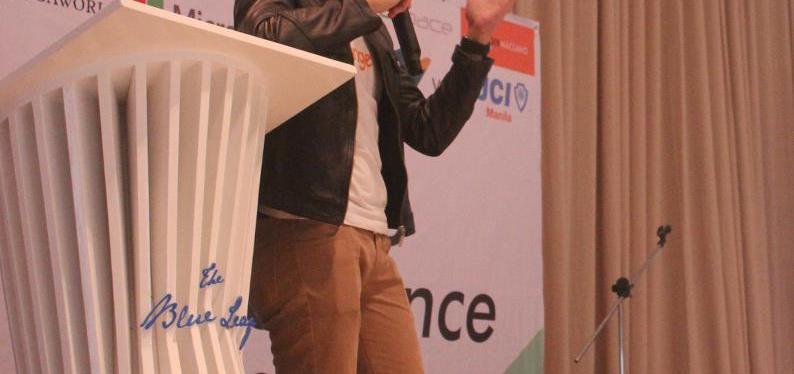
Yesterday, I had the privilege of giving a talk at the AIESEC Leadership Convergence Summit.

The person who spoke before me was Gian Scottie Javelona and I found his story riveting.

The people at the conference were branding him a “19-year old CEO.” But I think this title sells him short.

Anyone can call herself CEO. Those who get enough votes in their college business simulation companies have that title. Those who inherit Dad’s business at 19 can call themselves CEO (to Dad’s Chairman of the Board).

Quick, tell me the last Filipino you know who created a product in his college years and turned it into a business?

At 19, I was busy going out with my friends, playing video games, and cramming for the next exam. This guy probably does all that as well. Oh, but he’s also creating mobile enterprise software and trying to grow his firm at the same time!

Gian isn’t just a CEO, he’s an entrepreneur.

At 19 years of age, he’s a wunderkind.

Let me tell you the best part of his story for me.

Gian’s company, Orange Apps, has created a customizable mobile portal for schools. It runs on the Android platform.

Gian had one problem when he was trying to develop the app….

He didn’t have an Android phone!

So what did he do? At first, he kept on borrowing a friend’s Android phone. Finding this too slow, he finished building a payroll system for a client, and then used the funds to buy himself an Android firm.

This, my friends, is the very essence of entrepreneurship.

His school, PUP, has since adopted his platform. Gian is now busy getting his product to other schools and expanding.

All while trying to fulfill school requirements for his impending graduation.

Amazing.

1% Membership Requires Conviction

No matter how loud this blog becomes, 99% of people will still choose to go the usual route.

99% percent will still choose to go with the herd.

99% will still play it safe and choose the comfort of a twice-a-month salary.

What differentiates the 1% from the 99%?

What differentiates the 1% from the 99% is conviction.

I have seen this first hand with all the entrepreneurs and founders I’ve interacted with. They believe in their vision. More than that, they believe in themselves. It is an unshakeable, oftentimes illogical belief.

It is this conviction which allows them to take on the big hairy leap to go out on their own. But this isn’t what results in the 1% yet. Perhaps 10% of people will take this courageous leap.

But 9 out of these 10 people who will leap will give up the moment it becomes dicey, when they get punched in the mouth.  Most successful entrepreneurs and startups have had colossal failures marking their timelines. Our hero Steve Jobs very publicly got fired from the company he founded. He could’ve retired with his millions, but instead he used the failure as fuel to mount the greatest comeback in business history.

Unlike with most people, failure doesn’t make any significant dents in the conviction of the 1% – it actually strengthens it. (Failure can create the proverbial “chip on the shoulder” – which some investors love)

I like how the other meaning of conviction ties into this discussion. The other meaning of conviction is “judgement rendered.”

In a sense, this is exactly what the entrepreneur exposes himself to – judgement.

I wrote before at how the leap in people is prevented not by the incapacity of the person to take on risk, but a lot of the time, its “what will other people think?”

“I will leave my 15-year banking career to put up a startup which creates mobile apps for the elderly? OMG! What will my family say? What will my peers say?”

An entrepreneur just leaps in and effectively says:

Hey world, this is me!

You want to be like the 1%?

Then DECIDE.

That decision is the underrated element of the leap. Most people are wishy-washy with their decision, doing a “wait-and-see” versus an actual decision. (you who are guilty of this know what I mean) Or choosing to be in perpetual “data-gathering” mode. Stop talking about it and start doing it.

Can’t resign yet? Perfectly okay. Allot 2 hours a day working on your startup – plan and do. Too hard?

Then you’re in the 99%.

Let me end this post with lyrics from one of my favorite 90’s songs, Conviction of the Heart by Kenny Loggins. If you want to sing along or something, you can click here. (up to you if you want to sing on until the environmental part of the song 🙂

CONVICTION OF THE HEART, Kenny Loggins

Where are the dreams that we once had?
This is the time to bring them back.
What were the promises caught
On the tips of our tongues?
Do we forget or forgive?
There’s a whole other life waiting to be lived when…
One day we’re brave enough
To talk with conviction of the heart.

And down your streets I’ve walked alone,
As if my feet were not my own
Such is the path I chose,
Doors I have opened and closed
I’m so tired of living this life,
Fooling myself, believing we’re right when…
I’ve never given love
With any conviction of the heart.

“You want to be an astronaut kid? Go for it!”

You know, I’ve always said in this blog that if you are a single young person, you just have to go for it and take the leap, after all, you don’t have any large bills yet nor a family to support.

Wait, so does that mean that if you’re slightly older and have a family to support you have to push the “eject” button on your dreams?

I don’t think following our dreams has any time nor age limit. 

This year, I could easily single out 10 people whom I’ve talked to who more or less have told me:

“If I was only younger, I’d go for it.”

Or

“If I didn’t have kids yet, this would be an easy choice.”

I’ve posted this video before, but in this context, you just have to view it again, this TED talk by economist Larry Smith.

(Go ahead, view it first. It’s a great talk. I’ll be waiting here.)

I found the whole talk SO compelling (the type of video which makes your heart beat faster if you’re thinking about the leap), but what I remember time and time again occurs when Smith depicts an imaginary conversation where a father talks to his son about the practicality of pursuing a dream. The kid asks the father for advice about pursuing a dream. Smith then muses the different responses the father would have. Including…

I had a dream once, kid…but you were born.

Smith goes on to expound…

Do you really want to use your family, do really want to look at your spouse and kid, and see your jailers?

You could have said, you could have looked at the kid and said, “Go for it kid, like I did.”

Will you be giving your children an excuse or an example? 

I think all of us parents want the latter, right? We want our children to pursue their passions. So why don’t we give them the best example right at home?

I know, I know, it’s difficult. It’s not practical. It’s a steep, difficult climb.

But this is JUST like any other dream, right? No worthy dream is easy. Instead of the ball-and-chain we temptingly can ascribe our family to, they can just as easily be our biggest supporters and enablers. When I took the full-time startup leap, my wife just gave birth to my firstborn in the middle of the recession. You can bet I had sleepless nights thinking of practicality and risk. Knowing my wife was totally in my corner though, made it easier. Having a newborn kid made me work harder. Along with God, they were my inspiration.

I have three small children now, and I am psyched at the thought of having future “career talks” with them. One day, when I do talk to them, I want to be able to tell them that there is no need to follow the status quo. One day, when I do tell them, I want to be able to look straight into their eyes, I want them to be able to see I mean it, that I’ve lived it.

You want to be an astronaut, kid? Go for it.

(Know anyone whom you think would resonate with this post? Don’t hesitate, make a difference and share!)

Perhaps You are the Bottleneck

I’ve recently been talking to some of the incubators that have sprouted in Manila.

Let me tell you, we’ve come a long way from the “I want 80% of your startup since I’m shouldering all the risk!” we’ve always heard from angels and investors when we tried to raise money before.

If your team is top-notch and your idea is sound, you CAN get funding now for much less equity. Investors are getting to be more sophisticated. Plus I think there are more investors now who were startup founders themselves, so they know they’ll never partner with real entrepreneurs if they insist on majority shares.

I will always, always advocate bootstrapping as much as possible (at least to start), but if your idea direly needs funding, you will find it just a bit easier to raise money now.

So okay, let’s recap:

Funding = easier.

Ideas = a dime a dozen.

Startup support infrastructure = getting better.

So why haven’t we seen an AVALANCHE of startups? What’s the bottleneck?

If I take into account the number of people who are looking for co-founders, the number of people I know who are fence-sitting in corporate waiting for the “right opportunity,” and the same (great) people I see in startup circles and meetups – then the answer is pretty obvious: it’s the lack of people who are willing to take the leap.

C’mon people. You know who you are.

Don’t be like the proverbial torpe who lived the rest of his life wishing he asked the girl out.

World, You Ain’t Seen Nothing Yet!

It’s been close to a year now that I wrote this post.

In it, I lamented at how poor the startup support was in our country. I compared our startup scene to that of our neighboring countries and complained.

Then, almost on cue, all the activity started.

The first Startup Weekend was launched and was followed by another in a few months. Major startup incubators sprouted: Ideaspace, Kickstart, and Wireless Wings. Startup meetups were being organized here and there. Social media became the megaphone fledgling startups used to broadcast their stories. Various startup-centric web magazines have been founded, just in the last couple of months.

Almost overnight, the amount of support available to startups and its owners increased exponentially.

There was NONE of this when I started. This is wonderful! We’re still a long way from where we want to be, but it’s a fantastic start. The energy is palpable! I’m SEEING more and more startups being formed as we speak.

After just 10 months, I’ve gone from complaining to commending. Go Pinoy startups!

Look out world, you ain’t seen nuthin’ yet!

PS: though I STILL think our schools could do a better job supporting potential entrepreneurs