

If you are taking the leap from corporate, SERIOUSLY CONSIDER building a B2B

I was in a startup pitch event some months ago attended by a good number of people, a lot of which had corporate day jobs. I was listening intently to the ideas being pitched, and I jotted each of them on my tablet to get some sort of idea as to what exactly people wanted to get into. Almost EVERY idea pitched was a B2C (business to consumer: a business which offers products directly to consumers). A good number of them were social networking sites. A good number of them were location-based apps. A good number of them were online marketplaces. In fact, a couple of people thought of exactly the same idea.

This is all well and good, of course – it’s very good to think big. Why not create the next cool social network? Why not create the next killer location-based app? By all means, let’s dream big.

On the other hand, I was thinking the idea distribution was SO skewed towards these “sexy” apps: location-based, social, etc… There were hardly any B2B (business to business: a business which offers products to other businesses) ideas thrown on the table. This was surprising for me. My first thought was wondering about how many people around the world they were competing with. Moreover, there’s that danger of having a giant like Facebook or Google making a feature out of your idea – you’d be out of business in a hurry.

People, why not B2B?!

Here are some powerful reasons to consider it:

1) Online Purchasing Isn’t A Standard (yet)

While internet penetration is uncommonly high here in our country, online purchases are far from the norm. Not yet, anyway. And since our country is a third world country, it may take a while to get there. Since online purchases are commonly the lifeblood of web startups, it becomes a challenge to create a sustainable business model for those who insist on them. You could target a first world country nowadays, of course, since the world is flat – but then you’d have to worry about a ton of competition and a disadvantage of knowing the market a bit less.

2) Take Advantage of Your Corporate Domain Expertise

The ironic thing is that most of the people in that room with me were corporate lifers. Do they hate their corporate jobs that much that HARDLY any B2B idea were generated?

If you spent 5 years in Finance, or 7 years in Supply Chain Management, or 10 years in Human Resources, one thing is for sure: you know more about your corporate domain than most people. You know gaps / problem areas, or at the very least know people who would know about these gaps in detail. These gaps are tremendous opportunities. The fact that they are still gaps means you can come in and take that strategic early mover advantage. (instead of being, like the 167th mover in one of those “sexier” areas)

Also, while a great number of people do not like their corporate JOBS, I’m betting it’s not because of the domain. For example, I was in corporate HR for a good decade before taking the leap. It WASN’T HR that I loathed about corporate – it was the politics, the narrow responsibility sets, the butt-kissing, rigidity, etc… But HR as a domain and body of knowledge? I continue to love it.

I bet you feel the same way about your domain – marketing, sales, finance, etc…. There might be a reason you gravitated towards the domain. It might just be love of the game.

3) Take Advantage of Your Corporate Network

In corporations, one thing you have the opportunity to do a lot is to network. There is a TON of ways to do so: of course you start with your co-workers, but then you also have your suppliers, or the would-be suppliers who send you proposals, those people you met in trade shows or public training courses, business partners, and clients. Why not build something where your existing network can still be useful, instead of creating a new one from scratch?

4) Corporations Have Money

Of course, during economic downturns, it might prove to be a bit difficult to get them to open their wallets. But you know what? If you solve a significant problem for them, you’d be amazed at how easy it is to do so sometimes. Oh, and yes, and corporations have credit cards.

I have discovered that locally owned companies tend to open their wallets faster than their multinational counterparts, probably because they don’t need to consult their regional counterparts for significant purchases. These might be good to target first.

5) B2B Firms Work

Amazon, Facebook, Mang Inasal, Zynga – these are all shining B2C examples. If you’ve got a killer idea like that, then by all means, take the plunge. But do take a look at some of the biggest successes in the startup world: Salesforce, 37 Signals, Linkedin (used mostly by business professionals), Success Factors (recently bought by SAP for $3 Billion), Taleo (recently bought by Oracle for nearly $2 Billion as a counter to SAP’s purchase),  I could go on and on. These firms work. These firms scale.

6) Yes, You Can Go Multinational

Creating a B2B firm does not mean you’ll get stuck in just the local market. On the contrary. First, a lot of the companies you can target here are MNC’s. This means have regional affiliates they meet and talk to very regularly. This is one of the EASIEST ways to get to go international – just ride with your MNC clients. Do a good job with the local affiliate and they just might recommend you to their neighboring counterparts.

Another idea is viewing the local clients as a way to perfect your products for the international market. It will obviously be easier (and cheaper) to sell stuff here. You can start with that. Then as your portfolio grows, it becomes a virtuous cycle – you make your products and services better to account for the increased clients, and as a result your portfolio will grow even more – allowing you to position yourself nicely for international growth.

If you are a corporate lifer thinking of making a jump, then a jump to becoming a corporate entrepreneur does make a ton of sense, especially here in our country.
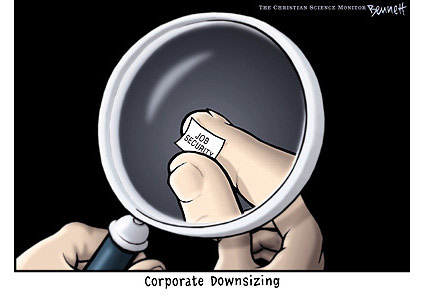

Insecurity Blanket: No, Your Job Isn’t Safe

As an “HR” guy, I frequently get my share of resumes of people who want to get “placed.” A good number of these are people who want to explore other options because they’ve grown tired of the their current company. A smaller number of these would be from people who were PUSHED OUT of their jobs because of “rightsizing,” “downsizing,” or “declared redundant.” The very interesting trend is that the last 2 years, I’ve been getting more and more resumes from GOOD people who were pushed out of their jobs – highly productive and skilled people who perform well. I even get resumes BY THE BATCH from HR friends in the industry who need help in facilitating successful placements for people they’ve downsized.

The game has changed.

I remember a not-so-distant time when corporations offered “employment for life,” and getting hired by the bigger firms resulted in you not worrying about money anymore – your house, your car, your medical expenses, and your retirement would all be accounted for by the Corporation.

If it isn’t too obvious, those days are long gone.

If you worked in the newspaper industry or the recording industry a few years ago – your industry specific skills are now all but obsolete.

Nokia, which ruled the cellular hardware industry just a few scant years ago, has just laid of 3500 workers and is closing down a main plant in Romania. Erstwhile powerhouse Kodak declared bankruptcy a few weeks ago.

Of course, you know what happened to the pension plans of a multitude of US citizens during the recent economic downturn.

Mergers and acquisitions, which occur so frequently now, also result in mass job cutting.

No, your job isn’t safe at all. If there’s one thing that’s NOT going to change I think it’s this new reality – the old days are not coming back.

Two major points here.

One, like a lot of people recording industry, you can kick and scream all you want and go sour grapes over this new reality, or you can see things with this lens: that this reality offers a TON of new opportunity. Why can’t YOU create the next disruptive company? There’s no better time – technology has made innovation a commodity.

Two, “corporate security” hardly factors anymore as an excuse for taking that leap you’ve always wanted to take (perhaps its more attachment to lifestyle upon closer inspection). Think about it – as you grow older and start having children and deep accountabilities, do you REALLY want to rely on your current firm for security in this day and age?

In no other point in history has following your dreams become more practical. Go for it.

(Know someone who would appreciate the content of Juangreatleap? Be a blessing and share now!)

6 Startup Lessons We Can Learn From Jeremy Lin

I started writing this a few hours after Jeremy Lin hit a dramatic, buzzer-beating three pointer over Toronto’s Jose Calderon to win the game for the New York Knicks. This latest episode caps off an incredible two weeks where Lin seemingly appeared out of nowhere in launching himself into worldwide public consciousness, averaging 27 points, 10 assists, and 2 steals, in leading his team to an improbable 6-0 record.

The world is just eating up this story because Lin represents the ultimate underdog story- he was basically ignored in the league for two years, until his current New York stint, where his beleaguered coach had no choice but to put him as a last resort. He promptly responded with 25 points, 7 assists, and a W.

The reason why I am a fan of Lin, and probably why millions of others are, is that I can easily relate to his underdog status. The interesting thing is, I identify with him so much as a startup founder. When I see Lin on the court, oddly enough I am reminded of my own challenges as a founder. As a startup entrepreneur, Lin represents the transition I want my startups to undergo – from nobody to somebody, from scrub to star.

The Jeremy Lin Experience can teach startup founders a thing or two, or six.

1) Stereotypes Don’t Matter.

Lin was overlooked by 29 other NBA teams for the last 2 years because he doesn’t fit the stereotype. Humble, Harvard-graduating Taiwanese-Americans who are vocal about their faith just AREN’T supposed to be basketball phenoms right?

I really relate to this, listening to a bunch of people tell me to my face that HR people aren’t really “strategic” and would be a poor path to business success.

Have you heard people tell you your chances of making it are slim because of some stupid stereotype or random characteristic?

As Lin is proving in the biggest stage: hey, it doesn’t matter.

2) Don’t drink your own Kool Aid.

Here is the fascinating thing about Lin. Watch ANY interview with him. See how he reacts to any references made about “Linsanity”, “The Jeremy Lin Show” or how good he is, or about how popular he is – he graciously deflects every single one of them and instead goes out of his way to praise his teammates and God.

This guy practically owns New York now and you can see how uncomfortable he is in the spotlight.

The first taste of success can be such a temptation for first-time entrepreneurs. After toiling in work and obscurity, it’s easy to start believing in your own hype and lose focus on what is important: listening to their customers, for starters.

Don’t fall into this trap. Stay humble and focused on what is important.

3) No Intimidation.

I was watching the Lakers-Knicks game a few weeks back and in that game you can see Lin drive headlong into the defense of 7-foot 2010 world champs Andrew Bynum and Pao Gasol. NBA megastar Kobe Bryant comes to guard me? No sweat! Here’s a crossover and a jumper.

I remember when we first participated in our first project bidding process way back when STORM was starting out. Three bidders. The first two were large, renowned multinational consulting firms in suits. Then, there was us. At that time, our office was still housed in my living room and we were still using second-hand fast food restaurant furniture.

Of course, we felt really very small and thought we’d have no chance. We gave it our best shot anyway. Why the hell not?

We won the bid.

4) Nailing That First Opportunity is Crucial.

The February 4 game against New Jersey wasn’t Lin’s first NBA game, but it was certainly his first big opportunity game – his first to play meaningful minutes. If Lin responded with, say,  4 points and 2 assist, then that could have easily been it – they were preparing to cut him for another player during that time.

But then Lin exploded for 25 points and 7 assists.

When opportunity comes, you have to be able to grab it and deliver. For entrepreneurs, these first significant opportunities are crucial – perhaps the first big client, or a big pitch to a VC. You can typically FEEL the opportunity. Then you have to deliver.

For STORM, a B2B firm, we felt that opportunity when we were presenting to an IT firm then-called Soluziona back in 2005. They became our first major client. Landing that first major client for an upstart B2B firm makes ALL the difference in the world because corporate clients always ask for other reference clients.

I remember they were negotiating that we shorten our projected project timeline from around 3-4 months to ONE month. We had utterly no bargaining power and said yes. And you know what, we just WILLED ourselves to make it in one month.

In retrospect, bagging that first big opportunity was so crucial. Once we had our first “reference,” it set us up for landing other opportunities.

5) Stars DON’T Appear Out of Nowhere.

Jeremy Lin, because of his background, certainly appears to have done so. One game he barely registered, and the next game, he’s a star.

Upon closer inspection though, you’d see the hard work he puts through. You’d see how he used the times he got cut as motivation to work even harder. THIS is where the star was made.

Aren’t startups so similar? They seem to come out of nowhere, but in reality, a startling number of them paid their dues and went through an awful lot of work before becoming the “stars” that they are.

Twitter was spun off by a company called Odeo – which existed years before they came up with the Twitter idea. It took Rovio 4 years of duds before they found the right formula in Angry Birds. Of course, Final Fantasy is named such because after a series of failures, Square was thinking if THIS game didn’t make money, they’d fold up.

6) Don’t Sellout.

During the lockout, Lin was approached by teams from Italy and China to play overseas. I think that would have really meant more money at that time for him. But Lin stayed through with the dream and stuck with his NBA dream, even as he was getting waived by both the Golden State Warriors and the Houston Rockets. Of course, he got his chance in New York, and all is history.

This is something a number of startup owners have to be thinking once the going gets tough. When the wallet starts complaining, the work becomes close to unmanageable, and a big wrench is thrown into your plans – isn’t it just tempting to take the safe route and get a “real” job?

The next time this happens, turn on the TV and try to catch the Knicks. I hear they got a real nice point guard.

(Subscribe now to JuanGreatLeap and never miss a post!)

The ONE Thing To Focus On When You Start Your Company

We are smart people. So before we started our startup, we thoroughly thought about our business strategy . Perhaps we drafted a comprehensive business plan which outlined our specific market and how to leverage our competitive advantages.

Armed with our plan, we started. We marketed and began selling. We talked to our customers.

Here is where it always gets interesting. When we offer our product, a lot of times, the consumer will ask us for something else. Another way to use our product. An altered product, perhaps. Or a service related to what we are offering, but not exactly what we are offering. When I was selling our HR technology products in our startup STORM, I was asked several times by HR Directors about whether we did executive search. I always thought it was a good thing that I kept on saying no.

Since we are smart, we would probably invoke Steve Jobs and think about his “Focus is saying no” mantra. You might be tempted to say no and say “the money’s good , but this will be a distraction.”

Let me give you one piece of advice:

Do the service. Bend over backward a bit. Then take the money.

When you begin startup operations, there should be one thing that should consume you above everything else: SURVIVAL. A lot of us have grand plans and we dream of raking in the dough the moment we start. Then we do start and the dual-reality hits us: it’s hard to get customers to open up their wallets and costs are higher than we expected. The dream then transforms into a (necessary) desperation.

Most startups kick the bucket in 5 years. 99% of them do so because they didn’t have enough cash to sustain operations. Cash is king.

As CEO, would you rather deal with a profitable company dealing with lack of focus, or a “strategic” company going under? Thought so.

Beggars aren’t choosers. Startups are essentially beggars. So take whatever money that you can to survive.

Saying no to focus is crucial, but it normally comes after a few years when your startup more or less has created an identity and is a bit more financially stable.

Cash allows your startup to be flexible. Cash will give you leverage – and time – to solve problems. Lack of cash is the opposite – it is a death sentence.

For startups, survival is success. If your startup idea is a good one, I guarantee you this: as long as you survive those critical first few years, IT WILL GET BETTER. But until it does, you have to hang in there and just concentrate keep your head above water. This means saying yes to any and every monetary opportunity available, as long as you don’t veer so much from your main vision ( a judgment call). Keep your head above water – there is nothing more crucial than this when you start. Eliminate luxuries, create an ultra-conscious culture to keep costs low, and maximize every earning opportunity.

The mind-blowing thing is, that “extra” thing that you were asked to do might be the bigger business opportunity than your original plan. Paypal started out as a Palm Pilot electronic wallet idea. The had an online emulator which did payments online, and at first, they were ignoring the sudden rush of people which wanted to do online payments. Then it finally hit them in the head that they were inadvertently sitting on a goldmine.

(Don’t miss a post! Subscribe now to JuanGreatLeap!)

6 Tips for Developing a Startup Without Quitting Your Day Job, Part 2

(This is the second post in a two-part series. Part one can be found here.)

Here are three more crucial tips in getting your startup to work while maintaining a day job.

4) Organize a STARTUP POWER WEEK

I got this idea from my friend Elmer, who  works fulltime in a service firm and manages to have time for a couple of startups. What I’ve seen Elmer do TWICE already is to plan and execute a STARTUP POWER WEEK.

Here are the steps:

a) Take a 5-day Vacation Leave 2-3 months in advance.

Of course, a vacation is the LAST THING on Elmer’s mind, in fact the opposite is more appropriate. The nine days he will free up is the startup equivalent of what Santa Claus does on Christmas Eve – Elmer will be delivering an insane number of items.

b) Arrange and Schedule EVERYTHING on these 9 days.

Think of the work you CAN’T do during your spare time, the work that can only be done during official work hours. These might include: face-to-face selling to a huge client, talking to a big supplier, or market research. Call a ton of people. Get them to commit to dates and times. Cram the 9-days with every strategic item you can get to work on. Yep, work the nights as well for crucial interviews or coffee talks.

Why don’t you just spread the leaves out instead of doing it all in a week? For Elmer, he HAS to do it this way because he works in the US and his startups are local – so he TRAVELS here during the nine-days. He can’t spread ’em. But there is another reason you might want to consider: momentum. I’ve SEEN first hand how Elmer makes these power weeks work – they are EXTRA productive for him.

During this one week, you will NOT be distracted by your day-job requirements (well, hopefully). During this one week, you can go into a deep dive. You can be totally immersed and it can be exhilarating – you get a a week’s feel of the startup life. At the end of the week, great momentum is created which can’t help but get carried over the succeeding ones. Momentum is everything.  

c) During and preceding these 9-days, take plenty of vitamins (oh wow, getting hit by the bug here would be such a choke-job).

5) Find Passionate Co-founders

First order of business: find a passionate, FULLTIME co-founder. There is a MUCH greater chance for your startup to succeed if SOMEONE is fulltime, preferably that someone who will do a bit of sales, marketing, or business development. Can you imagine doing sales for your startup while having an 8-5 job? (think about that for a moment)

I’ve done that. I’ve had to cancel meetings with my startup AN HOUR before the scheduled time because my boss just wanted to talk to me. Quite tough to operate this way.

I’ve now started quite a few startups – some have failed, some have succeeded. What do all the successes have in common? Each of the successes had a fulltime partner. I can’t over-emphasize how crucial this is.

Note: you can HIRE for this full-time need and pay an employee to do it. However, one big factor I’ve discovered is: if you have a fulltime job, you”ll only have a limited time supervising and leading an employee. There is a GREAT chance that not only will your employee end up being unproductive, but demotivated as well. A co-partner, on the other hand, will have equity in the firm. The equity will likely make him much more invested and motivated in building the firm – especially if you aren’t around most of the time.

6) Respect Your Current Employer

Under no circumstances must you compromise your integrity by compromising the interests of your current employer. None.

As tempting as it may sound, you mustn’t allow yourself to do your startup work during official working hours, or compromise the quality of your work in any way because you were too distracted with a startup-related project.

There are practical reasons for this: getting caught (and fired), ruining your reputation (which is crucial when you start selling stuff in your startup), the company confiscating your startup work (whatever is saved in your company laptop DOES NOT belong to you),  and others.

But I think it can boil down to one thing: the golden rule.

Plus, karma’s a bitch.

Do check out this related post about planning carefully for the startup runway.

(Don”t miss a post! Subscribe now to Juan Great Leap!)

6 Tips for Developing a Startup Without Quitting Your Day Job, Part 1

For a lot of us, taking an immediate startup leap can be a daunting task – as much as possible, we want to remain practical and mitigate risk. Before diving in, we want to ensure that the startup can sustain our family’s needs.

Fortunately, it IS possible to create a startup while holding on to your day job. Again, the definition of what a startup is crucial here. While I find that it is possible to START a startup on a part-time basis, I would argue that it is impossible to SIGNIFICANTLY GROW one while being attached to a day job.

Take note that we are talking about startups here. It is entirely doable to pull off creating a small business like a food stand franchise or an internet cafe while never leaving your day job. A true startup, however, is a different matter.

If you are planning to create a significant startup, you already need to think of your current day job as temporary. 

You have decide that when your startup reaches a certain milestone, you will need to jump in. No startup can live and grow to its fullest potential if the founder doesn’t treat it as its number one professional priority.

(Think of all the great startups you know. All of them had founders who gave their ALL)

But starting a startup? Entirely possible. I went through this route myself. Here are some insights from that experience.

1) Take a Deep Breath

If you want to build something that is truly of value WHILE you have an 8 to 5 job, then you have to accept that it will take sacrifice. Something WILL give because there are only 24 hours in a single day. Whether be it sleep, or time with loved ones and friends, or the time you spend on your hobbies – something will have to be sacrificed.

It might be time to have a good talk with people around you who will be affected, not merely so they will understand, but also to help you garner much-needed support.

Take a deep breath. Understand what you are taking on. Pray. Then start.

2) Maximize startup work time

Here are some suggestions:

a) Work through lunch. I would eat my lunch on my table and work through the whole hour – typing up proposals, creating copy, pushing numbers. Sometimes we would schedule interviews during these breaks in a nearby coffee shop. That’s 5 hours a week right there.

b) Do not make traffic a factor. Hang out in the cafeteria and work until traffic subsides.

c) If possible, move to a place near your work. When my first startup STORM incorporated, I decidedly moved into a condominium just beside Tektite Ortigas where my day job was. That condo eventually became the first STORM office, creating a ton of strategic efficiencies.

d) Get another day job. If your current job makes you work like a dog for 14 hours a day – quit that job and find something with better work-life balance. It is IMPOSSIBLE to do something else if the job requires that many hours from you day-in and day-out. Again if doing a startup is your main goal, you have to look at your current job as a stepping stone. If your current job isn’t helping you towards your ultimate goal, just quit. Find another job.

3) Conserve Salary

One thing you will quickly notice when you begin working for your startup is that the actual expenses are always much greater than your projections. Some startup resources actually tell you to expect double. Turns out you’re using more paper, or more ink, or that you need an intern to do research, or the old PC you borrowed for operations breaks down, or your electricity costs soar during the summer. So where will you get the money to pay for these expenses?

This is one advantage of starting while working part-time. Instead of draining a limited “war-chest” or raising more money, you can perhaps bank on your salary. Frugal living then becomes a must, as it can feel like you added a new baby to your family.

Click here to continue onto part 2! Next three tips include arranging a “Startup Mega-Production Week.”

(Know anyone you think just NEEDS to hear the content of Juangreatleap? Be a blessing and share NOW!)

REPOST STICKY: 6 Tips for Developing a Startup Without Quitting Your Day Job, Part 1

For a lot of us, taking an immediate startup leap can be a daunting task – as much as possible, we want to remain practical and mitigate risk. Before diving in, we want to ensure that the startup can sustain our family’s needs.

Fortunately, it IS possible to create a startup while holding on to your day job. Again, the definition of what a startup is crucial here. While I find that it is possible to START a startup on a part-time basis, I would argue that it is impossible to SIGNIFICANTLY GROW one while being attached to a day job.

Take note that we are talking about startups here. It is entirely doable to pull off creating a small business like a food stand franchise or an internet cafe while never leaving your day job. A true startup, however, is a different matter.

If you are planning to create a significant startup, you already need to think of your current day job as temporary. 

You have decide that when your startup reaches a certain milestone, you will need to jump in. No startup can live and grow to its fullest potential if the founder doesn’t treat it as its number one professional priority.

(Think of all the great startups you know. All of them had founders who gave their ALL)

But starting a startup? Entirely possible. I went through this route myself. Here are some insights from that experience.

1) Take a Deep Breath

If you want to build something that is truly of value WHILE you have an 8 to 5 job, then you have to accept that it will take sacrifice. Something WILL give because there are only 24 hours in a single day. Whether be it sleep, or time with loved ones and friends, or the time you spend on your hobbies – something will have to be sacrificed.

It might be time to have a good talk with people around you who will be affected, not merely so they will understand, but also to help you garner much-needed support.

Take a deep breath. Understand what you are taking on. Pray. Then start.

2) Maximize startup work time

Here are some suggestions:

a) Work through lunch. I would eat my lunch on my table and work through the whole hour – typing up proposals, creating copy, pushing numbers. Sometimes we would schedule interviews during these breaks in a nearby coffee shop. That’s 5 hours a week right there.

b) Do not make traffic a factor. Hang out in the cafeteria and work until traffic subsides.

c) If possible, move to a place near your work. When my first startup STORM incorporated, I decidedly moved into a condominium just beside Tektite Ortigas where my day job was. That condo eventually became the first STORM office, creating a ton of strategic efficiencies.

d) Get another day job. If your current job makes you work like a dog for 14 hours a day – quit that job and find something with better work-life balance. It is IMPOSSIBLE to do something else if the job requires that many hours from you day-in and day-out. Again if doing a startup is your main goal, you have to look at your current job as a stepping stone. If your current job isn’t helping you towards your ultimate goal, just quit. Find another job.

3) Conserve Salary

One thing you will quickly notice when you begin working for your startup is that the actual expenses are always much greater than your projections. Some startup resources actually tell you to expect double. Turns out you’re using more paper, or more ink, or that you need an intern to do research, or the old PC you borrowed for operations breaks down, or your electricity costs soar during the summer. So where will you get the money to pay for these expenses?

This is one advantage of starting while working part-time. Instead of draining a limited “war-chest” or raising more money, you can perhaps bank on your salary. Frugal living then becomes a must, as it can feel like you added a new baby to your family.

Click here to continue onto part 2! Next three tips include arranging a “Startup Mega-Production Week.”

(Know anyone you think just NEEDS to hear the content of Juangreatleap? Be a blessing and share NOW!)

With great FREEDOM comes great responsibility

When I took the leap to fulltime startup founder back in 2008, the very first thing I felt was total liberation. Suddenly, after a solid decade of bosses, schedules, rules, and policies, there was...beautiful freedom.

I could do whatever I wanted anytime I wanted!

The first few months of this were so liberating. I would go to the office late, work from home, or take long lunch breaks – without any immediate consequences.

If you are a stickler for structure and rules – then this would probably be a hellish experience. If you are a bit of a rebel, like me – then this is heaven. I make the rules. I answer to myself.

Of course, I’d love to tell you that it ends happily ever after, that an entrepreneur’s life is really about doing whatever you want at anytime.

Well, yes and no.

Yes, there are no immediate ramifications to your daily decisions on where to allocate your time. There are no formal letter warnings, reduced leaves, getting scolded, getting a salary deduction, or even getting fired.

What I discovered though, was that the ramifications of my actions (or inaction) come a bit further down the road.

When you put up your startup, what you will discover fast is that the time and effort you put in the startup has a DIRECT correlation with your bottom line, and in turn, your capacity to pay yourself.

For example, early on, I was in charge of sales. I remember that there were times when I would have to cut my salary for particular months so we can continue to pay employees. I could actually trace these cuts back to weeks where I knew I could have called more people or have done a better job following leads up.

Direct correlation. The more you work, the more you earn. The less you work, the less you earn. It can’t get any simpler than that.

This is very different from corporate, where like clockwork, you get the same amount of salary on the 15th and the 30th no matter what happens or how you perform.

So yes, the startup owner does enjoy the freedom to dictate what transpires in her workweek. If I want to take a leave the whole next week to go to Boracay, I can do so. No one would stop me. I could cancel all my meetings with my clients and move them to the week after.

I just need to understand that the time missed comes with a direct opportunity cost, which, in turn, WILL have a direct effect on my own bottom-line, one way or another.

The younger your startup, the more direct this correlation will be. As time passes, you will have an opportunity to build your startup in such a way that it can be more independent of your time. (If this is the goal though, you might need to rethink why you put up a startup you want to escape from in the first place)

Before that happens though, you gotta give your baby all the time, love, support, and yes, the necessary structure it needs to grow.

(Join the Juangreatleap movement and learn more about startups! Subscribe to the blog now to get the newsletter and join the forum!)

Why you should build an ARMY of mentors

No startup is an island.

Since independence is a pretty common entrepreneurial trait, going at it alone becomes a mistake that’s easy to fall into for a lot of startup founders.

This is a mistake.

Listen carefully. Developing an honest-to-goodness startup is a difficult chore. Most startups still fail within 5 years of being founded. You need all the help you can get. When you get started, one of things you should always remember is to develop your support structure. You need mentors.

Notice I used the plural form there. It’s easy to think that you have to go looking out for one mentor. Do more. Get an army of great ones. This ALWAYS pays off.

Expect not only to receive wisdom and sage advice from your mentors, but possibly even the following items:

1) friendship and emotional support

2) a large network of very useful contacts

3) possible clients

4) possible capital

In corporate, I’d had an image of a mentor – an older person in the same company who is typically an expert in what I am doing.

What I’ve discovered in startups is that there can be many different types of mentors. Here’s my list.

1) The Domain Mentor

This is the mentor you run to for advice with regards to the particular field your business is in.  Having established an HR solutions firm with STORM, it was important for me to have people to run to with regards to HR. I ran to Gina Hechanova and Bopeep Franco of Ateneo CORD for HR advice when STORM was growing. We even partnered for some projects were they needed a technology partner.

2) The Entrepreneurial Mentor

No matter how long you talk to your domain mentor, it would be really impossible for her to relate to what you are going through as a startup founder. Knowing what the business is about is vastly different from running the business. It would be quite advantageous for you to talk to someone who knows what exactly it takes to build a successful startup – who has felt what you feel, who can tell you “that’s normal” and “you should abandon that now.”

This was our challenge when Pao and I built STORM, we had no entrepreneurial mentors – so we had to go through everything through trial and error. This almost killed our firm many times. I have no doubts that if we could have networked with an entrepreneurial mentor early on, it would have been smoother sailing.

3) The Peer Mentor

Karen Yao is the founder of the HR Consulting firm Congruent Partnerships. She is my age and is an awesome HR practitioner and facilitator. Around once a month, we would have coffee and we would talk and exchange ideas about HR and startups. We usually exchange advice on stuff like hiring, office space and rent, the future of our respective firms, what the other would think about a new concept the other would like to introduce, and so much more. Karen is what I call a peer mentor – the direction of the mentorship is two-way, and we see each other as peers. I am lucky to have Karen to talk with because she functions as both a domain mentor and an entrepreneurial mentor – this always makes our talks so much more interesting.  And naturally, we have given paying projects to one another.

4) The Life Mentor (Or Life Coach)

So how will startup life affect your relationships with your family, friends, and loved ones? When does work become too much? How is your prayer life? How are you eating?

Taking the plunge and forming your own startup won’t really be a cure-all. Yes, it can make your professional life that much more rewarding. I am into the notion though, that a happy life is a balanced one. There are other aspects of life that you cannot take for granted: physical, emotional, social, spiritual. A poorly managed dimension can easily drag all the rest of the dimensions – so it’s very important you have someone in your corner whom you can talk to about not merely your startup, but how it relates to the rest of your life.

I am quite lucky in this regard because I married one of the wisest people I know.

5) Encouraging Friends

Doesn’t really fall into the “mentor” category, but does so in the “support structure” concept. I’d thought I’d might as well throw this in here.

Are some of your friends negativity-mongers?  You know, those people who always complain, who always see the glass half-empty, or will always point out the huge risk you are taking in going after your idea. Lots of these in corporate. (some are just plain negative and cannot help it, but some are crabs)

You are who you surround yourself with.

So be sure to surround yourself with people who encourage you, who will stand by you. Not only that, but also try to surround yourself with people who are less afraid of taking risks in their lives, people who are willing to put stuff on the line in going after what they want.

So there you go – different types of mentors for the startup founders. I purposely didn’t include here “formalized” mentors like the Board of Directors or Advisory Boards – this will be taken up in a future post.

Just some last things. Of course, I recommend you take initiative and ask people whom you respect if they are open to being your mentor. (you’d be surprised at how some people would just want to help) Just two pieces of advice:

1) Know if they’re a good guy or a bad guy

Doesn’t get any more basic than this. The main thing about being a mentor is not only the wisdom you will gain, but more importantly, that the mentor has a personal stake in your success. Remember that. A mentor wants to see you succeed.

You may know a number of entrepreneurs who are all about money. You know who I am talking about. The first thing this person would think of when they meet you is “how can this guy make me more money?” There are also arrogant ones who think they are God’s gift to the industry, or people who simply will not share anything with you “keep their edge.” Avoid these people like the plague. You, like most people, can probably smell them a mile away.

Go after good guys. Look at their backgrounds, see what type of work they’ve done and who they’ve associated with. Talk to people who’ve worked with them. You, like most people, can probably smell good guys a mile away as well.

2) Don’t force it

The big thing about the mentor-mentee relationships is that you should have a high degree of comfortability and compatibility: there should be chemistry, you should like one another. This is why a lot of the formal corporate mentor programs don’t work – it feels forced. So don’t force it.

It might not be a good idea to just email someone “Can you be my mentor?” Have coffee with the person first, get to know the person first. Check for rapport, check for chemistry.

Remember, you cannot afford to be an island. Surround yourself with great people you can turn to for advice, who will be there for you, and who want you to succeed.

(Join the Juangreatleap movement and learn more about startups! Subscribe to the blog now to get the newsletter and join the forum!)

The Crucial Art Of Momentum Management, part deux

In the previous post, we talked about managing YOUR momentum in the startup process, about how we have to strike when the iron is hot and take advantage of our energy.

But what happens now when you’re now working with a team of either founders or employees?

Things become a bit trickier because now the startup exists outside of you. It now exists in your co-founders/employees, as well as the product you are now presumably working on.

Identifying Momentum Shifts

First of all, you have to be able to learn to READ how your momentum is. Is there an impasse in activity? Is output slower?

Sometimes the signs are subtler: has a co-founder’s energy dwindled? How does undergoing your first bad break affect the team?

The more you get to know your team, the better you would be at reading the signs.

Then, as startup founder and dreamer, it is up to YOU to ensure energy is sustained, up to you to pick guys up.  I have yet to meet a startup founder who can be described as “low batt.” They can’t afford to. When momentum slows and the difficult times come, people look to the founder for motivation and energy.

Challenge: Doing It Part-Time

For practicality purposes, a lot of startups are founded by people with fulltime day-jobs working on the startup part-time, very typically with other part-time co-founders.

This is a challenge because it becomes easy for people to miss meetings, or miss updates, or miss deadlines. String together a few of these and sometimes before you know it your startup is dead – and people are just too distracted/disheartened to pick up the pieces and start anew.

Keeping momentum in this sort of situation requires one thing: that you become relentless. You have to be relentless in finding time to work on your startup. You have to be relentless in keeping your team accountable to deadlines. You have to be relentless in managing and sustaining momentum.

Creating Cadence

There has to be some structure that your team can adhere to and bank on. Introduce these and make sure the team sticks to them. It could be in the form of start-of the week Skype teleconference meetings between the founders, or Googledoc files people fill in with weekly updates, or perhaps 2x a month Saturday lunch meeting. Monitoring progress helps a lot in achieving more of it.

Just Care

In the end, perhaps the most important thing to remember here is that you just have to care enough and do something if you see slippage. Sure, it can be awkward as hell to call out a slow-performing co-founder. Yep, you don’t want to be the bad guy who called that meeting when it’s 5:30 pm on a Friday, and everyone is tired from their day jobs. Someone’s gotta do it though. And yes, that means you.

Hey, no one said it would be easy.