How you can use FEAR as a REVERSE Spider Sense

tarantula

Fear has been my constant companion all throughout my startup career.

I remember feeling I might be laughed at as I was about to present my idea to potential partners or investors.

I remember that crippling feeling. That extreme doubt I felt when I was about to resign from my fulltime job.

I remember hearing all the “no’s” in this journey, the disheartening voices and fearing they actually might be right.

I remember delaying the first-ever post of Juan Great Leap (JGL) for weeks for fear other people might judge me.

After developing several startups (both successes and utter failures), and the unexpected growth of the JGL audience, you’d think I finally would be free from fear’s clutches.

It’s still there.

I’m still scared things might not work. I’m scared people will laugh. I’m afraid of what other people might think. I’m afraid a new startup idea might flop.

The difference now is, not only have I learned to live it, but I have learned how important it is to EMBRACE IT, especially in today’s business climate.

Let me explain.

relayContinuous Innovation Is Now a REQUIREMENT

The industrial age is dead and dying, along with all its guarantees (being an employee of one firm for life, worry-free retirement, etc…).

Innovation is the new currency.

Innovate or DIE. (RIP: Kodak, the big-label music industry, the dodo, etc…)

Companies know this.

Witness how ALMOST ALL companies have “innovation” as a company value, or how billions are poured into R&D.

This is true for both companies and of people.

For example, programmers now cannot invest too heavily in being an expert in one platform. HR people are finding out that job descriptions are getting obsolete (or at best, very high maintenance) because they change all the time. The best corporate managers are those who are able to maintain excellence despite getting deployed to handle very different things and cope with a diverse set of problems.

So how does one cope in this new dynamic?

Becoming flexible.

How does one THRIVE in this new dynamic?

You HAVE to take risks.

Risks automatically comes with a possible downside. That downside is something we fear. (no fear? then it might not be that much of a risk for you)

You want to THRIVE in this environment? Then you have got to face your fears.

Embracing Fear

Quick story. After our first, well-attended Juan Great Leap conference in Ayala-TBI, we were brainstorming as to what to do next. The safe route would have been to do another keynote / panel discussion affair. But then an idea came to mind: what about a group speed dating activity which involves 20+ entrepreneurs?

We all saw the positive possibilities, BUT…

It had never been done before. It would be a logistics nightmare. There were so many questions. Would people hear one another? What if nobody came – this was something very different, so people might not immediately see its value.

It was either going to be work splendidly, or it would crash and burn. There was little in between.

While we were talking about this. A familiar feeling made itself known to me.

Fear.

This was the precise point when I knew we HAD to do this group speed dating thing.

spideysenseReverse Spider Sense

Spidey’s spider-sense tells him if he is in any immediate danger (spider sense tingling!). Fear has become something of a reverse spider-sense for me. If it tingles – there is opportunity!

Now, when evaluating opportunities, I LOOK for that fear.

Is the fear in me?

If there is no fear, then it could mean either of 2 things:

1) I am not interested in the opportunity.

Subconsciously, I already know I don’t find (or at that moment I am not finding) the opportunity presented interesting. Perhaps because its not within my realm of expertise, or perhaps I just think it isn’t feasible for me.

Possible scenarios like this would include: someone inviting me to invest in a startup in a field I don’t really understand that much, or listening to a salesperson pitch a product I have no use for.

2) There isn’t a great deal of risk

If there isn’t a risk, then I am not too worried about it. Chances are great the possible returns won’t be so hot, either. I can say yes to the opportunity, but it won’t really keep me up at night imagining the possibilities.

Possible scenarios like this would include: someone wanting to give me a 1% share for a startup in return for monthly advice, or doing maintenance work in the office, or choosing what tiles would suit the office bathroom.

But if there IS fear?

Then I probably would be asking a LOT of questions about it. I would be nodding or shaking my head vigorously. I would be up – a lot of times all night – thinking of the pros and cons.

If there is fear, then I know that my subconscious is HIGHLY considering this course of action. It ALREADY knows if the opportunity in question is internally feasible for me or not. I wouldn’t even feel the fear if it were OUTSIDE my capabilities. (see #1 above) Fear tells me there is a possibility I can pull it off.

I ALSO know that this would be something WELL WORTH doing, or at the very least, worth a much longer consideration time. Fear is a sign that the returns would be awesome.

This could involve pursuing a huge pivot for our firm, or pondering the high cost of a GREAT hire, or asking someone to be key member of the founding team or the board, or doing a sales presentation to the CEO or the MANCOM of a potential huge client (not really a decision, but an opportunity nevertheless), proposing to my wife, saying goodbye to my decade-long HR career, or even me in my room, musing about a potential strategy.

Fear has ceased to become crippling. It has become my friend. It can be your friend too.

Hoooh! My friend, Your Friend…Whatever Peter! I’m miles away from that! I’m afraid to even tell my friends I’m thinking about starting something!

It’s a process (like EVERYTHING worth its while), will NOT come overnight, and there are no shortcuts.

Here are some tips that may help:

1) Surround yourself with healthy risk-takers (don’t know anyone? go to startup events, go to open coffee – LOOK for healthy risk-takers)

2) Fail

In some ways, this might be like swimming. The only way for you to learn is to dive in.

There is one HUGE thing that happens when you fail – YOU REALIZE ITS NOT THAT BAD.

Because of our primitive survival instincts, we pre-programmed to assume the WORST. (OHNO, I will be out on the streets if I fail! I will be the laughingstock of the barkada, nay, the whole country! Woe is me! WOE IS ME!)

It’s not that bad.

Of course, I’m not saying you should DELIBERATELY fail – but try doing things out of your comfort zone. Perhaps you can try starting the thing you’ve always wanted to do but always feared, but do so by…

stairs3. Starting with smaller risks

Start with low-risk items, and gradually proceed with bigger ticket risks.

Got an idea?

Level 1: Do a powerpoint (not so risky)

Level 2: Invite close friends and present your idea (a tad risky)

Level 3: Invite not-so-close friends you think would be an expert on your idea and present (riskier)

At this point, you’re BOUND to get some negative comments / rejection already (this ALREADY could be felt as a huge failure for some people)

Level 4: Recruit a Co-founder. Among the people you’ve talked to, do a formal proposal saying that you are DOING the idea and you NEED their help as a partner (risky)

Hey guess what – you’ve started a startup!

(Know anyone who would appreciate this post? Hit the buttons and share below and share!)

How Exactly the Corporation Kills Your Entrepreneurial Spirit

hopeless

Gary Sells Soap

A few weeks ago I felt I was representing the startup world when I was trying to convince a high-caliber fresh graduate to try out the startup life. (Let’s call him “Gary”)

Yes, while he had several tempting, lucrative offers from MNC’s, any of which would’ve dwarfed whatever salary offer any startup could’ve given, he was also deeply intrigued by the startup life and was involved in several startup-related activities on campus. Moreover, he had enough of the “I-want-to-do-something-different” streak in him that I allowed myself to hope: “Hey we have a chance.”

Soon enough, I got a text message from him a few days after…

“I decided to try out my luck in corporate first.”

Along with the obligatory…

“But Peter, I know this isn’t really for me. Maybe in a 2-3 years, I’ll try it out in a startup. Maybe sooner.”

I texted him some well-wishes, but in my mind, I just sighed.

I knew there was a great, great chance the startup world just lost another talent. The chances of Gary coming back in a year or two are as close as the Charlotte Bobcats (now Hornets!) winning the NBA title.

How do I know this? Here’s a very simple answer.

Gary will be given an ungodly salary as a fresh grad.  This will make him feel good because a) he can afford a more luxurious lifestyle b) his friends will say “wow, ang yaman mo na” to which he’ll reply, “ito naman oh, hindi naman” while secretly smiling inside during the whole conversation.

It is SO EASY to get used to the more luxurious lifestyle, ESPECIALLY if you aren’t used to it. (this also forms part of my theory as to why you also have a lot of rich folk doing startups – they wouldn’t be sacrificing much) In 2-3 years, after 2-3 more salary increases, would YOU give up this lifestyle to work for a startup where you will work DOUBLY hard and get paid CONSIDERABLY less, with no guarantee of  success? (oh man, I might’ve chased away more people)

“Why are you even dismayed?” you may ask. Yes, I know a huge majority of people won’t choose this road less travelled. Most people aren’t built for it.

Yeah, I know.

It’s just sad to witness and feel this statistic first hand. Especially when I KNOW that if you do have that itch within you, these days are the best days in history to follow your startup dream.

Alright. I concede.

For the present time, I concede that corporate will have their way with 99% of graduates, even with those like Gary who have great startup genetics. I concede that for the present time, these Gary’s would spend not merely 1-2 years, but will be sucked in corporate life until they inevitably feel either a quarter life crisis (5-7 years down the line) or even a mid-life crisis (10+ years down the line).

Fine. 

This article is for all the Garys in the world who are in corporate – people who have sincerely thought of putting up their own thing, but for one reason or another (hello, fear and need for security!), have chosen to go (or remain in ) corporate. This article is meant to help prevent your entrepreneurial spirit from being COMPLETELY stamped out.

We still need you to make that leap down the line, Gary. 

Calling to mind the multitude of people I’ve interviewed, the people I’ve asked to form startups with (who have since agreed or declined), my own leap from the corporate jungle, and the decade-plus years I’ve spent trying to get people into corporate (from my previous life in HR management), here’s a list of the things you need to be cognizant of in the corporation.

If you imbibe them, it can make it almost impossible for you to make that leap.

1. Don’t get used to corporate routines

routine

Ask any startup entrepreneur about their schedule and they will tell you very quickly – every day is different. There is  no discernable pattern. I could be in knee-deep recruitment in one instant, cleaning the bathroom in another, talking to a lawyer in the next, and then diving into product development right after.

An entrepreneur does THE MOST IMPORTANT ACTIVITY that needs to be done, now.

This is quite crucial because a startup is in the SURVIVAL game – it cannot afford to have its founders waffling on the most urgent matters that need to be done – just because “schedule” doesn’t dictate it.

A corporation shoves schedules in our faces. Be here at this time. Check emails at this time. Every Monday mornings, we have a team huddle. Every 15th and 30th, you need to send out this report.

There are daily, weekly, monthly, and even annual routines.

For example, in my HR life before, I already knew that during the 1st quarter we would be very busy with salary increases. 2nd quarter – recruitment and the company outing. 3rd quarter, midyear evaluations. 4th quarter, final evaluations, and the Christmas party.

When I got out of corporate, the first adjustment I had to tell myself was: I didn’t need to do particular things at particular times. (this took me weeks) I could just do WHAT I FELT was most important.

2. NEVER conclude that excessive politics are a natural characteristic of all firms

politicsI’m sure you’ve heard the saying “as long as there are people, there will be politics.”

Sure, I agree.

But there is an obvious level wherein the politics become detrimental to an organization. Like you know, when a clear-cut RIGHT option is not chosen just because of politics. (undeserved promotion for a undeserving bum who kisses the boss’s ass, anyone?)

No, it doesn’t need to be that way. Great entrepreneurs understand that the RIGHT idea/choice has to take precedence over anyone’s ego or personal agenda – and they build their companies accordingly.

A big company can survive the instances of repeated bad decisions due to politics. A startup can’t.

3. NEVER Race With Speedy Gonzalez

I wonder how many people own iPhones and Samsung Galaxies by opting to take on big monthly plans they can’t afford and don’t really max out?

Why do this? Well, because everyone else is, right? We have to keep up with our peers – nay, be ahead of them!

speedy-gonzales
This is Speedy 🙂

Ah, the rat race. Corporations perpetuate this sort of culture very very strongly.

Think about it. Don’t all manager-level employees need to have a car plan? Isn’t the own condo-car dream package THE standard dream among yuppies? Why do salary increase days trigger the highest incidences of chismis in an organization?

The rat race.  We focus on whatever everyone else is getting.

I remember when I left corporate, I surrendered my Nokia Communicator 9800 (or whatever – it was a yuppie status symbol at the time) to the office. With my much smaller startup salary, I was scouting for which phone to buy. To my horror, I realized I now could only afford mid-level plans and be able to secure a “low-tech” cellular (gasp!).

I was thinking to myself, “but what about my productivity?! I NEED a smartphone!”

Well, it didn’t bother my productivity one bit. I saved a couple of thousand pesos per month as well, which was crucial in my own leap.

Repeat after me:

I DON’T need a top of the line smartphone, a car, a condo, P250 meals, P150 coffee, a P50K+ laptop, or a blazing FIBR connection, or whatever it is my peers are obsessing over. 

 Let these be items be your reward when your startup is profitable, and not be obstacles to profitability.

4. NEVER Adopt The CYA Mentality

 “Hindi na namin covered yan.”

“That’s not my responsibility.”

“It failed because ABC happened, and all ABC’s are under this other department.”

cvaCYA – Cover Your Ass. I absolutely HATED this when I was an corporate.

NEVER make this a habit. Might as well pour gasoline on your startup and light it up. (this will do less damage to your startup than a team of unaccountable founders)

A little accountability, a little “guys, it’s my fault” goes a LONG way in building a culture of embracing responsibility.

Remember, these things start from the guy on top. Once your employees see YOU owning up, it’ll be easier for them to do the same.

5. BE WARY of the Loss of Risk Appetite

Because innovation involves doing something new, it connotes carrying some degree of risk-taking. This is something that OBVIOUSLY should be a part of a founder’s make-up and outlook. If a certain innovation is good for the firm, then an entrepreneur would ALWAYS consider it immediately.

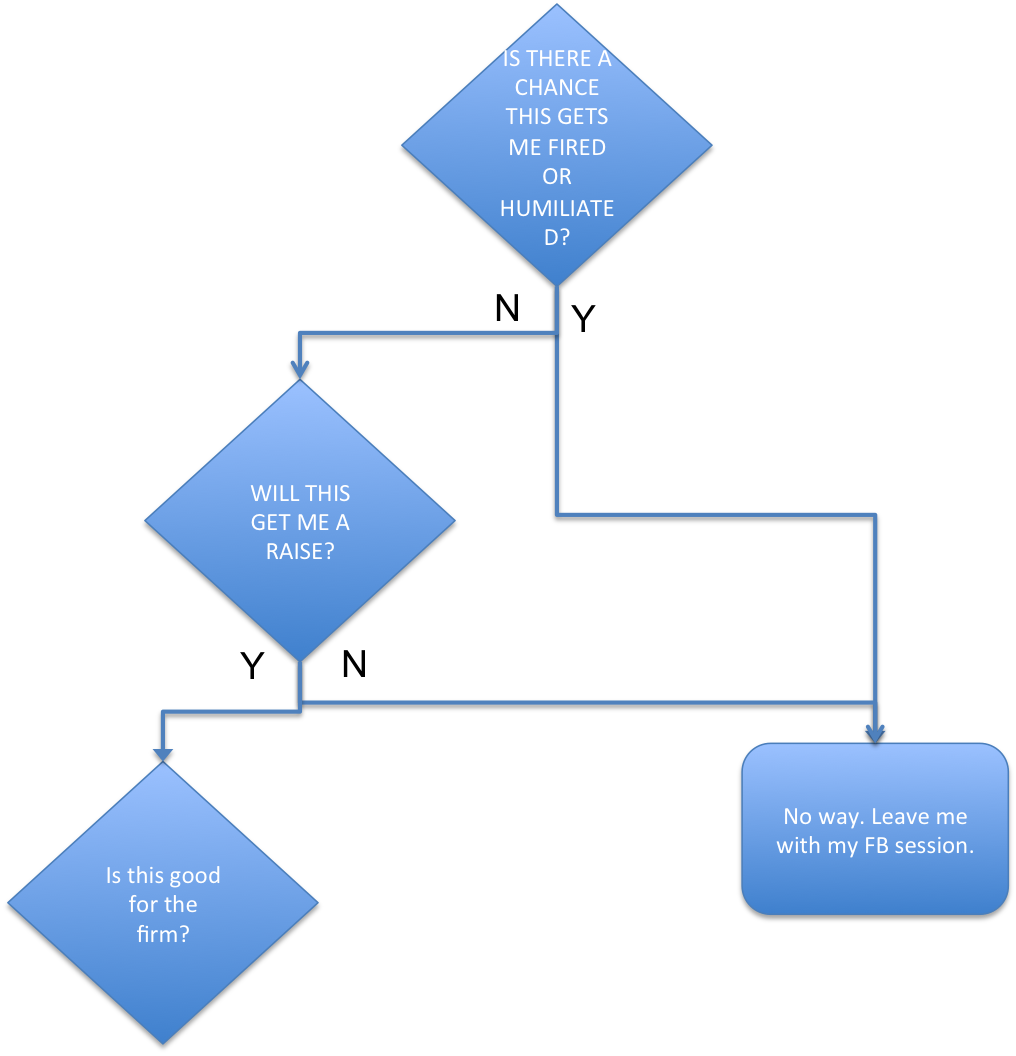
In corporate-land however, I’m suspecting that for a number of people in corporate, the decision making process for innovative actions are HIGHLY DICTATED by the simple diagram below, adding two more questions before one even considers the viability of the option:

diagram

Before you say, “That’s not true! That’s a hasty generalization!” Allow me to say that I think those two questions are but NATURAL for us to feel – since most of us don’t actually OWN these large corporations we work in. In your heart of hearts, do you REALLY want the MNC you report to to hit $100,000,000,000 or whatever the target is? Will you be like, all teary eyed and distraught if the target isn’t reached? Hmmm….I’d wager “I want to have a good career here” might just be the more powerful motivator.

Contrast this to a startup, where YOU CAN BE THE OWNER. In this case, your decision -making process will be a bit more robust – as your own motivations will be perfectly aligned with your startup.

Lesson here: do not allow your motivational compass to have “great salary increase” or “I don’t want to ruin this comfortable thing I have now.”  as its True North. This will KILL your risk-appetite, not to mention make you very short-sighted, only going after the next salary increase. (and the next, and the next….)

Remember, while some of these things are easily observable, the way they change us is very subtle. Be on your guard and defend your entrepreneurial soul.

Universities Represent!

student entrep conference
Universities Represent! (from L – R) Christian Go (ADMU), Albert Mercado (MAPUA), James Fernando (DLSU), me, Angeli Recella (DLSU), Red Bermejo (ADMU), Quina Baterna (ADMU), Luis Gan (UP)

I had an absolute blast early today with 6 awesome student leaders (sorry Angeli, you don’t count anymore) talk about ideas on how to propagate the startup movement in campuses.

Basically, the group introduced themselves to one another, ate doughnuts, and then the awesome brainstorming happened.

There is one big plan the group is concocting (to be revealed soon). The next step is to get more universities represented in the next meeting, when more concrete details, will be decided on.

The next meeting will be next Thursday (May 23) at 3:00pm (venue still to be decided on). If you are an entrepreneurial student who wants to help out in spreading the startup movement in your school, do send me a message at peter@juangreatleap.com to get a reservation for this next meeting, along with an explanation as to why one of the seats needs to have your name on it!

Take the leap! Represent!

How To Assemble Your Startup Entourage

entourage

(the following is a guest post by multi-awarded entrepreneur Maoi Arroyo)

As a junkie of all things startup, I’ve always loved shows like Bloomberg’s TechStars. Whichever season you watch, these entrepreneurship-themed reality shows try to select the best teams as opposed to the best ideas. As Ed Catmull, co-founder of Pixar, famously said

“The view that good ideas are rarer and more valuable than good people is rooted in a misconception of creativity. If you give a good idea to a mediocre team, they’ll screw it up. But if you give a mediocre idea to a great team, they’ll make it work.”

If there’s one thing I learned in the nine years I’ve helped tech-based startups get off the ground, it’s that business is a team game, and the firm with the best team wins. It’s unavoidable that the media and the public focus on the “front men”. Steve Jobs, Elon Musk, Dado Banatao: the charismatic and slightly kooky guys get the attention. People gravitate to “self-made” men.

Except that there is no such animal.

Show me anyone you think is “self-made” and I will show you at least three other people who helped get them there and are wealthy enough to do anything they want.  Larry Page and Sergei Brin founded Google in 1998, and Marisa Mayer was employee #20 in 1999. If her name sounds familiar it’s because she’s now CEO of Yahoo. Why in the world would she want to be in charge of a floundering company like Yahoo? Because after you grow a company from 20 to 30,000 staff; you have enough money to  be comfortable and you can do something ludicrously risky.

So the question is: if you want to be the next Google, how do you find a Marisa Mayer? Who do you recruit to your founding team and in what order?

The DOM

expertSorry, it doesn’t mean what you think it means. DOM is shorthand for the person with Domain Knowledge. You want to start a restaurant? Makes sense to start with a chef. App Development?  A programmer would be useful. Fashion? A thorough examination of the fashion portfolio and comparative analysis of chaka-ness is a must.

Domain knowledge can come from experience, education, or both. Choo Yeang Keat was a Malaysian cobbler who had been making shoes since he was 11. He built a respectable business which exploded when Tamara Mellon, accessories editor from British Vogue, partnered with him. Jimmy Choo’s shoes now sell in 32 countries for prices that regularly give husbands palpitations.

If you are the DOM, you’d better have geek cred and partner with someone who is market savvy and handle all those pesky numbers and “models” that always seems to be encapsulated in PowerPoint Smart Art. If you aren’t the DOM, find one and give them the role of Chief Technology Officer.

The Wizard

wizardSome people call them mentors, but I call them Wizards. Wizards are both mentors and tormentors. It’s Merlin’s job to tell you that this Lancelot guy you’re thinking of hiring is cuter than you and your wife is into him. It’s Gandalf’s job to call you a “Fool of a Took” when you wake up the Balrog. The Wiz is going to provide you insight to the very important baby steps you should take BEFORE you found the company. Things like technology and market validation before you waste your money on a patent. In return for this knowledge, you should give them a part of your company EVEN IF they aren’t going to be involved in running it from day to day. 3% equity up-front or 10% vested over 3 years (translation: “3 gives”); in preferred shares that have no voting rights but get paid FIRST when you issue dividends. Like any RPG, your wizards will stand back from the fray and need time to cast massive spells. Keep them with you and don’t let them get overwhelmed.

The Anti-You

oppositesIsolate the key things that are characteristic of you and find someone who is the complete opposite. I’m the kind of person who can come back from the bathroom with 20 new ideas that I want to pursue simultaneously. I have a knack for exaggeration. Math classes gave me PTSD. No one has ever accused me of shyness or humility. So I found a detail-oriented, frighteningly accurate, introverted co-founder who inhales numbers and exhales cash. Naturally you have to have the same vision and integrity, but someone you respect has to stand up to you and pull you back from insanity.

The Spartan

spartanThe Spartans embody the philosophy that makes start-ups work. If one Spartan falls, another one takes his place. They work as a single unit. All of them are leaders. Filipinos seem to live in horror of having “too many leaders”. That’s because we misunderstand what leadership is. Being able to lead well is a skill, not inborn ability. You can get people to listen to you by being charismatic; leading them is something you have to learn how to do. It’s essential to be in command of yourself before you try and command others, and you must prove yourself worthy and deserving of your team’s trust in you with your every action. A leader for a startup is not “in the rear, with the gear”. They stand shoulder to shoulder, right up front. They are the tip of the spear. They are the first among equals.

The Spartan is your CEO. On very rare occasions is your DOM a Spartan. That’s because the critical job of a CEO is sales. You know how a Founder-CEO is pitching? His mouth is open. That’s all they do. They have a recruitment pitch, they have a sales pitch, and they have a fund-raising pitch. If your CEO can’t pitch, get another CEO. There will be no cash to manage, no team to enable, no world-changing company if they cannot pitch.

You can call yourself an entrepreneur but until you get a solid team and some cash, you’re just some wannabe with a great idea. Ideas don’t change the world, people do.

Don’t stay a wannabe.

You can learn the fine art of PitchCraft on Saturday, May 25. Karen Hipol, associate director of Carillion Partners, will teach you what to pitch and I’ll teach you how to do it. Attend the event and you get an opportunity in June to get in front of institutional investors, all for one low price! (See I told you all we do is sell).  The PhP 500 discount ends on May 15th, and slots are limited. Sign-up today and build your dream team! – Maoi Arroyo

Juan Great Leap Calls on 5 More Student Leaders!

I’ll be meeting around 5 student leaders next Wednesday, 4pm, at the STORM conference room, at Unit 602, Centerpoint Building, along Julia Vargas. The main agenda will be: 1) How to push entrepreneurship and the startup movement in universities 2) How to help student entrepreneurs   (Map here) Our conference room seats around 10 people, so there are 5 seats still free. I wanted to open it up to interested parties.

Do you want to join this conversation?

If you are an incoming undergraduate student, interested in entrepreneurship, and you’re the type of person who gets things done, then you might want to join us.

This is the actual room to be used 🙂

If you are interested, please do send me an email at peter@juangreatleap.com, along with an explanation on why you’d be a good choice.

(know anyone who might be interested in this? forward and share!)

May Open Coffee Is Now Brewing! Sign up now!

JGL OPEN COFFEE2

WHAT: MAY OPEN COFFEE

WHEN: 930am-12:00 noon, Saturday, May 18, 2013

WHERE: 47 East Co-working Compound (47 Esteban Abada, Loyola Heights, QC)

Inviting ALL entrepreneurial-minded people: young or old, newbie or veteran to join this month’s edition of OPEN COFFEE.

This event has been outdoing itself every month we have it, so I’m pretty excited to see what this month’s version will  offer.

Don’t you miss it! Sign up here now!

Here’s how the last one went…

Just Start.

just start

I think sometimes we overestimate what it takes to “start” – especially for those of us who are first-time entreps and don’t exactly know what were doing.

(welcome thought: I suspect most first-time startup founders fall into this category – everyone starts out feeling stupid)

Perhaps we’re thinking:

“Oh gosh, I need to raise a million bucks.”

or

“I need a technical co-founder who has a 3.8 GPA in computer science.”

or

“To do this I need to resign from my job and risk everything! Need to prepare.”

or

“I need to win one of those startup contests!”

You know, if we always think this way, we might never come to the point when we think we’re ready to start. It will end up as just some lofty dream we scarcely scratch. Soon, we may begin to tell ourselves it’s exactly that – just some crazy dream.

I remember when I first realized I wanted to share my experiences as a startup founder and entrepreneur, I wanted to write a book. It was my lofty dream, and it was so hard to start – I felt I had to have the whole book concept crystalized in my mind before starting. The sobering moment came when, after 3 months, I realized there was no progress with what I was trying to do.

So I decided to just start. 

I got a free wordpress account, read a bit about blogging, and just wrote my first post. Then the name just came to me – Juan Giant Leap. But then I realized precisely what I am writing about now – the leap doesn’t need to be GIANT to be GREAT.

I thought that precise nuance was important. So, even if I thought Juan GIANT Leap had the better recall, I went with GREAT.

And so Juan Great Leap was born.

Instead of worrying about starting, just start. 

No need to put distracting pressure on ourselves.

Some practical ways to start simple:

  • Talk about your idea with someone whose opinion you respect, or an industry leader in the idea you are thinking of. 
  • Get some real customer feedback – hold chats with potential customers of the idea you’re thinking of.
  • Attend Open Coffee and pitch your idea (for free, without pressure, with people who want to help)
  • Have dinner with potential co-founders. No need to hard-sell (“Would you want to be my partner?!”), instead coyly just ask for advice. (“I value your opinion, what do you think of this idea?”) If the person is truly interested – and would be a fit – the person would actually volunteer and ask if you need help.
  • Think of a name, and invest a bit in buying a URL. You’ll be amazed at how empowering this is – because in some way, your startup is truly “alive.”
  • Get off your butt. Your startup will never happen if it never leaves the realms of your imagination. Get out and talk about it. Create it. Slowly is surely.

The Software Guru: On Refuting Peter, Premature Startup Culture, and Change for the Next Generation (Part 2 of the Joey Gurango Series )

The Software Guru, Joey Gurango of Gurango Software

In one of his blogposts, Peter, refers to the concept of the Argonaut from the book, Start-up Nation.

What are your personal opinions on the contribution of the Argonaut to a Philippine Startup Nation? 

Joey: I think the Philippine Startup scene is about 10 years away from being labeled as mature. A lot of my colleagues, maybe including Peter, might say that we’re on the cusp, about four years away from being a mature startup scene, I don’t think so. I actually don’t agree with some of the assumptions  [Peter] is making on the Philippines as a Startup Nation and the impact that you can make on it.

For me, it’s almost like saying that the Philippines is a mature democracy, but how far are we from a being a mature democracy? Well, to fix the problem it’s not just a matter of a constitutional amendment or having honest government officials or organizationally trying to change things, I think it goes far beyond all that stuff. It gets down to the common tao, the man on the street. Same thing, when thinking about ourselves as part of a mature Startup Nation. The common man on the street does not think about business. He thinks,

How do I get mine?

Now, I don’t mean that in a derogatory way, but there are too many people in this country that aren’t able to fulfill what would be considered the basic luxuries of life. There aren’t too many people who are at a level, in which they can comfortably say,

I’m enjoying my life, and I have time to think about things other than trying to just make ends meet from one paycheck to the next.

As long as you have a society, in which majority of the people are trying to make ends meets, you won’t have the mentality to think about starting a business. Now, when I say business, I don’t mean a business, in which the guy is doing pasaloads or running a sari-sari store. I’m talking about a real business which will attract employees and grow into something substantial. But when was the last time you saw a locally made television show that featured this happening?

In comparison to the typical US sitcom, how often do you see the TV characters start a business? Just the other week I was watching The Office and one of the characters in The Office was going to join a startup. It’s a common thing there [in the U.S.], but I don’t see that in the mainstream media here [in the Philippines]. If anything, you see some big business man who is corrupt, greedy and oppressive to his employees doing anything to make a profit. I believe that’s the common man’s perception of a successful businessman. We have to change that first. It’s going to take a while…many years…

In your opinion, what is the key to development in the Philippines?

Joey: Changing people’s perception about entrepreneurship. In all the things we’re doing, what Peter’s doing, what I am going to do as part of our advocacy with the Software Industry Association, and TechnoNegosyo. All of these efforts when you get down to it is geared towards changing people’s perception. We want to show people that pursuing a career in entrepreneurship is viable.

Right now, what the masses understand are celebrities. The most popular figures in the country are celebrities or politicians.

But you talk to the common man about who the most popular business man is and they’ll probably say MVP or the Ayalas. If you ask them about a regular businessman, not part of a conglomerate or oligarchy, who started a business… you ask them who started Jolibee… they wouldn’t know. This is the type of rags to riches story that our culture doesn’t promote.

Will changing the perceptions of individuals change our country?

Yes, and it starts with your generation. It starts with the people who are in their 20s.  It will take a whole bunch of successes and more people learning about what theses successes do to make this movement happen.

The Software Guru: On Refuting Peter, Premature Startup Culture, and Change for the Next Generation (Part 2 of the Joey Gurango Series )

The Software Guru, Joey Gurango of Gurango Software

In one of his blogposts, Peter, refers to the concept of the Argonaut from the book, Start-up Nation.

What are your personal opinions on the contribution of the Argonaut to a Philippine Startup Nation? 

Joey: I think the Philippine Startup scene is about 10 years away from being labeled as mature. A lot of my colleagues, maybe including Peter, might say that we’re on the cusp, about four years away from being a mature startup scene, I don’t think so. I actually don’t agree with some of the assumptions  [Peter] is making on the Philippines as a Startup Nation and the impact that you can make on it.

For me, it’s almost like saying that the Philippines is a mature democracy, but how far are we from a being a mature democracy? Well, to fix the problem it’s not just a matter of a constitutional amendment or having honest government officials or organizationally trying to change things, I think it goes far beyond all that stuff. It gets down to the common tao, the man on the street. Same thing, when thinking about ourselves as part of a mature Startup Nation. The common man on the street does not think about business. He thinks,

How do I get mine?

Now, I don’t mean that in a derogatory way, but there are too many people in this country that aren’t able to fulfill what would be considered the basic luxuries of life. There aren’t too many people who are at a level, in which they can comfortably say,

I’m enjoying my life, and I have time to think about things other than trying to just make ends meet from one paycheck to the next.

As long as you have a society, in which majority of the people are trying to make ends meets, you won’t have the mentality to think about starting a business. Now, when I say business, I don’t mean a business, in which the guy is doing pasaloads or running a sari-sari store. I’m talking about a real business which will attract employees and grow into something substantial. But when was the last time you saw a locally made television show that featured this happening?

In comparison to the typical US sitcom, how often do you see the TV characters start a business? Just the other week I was watching The Office and one of the characters in The Office was going to join a startup. It’s a common thing there [in the U.S.], but I don’t see that in the mainstream media here [in the Philippines]. If anything, you see some big business man who is corrupt, greedy and oppressive to his employees doing anything to make a profit. I believe that’s the common man’s perception of a successful businessman. We have to change that first. It’s going to take a while…many years…

In your opinion, what is the key to development in the Philippines?

Joey: Changing people’s perception about entrepreneurship. In all the things we’re doing, what Peter’s doing, what I am going to do as part of our advocacy with the Software Industry Association, and TechnoNegosyo. All of these efforts when you get down to it is geared towards changing people’s perception. We want to show people that pursuing a career in entrepreneurship is viable.

Right now, what the masses understand are celebrities. The most popular figures in the country are celebrities or politicians.

But you talk to the common man about who the most popular business man is and they’ll probably say MVP or the Ayalas. If you ask them about a regular businessman, not part of a conglomerate or oligarchy, who started a business… you ask them who started Jolibee… they wouldn’t know. This is the type of rags to riches story that our culture doesn’t promote.

Will changing the perceptions of individuals change our country?

Yes, and it starts with your generation. It starts with the people who are in their 20s.  It will take a whole bunch of successes and more people learning about what theses successes do to make this movement happen.

How to Use Consulting as a Bridge Between Corporate and Startup

stepping

I had a great lunch meeting today with a very talented friend who’s been working in corporate for nearly two decades already. During that span, he’s built impressive credentials and has worked on different projects in his chosen corporate function.

“I’m at that point Peter where I’m at a crossroads in my corporate career. If I leave my company now, I can apply for department head in another firm, but then what? I’ll be looking at a future of just jumping as department head from one company to the other?”

(I was at that same crossroads before, so I could really relate to what he was saying.)

A common friend of ours who was managing her own lucrative consulting practice was asking him if he wanted to pursue the same. It was something my talented friend could establish easily. He then thought of talking to me to get more feedback on making the leap.

I said:

 “Ah. I think one point to consider is the decision to go into consulting or pursue a startup. They are different things.”

Consulting vs Startups

Having been involved in both consulting and startups, I know first-hand how different they are.

A consulting practice centers around the skills and reputation of the Consultant. The ensuing organization is built to extend the reach of the consultant.

For example, from time to time, I still agree to HR Consulting engagements with some firms. They pay me for my HR expertise. If I were to build an organization around this “service,” it would involve creating a support structure around me so I can maximize my contribution – admin people to ensure I don’t get bogged down, a junior consultant to help on the ground with projects, etc…

This is of course, a GREAT thing. I know numerous people who have created either solo consulting practices or consulting firms who have employed 2-3 people, even more. These people are immensely satisfied and do not worry about money anymore.

If you wish to scale though, and make a splashy startup, it probably would not be through a consulting practice, as a consulting practice does not scale. The consulting practice organization is built around the consultant’s particular skill. Since there are only 24 hours in a day, there is only so much that you can do to extend your reach.

While a consulting practice is built around the consultant, a startup’s goal, on the other hand,  is usually create a repeatable, sustainable business – or in other words, to make itself operationally independent of the founder.

If you take me out of the equation in STORM, for example, STORM would still exist. It would still make operate. Of course, a lengthy separation would have ramifications on long-term strategy and growth (I hope), but unlike in a consulting practice, taking the founder from a working startup doesn’t mean it tumbles like a house of cards. (independence is the goal, obviously – taking a founder out of an early-stage startup is a wholly different matter).

In a startup, the product or service offered is SEPARATE from the founder, the founder BUILD the product. In a consulting practice, the product IS the consultant.

So, for those who are interested in doing a startup, and have garnered a signifiant amount of skills and experience in a particular corporate field – here’s one strategy you can do:

Do the Karen Yao

Use the financial stream and flexible hours of your consulting practice to build your scaleable startup idea on the side. Then, as your startup makes revenue, you can spend less and less time on your practice and more and more time on your startup.

Screen Shot 2013-04-18 at 10.57.41 AMTake my good friend Karen Yao, who was one of the entrepreneurs in Startups Unplugged. Like me, she built for herself a corporate career in HR. Then she jumped into a consulting career. During this time, she built Congruent Partnerships – first as a vehicle to extend her consulting practice, but then recently pivoting towards a more scaleable startup idea: HR outsourcing services for SME’s.

The thing is, the jump from corporate to consulting isn’t such a HUGE leap as jumping headlong into a startup. For one thing, you will be using the same expertise you were using in corporate – so work-wise, it will be a very comfortable shift.  The only difference is that the payment just isn’t through salary anymore, it shall be though project-based contracts. Moreover, it’s a good transition – you are already getting exposed to some of the elements of managing a startup: client work, accountability, finances, managing your own time, etc.

Since you manage your own time, you CAN NOW allot some time during the week to work on your startup without giving the startup the whole burden of paying for your expenses. This is crucial. One of the big challenges of doing a startup is running out of money. Running out of money basically means you run out of time to work on your startup.

Leaning on your consulting practice is a way fund your startup product development. You can extend your startup runway significantly.

Have your cake and eat it, too

If you choose to work on a startup which is RELATED to your consulting practice, then that’s a HUGE win-win scenario. Your consulting meetings are not only monetary opportunities, but now also double as pertinent data-gathering and validation activities for your would-be startup.

If your consulting clients are your target customers for your eventual startup? That will be super! You can ask them crucial questions like, “What do you think of this product?” or “Would you buy this product?”

Execute the consulting leap within the same entity

If you make a quick visit to Karen’s site, you’d find that congruent has three product lines: consulting, outsourcing, and solutions. I remember when Karen first started Congruent – most, if not all of her clients were in the consulting business. Gradually though, as the consulting line paid the bills, she began building her outsourcing and solutions lines. Nowadays, she is less dependent on her consulting line. Pretty soon, I’m wagering she will have to make a decision: do I let go of the consulting line? 

We started STORM  pretty the same way. When we started back in 2005, we had no actual product and an undeveloped market. We only had a product idea – flexible benefits.

For us to buy time to both develop the product and educate the market, we made money by going into consulting – we started offering organizational diagnosis to corporate clients. This actually became a profitable business line, which kept us afloat for a few years while we were developing our scaleable product. After some time, our flexible benefits line started making money. Soon, it made more money than our consulting line. Recently, we changed our name from STORM Consulting to STORM Rewards, fully making the transition by dropping our consulting business and offering a pure product.

This is one strategy you can do – you can create a consulting company immediately and course your consulting revenues through this entity. Then when you’ve developed your product, you can easily do a quick pivot.

Your financial books will look better, too.

Do Prepare For Your Consulting Leap as Well

If you are planning this sort of stepping-stone strategy, one mistake is to focus too much on the startup leap, forgetting that the consulting leap needs to be taken very seriously.

It is far from automatic that you can transition from corporate to consulting. You have to have led a great career in your function. You have to be REALLY GOOD at what you do. If not, then no one will pay you. You have to have distinguishable expertise in your craft and you have to have the knack of selling yourself well. You have to consciously develop yourself as a consultant.

Also, plan it out. 

If you already know, for example, that it will be your last year in corporate before you take the consulting leap, THEN BY ALL MEANS USE THE YEAR TO TRY TO FIND A MARKET ALREADY. Send feelers to other consultants in the same field if they have extra work you can do. Do free projects on the side to build a credible portfolio. Network and announce your plans to possible clients. Hustle.

So, if you find the startup leap daunting, perhaps you can do an easier leap onto consulting first, before taking on your ultimate startup leap. It’s a very very viable stepping-stone option. I’ve seen HR practitioners build HR firms, brand managers create marketing consulting startups, finance guys doing finance firms, and so on.

Might as well as be you.