Don’t Put Parrots In Customer Service

A few weeks ago, I was in the hospital passionately arguing with an HMO officer who was insistent on applying a policy which was so evidently not applicable to my own particular case.

“If we implement this policy, instead of the insurance paying for my fees, I would be paying YOU – it doesn’t make any sense.”

“Ganoon ho talaga.”

WHAT?! I was furious. But I understood what was happening. The person on the other line was trained to placate customers and explain policy, but no true power to interpret or be flexible.

This is inherently why customer service sucks in so many companies – most customer service personnel are simply given a script and if-then scenarios. Invariably, there WILL be cases which won’t fall under any of the planned scenarios – a lot of them. So what happens?

“Ganoon ho talaga.”

“I’m extremely sorry sir, but that’s policy.”

“Let me work on this sir, I’ll put you on hold.” (I’ve had a service put me on hold before for an hour)

A friend of mine told me before that the root cause of this was structural – the product management group is oftentimes separated from the group which does customer service. It gets worse in this outsourcing age – the customer service group can be in an entirely separate company. Structurally, customer service would NOT have easy access to information, nor would they be in a position to make any calls about how to interpret a policy for a specific customer incident.

The problem is, customer service IS a part of the product.

This is why I love Citibank Phone Bankers – I can feel a real difference with how empowered and well-trained they are. In my years phone banking with Citibank, I’ve yet to have a problem they couldn’t solve by themselves in a span of a few minutes, or give me a number where I can talk to a person who can solve my problem. I also know they are paid well and are taken cared of – it’s tough to pirate them. Good job Citibank, you’re putting your money where your mouth is.

Any business that has customers will automatically have to think about customer service. How is your business treating its customers? Do the people who manage customers directly have the power to solve unforeseen customer issues? Or are they parrots with a script?

(Subscribe now to Juan Great Leap and never miss a post!)

To ensure success, go DEEPER not wider

Okay, so you are a startup owner.

Chances are great that you have limited resources. Understanding that you cannot be everything to everyone, you identify a niche and concentrate on that.

I am now getting more and more convinced that the niches we think are specific enough are STILL oftentimes too broad. We have to go deeper.

When STORM was originally conceptualized, we wanted to be a technology firm which specialized in HR. Soon enough we found out that was too broad. So we thought of specializing on benefits. You know what? Still too broad. This year, our big decision is just to concentrate on ONE thing: Flexible Benefits. See all those other products in our website? We shall soon be pulling all them out. We realized we needed to focus ALL our resources on ONE problem: getting Flexible Benefits right. We want to solve this problem with all we’ve got. We want to solve this problem better than anyone else in the world.

This boils down to the decision if you want to do one GREAT thing or merely good things. Spreading your limited resources across many things increases the probability of making a lot of mediocre products. Just remember that mediocre doesn’t have a shelf life, being great does. Look at Apple. ONE phone at a time. ONE tablet at a time. They just make that ONE thing the best there is.

Got an idea? Know who your target market is? Here’s a suggestion: segregate this market further and choose to niche even more. (Of course, you have to walk the tightrope here a bit and ensure you have a big enough market)

Creating a tablet application for children? Pick a specific age group, say 5-6 years old. Then do heavy research on the developmental aspects and mental acuity levels of children 5-6 years old. Then release a product specifically for children 5-6 years old. If you are a parent, and you have a 6-year-old, wouldn’t you want to buy a product specifically created for your child instead of getting a “for 8 years and below?”

Designing a clothing line for mommies? It might not be specific enough. Then research on the style differences between women who are 20-25 and everyone else. Focus your marketing and sales activities just on this demographic. Ignore the rest. You know what, not only will you capture the 20-25 market, but also the women in their 30’s who want to look younger.

And for all those people creating software houses? For goodness sake, pick a niche. Learn that niche. Yes, you will get offers to develop other stuff outside your chosen niche. Resist the money and decline. You can make that money up once you begin dominating a more specific niche. And no, “mobile” isn’t a good enough niche. Go deeper – pick an industry, a vertical, or an even more specific platform. Think about your specific customer and then sell specifically.

Go deeper.

(Subscribe now to Juan Great Leap and never miss a post!)

Assemble Your Avengers! An interview with the best startup recruiter there is, Nick Fury

A JUAN GREAT LEAP EXCLUSIVE: An interview with General Nick Fury himself, credited with starting two very successful startups: SHIELD, where he now serves as Director, and more recently, The Avengers.

Peter Cauton: Uhm, thank you very much, Director for allowing us an audience. The Juan Great Leap community is ecstatic for this opportunity to learn from you.

General Nick Fury: Good for you this is part of the community service sentence they gave me, you know, when it was found I had something to do with the destruction of New York. Let’s get on with it, son.  Nice hairstyle.

PC: Uhm, thanks. Anyway, sir! All our startup enthusiasts want to know, sir, how exactly did you pull off this recruitment coup with the Avengers?! I mean, what an amazing, kick-ass haul of founders!

GNF: Thank you.

GNF: Well, to be honest with you Cauton, the first thing I thought of was the problem I chose to tackle. I told myself, Nicky, if you wanted to protect the whole g__amned world, who would you enlist? This was what created SHIELD decades ago. I got the best agents from the CIA, the FBI. Got a lot of applicants as well. And you know what, we were fine. We kept the peace.

GNF: Until all these different E.T.’s decided, let’s phone their freaking homes! Then suddenly you had Aliens of Mass Destruction, throwing around my SHIELD guys like ragdolls. I became desperate. Very desperate. So this was my new problem: how do I protect the whole freakin’ earth from freakin’ alien invasions? With an emphasis son, on the S.

GNF: In. Vhay. Shon. SSSS.

GNF: This was the scope of my problem, son, and I knew I had to create a new startup to tackle it. I had to assemble a team of highly talented people. The creme de la creme.

PC: Any insights or recruitment tips for our readers on how to find highly talented people like these?

GNF:  Well, for starters, it’s mighty hard to find them. You gotta do the heavy research. We found one guy frozen at the bottom of the ocean. I recruited one girl from the competition. One was hiding in India. One just sort of fell from the sky. Tough to find them.

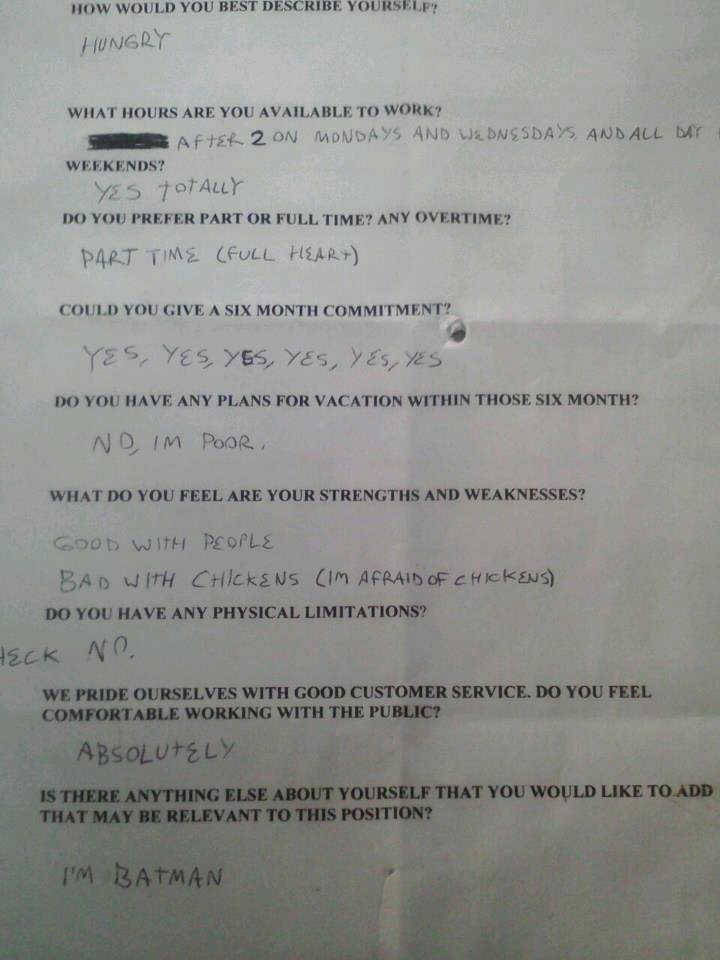
GNF: Then you have to evaluate them. We passed on a lot of other potentials before selecting this group. You can’t settle. Selection is everything! For example, we almost hired this brilliant guy who was dressed like a bat, and was a cross between Stark, Hawkeye, and Widow. But I felt, you know, that he wouldn’t have been much of a team player. So we dropped his ass. Here’s his application form. He’s a bit more impressive in person.

GNF: Anyway, once I zeroed in on who I wanted, I switched on the Fury-charm and tried like hell to get them on board. I followed them around, one by one. Flat-out stalked them. Had one on one talks with them, coffee with them. Me. General Nick Fury, Director of SHIELD. In Starbucks. But you gotta swallow some pride when you are interested in getting the best of the best.

 PC: Any suggestions on founder composition?

GNF: Balance. If you notice, I got people whose talents complemented one another. When Thor said yes, for example, I quickly called Hercules to say, “Look kid. I don’t have time. To wait. For you. To ask. Your father! You’re out. Fury out. “

GNF: We didn’t have expertise redundancy.

PC: Uhm, but what about Hawkeye and Black Wido…

GNF: Can Hawkeye seduce male dictators to get information?

PC: Well, no bu…

GNF: There you go. Let’s move on. As I was saying earlier, balance. Another thing I did was to ensure we had technical founders who had different specializations. In this time and age, getting on the tech bandwagon can be crucial, whatever your chosen startup field is.

GNF: I also got someone whom I knew would have the potential to lead someone from the ground, since I got general stuff to do. Wait, but not general as in standard stuff, mind you, but general as in GENERAL Nick Fury stuff.  I needed a COO to my CEO, a Sandberg to my Zuckerberg. Is my point clear?

PC: Crystal. Did you have trouble making them get along?

GNF: Did I have trouble making them get along? DID I HAVE TROUBLE MAKING THEM GET ALONG?! YOU CAN BET YOUR ASS I DID!

PC: …

GNF: Sorry, it’s a bad habit.

GNF: Anyway, you should have seen what happened when all them met in a room. They were at each other’s throats. Being the master psychologist that I am, I KNEW this was what would happen if you brought great people in one room. One very important role I have is ego-management. There should be enough room for all the egos.

PC: So what did you do?

GNF: I did some uh…motivational tactics designed to show them that the vision was so much more important than their individual goals. That they had to put their differences aside to work on the common goal. I also ensured they had bonding time outside work so they could get to know each other a bit better.

PC: Did it work?

GNF: Do I have one eye?

PC: Uh…yup.

GNF: Case closed. Fury out. (disappears into basement)

(Never miss a post! Subscribe now to Juan Great Leap!) 

My Post-surgery Paradigm

Last Friday morning, I was wheeled into an operating room. They strapped my arms in crucifix position. (yep, apparently they strap your arms). Then the doctors came in and introduced themselves to me.

They were about to perform laparoscopic cholecystectomy. I was having my gall bladder removed due to stones and a polyp.

“Hi, I’m Dr. _____ assisting me is Dr. _____. Your anesthesiologist is here, Dr. _____. In a few seconds, you will fall asleep, by which time we will proceed to cut you up”  – yup, this is what basically happens 🙂 

One doctor explained that she was now introducing the anesthesia through the IV, and that I would soon begin to feel drowsy. I instantly remembered this scene from one my favorite movies last year. A gas mask was then propped over my head. Then…

The next thing I knew, I woke up in a busy room full of people.

I was told I was in the recovery room and that I should get some rest.

When I was wheeled back to my room and I was bit more into it, I started noticing the differences:

There were four white bandages on my stomach. They were painful.

My throat was very dry and sore (I was told I was intubated).

I felt very weak and couldn’t move around much.

I couldn’t move my left arm at all! (Apparently, I belong to the small percentage of the populace who have a bad reaction to an intramuscular injection. My shoulder muscle became so swollen, I couldn’t lift my left arm)

It was really hard to get up from bed. (Try getting up using no abdominals and only one arm functioning)

All I wanted to do was rest.

I spent the next 3 days mostly in bed at the hospital.

Since I really couldn’t go online (too much trouble with one hand), 80+ channels became boring fast, and my sleeping patterns were destroyed, I did a lot of thinking, instead.

I always tell people that in the times I get really sick, I get to feel very human. Each episode got me reacquainted with my own mortality.

This experience was something more specific than that. It made me feel old.

I imagined that growing old was like that – when parts of my body would begin betraying me. The difference being, instead of my body recovering over time, it deteriorated over time. Slowly but surely, I would lose control over the only thing in the world I had complete control over. Worse, I would be keenly aware of the things I used to do, of what I’d lost.

What I felt after all this thought?

I just wanted to go back to work right away. I wanted to be productive right away.

It’s now Wednesday night, and I write this with still some pain in my wounds. I still cannot sleep on my side. My left arm is still limited. I still cannot get up from bed in less than 5 seconds. My arm and my stomach shoot pain waves to my brain when I carry my children. Worse, I can laugh, but not heartily. No one would blame me if I stayed home.

However, I insist on going to work tomorrow.  I have dreams to fulfill, and I want to go out trying to fulfill them in my prime, at the height of my powers. Each day counts. 

Being productive is easy to take for granted. The problem is, there is a finite window to productivity. We all grow old. We become less and less productive after an apex.

Don’t waste the most productive years of your life.

Think strategically. Won’t it be logical to build your dreams – presumably stuff that’s pretty hard to do – during your prime? During that point in your life when you have the most energy and will to take it on? Wouldn’t this ensure the highest probability that your dream happens?

No need to wait for that mid-life crisis.

Interested in $25,000.00 funding and the chance to go on a US-based 12-week accelerator program?

Hey people! Got a tech startup? Need funding and guidance? This might be interesting… 

Ohio-based Launchhouse is launching the Launchhouse Accelerator Program.

The LaunchHouse Accelerator is inviting the world’s brightest entrepreneurs to participate in a 12-week Accelerator program. Selected teams will receive $25,000 in funding and will be surrounded with experience-based lab sessions, world-class mentors from their specific industry, an innovative work environment, dinners with successful entrepreneurs, and networking with mentors.

To apply, entrepreneurs need to be in a tech-related field with a team of two or three co-founders. Ten teams will be selected for the 12-week program in September.

Teams will relocate to Cleveland, OH for 12 weeks to work in LaunchHouse’s 23,000 square foot Silicon Valley-esque space. Its furniture and colorful, collaborative work space promotes genius and impromptu brainstorming sessions, day or night, with awesome, like-minded people.  Accommodations will also be sponsored by LaunchHouse.

The LaunchHouse Accelerator program aims to help entrepreneurs take their ideas to validation during the length of the program. LaunchHouse’s development methods are customer-centric, meaning that from the very beginning you are engaging your market. At the end of 12 weeks, each team will present to local and national Venture Capitalists and Angel Investors on our Showcase Day on November 28.

Entrepreneurs can apply here. 

Philippine startups represent! 

Generate Startup Ideas Using Tourist’s Eyes

When we are travelling for the first time in a foreign location, time seems to slow down, and we get to absorb all the juicy details.

There is no little thing which escapes us:

how the air is different

what clothes people are wearing

how the food tastes

how people greet one another

how clean (or dirty) things are

what people listen to

how people drive

how people eat

how the architecture is different

Isn’t it interesting that we are suddenly ultra-aware of the things around us. We find our heads and eyes ever-circling and observing, trying to take all the detail in. We look at the world with wonder. We figuratively (and depending where, sometimes literally) stop and smell the roses.

Contrast that to being in a place which is very familiar to us. In very familiar places, we can walk with our heads down and get to our destination. We can even drive very familiar routes almost unconsciously. We take things for granted and miss details. There is no wonder.

We miss opportunities. Sometimes right under our noses.

ALWAYS observe like a tourist. Look at the world with wonder, even when in the familiar.

You’ll be surprised at how many new ideas you can come up with.

Humble Pie is essential to the Entrepreneur’s diet.

We all know that confidence and having cajones is a big part of being a successful startup founder or entrepreneur. You simply cannot make the leaps and bold decisions necessary without that certain confidence.

What I am discovering more and more though is that confidence’s seeming polar opposite, humility, can be just as critical.

Here’s why:

1) Humility Enables Learning

Learning is the new metric for growth. The faster you learn, the faster your startup develops. If you are able to create an internal system which systematizes learning, then you are halfway there.

Take a look at Facebook’s 2005 interface:

This old version is now completely unrecognizable. The 2012 version is infinitely more user-friendly and intuitive – an incredible social media experience. How did they get from point A to point B? They must have gone through hundreds, if not thousands, of iterations, small and large. How did they know what to iterate and how exactly to improve it?

They learned.

What is the pre-requisite for learning? That acceptance that the present condition is flawed.

This requires humility.

2) “I was wrong” is a way of life 

When starting or running a business, making mistakes is a absolute given. You will make mistakes. A lot of them.

Startups are usually small organizations, so it is plainfully obvious when a bad decision is made. Usually, it is pretty easy to correct. Just tweak and move on, right?

Well, to correct a bad decision, you first have to admit you made one. Here is where the trouble begins for some people. Don’t we all know of people whose pride is such that they never admit a mistake, and worse, blame everyone and everything before they take accountability.

For a startup, time and energy zappers such as this could be fatal.

For a startup, creating a culture of ownership, accountability, and yes, admitting mistakes is vital. When driving culture of course, everything starts from the top.

The startup CEO has to quickly admit when he is wrong, and then quickly pivot the firm towards another option. The faster this is done, the faster the company can get to the right option, the lesser the strain on resources. He has to walk that line between powerful conviction and the ability to admit mistakes quickly.

This requires humility.

3) You have to hire people better than you

After the founders, the first employees you hire set the tone for what happens after. If you hire awesome people, you create an absolutely great foundation. A great team is everything. To ensure this, you have to be prepared to hire people who are better than you.

This takes BOTH confidence and humility.

Confidence, because you need it to bury your insecurities regarding questions like: “Will they outshine me?” or “How will other people still regard me?”

Humility, for simply the acceptance that there ARE some people better than you and that you NEED them.

(Moreover, great people can easily distinguish a blowhard from someone with authentic confidence. Who do you think they’d prefer working with?)

4) Hubris kills

Left unchecked, excessive confidence can lead to hubris. Hubris can lead not only to the fall of large corporations (see Enron), but startups as well.

Overconfidence can lead a to a great many things which can kill startups: unilateral decision-making, not listening to customers and partners, a false sense of entitlement, resting on one’s laurels, excessive self-rewarding, refusal to accept the real situation, denial of probable consequences, and so on. This has led to the splitting of several founding teams I know – when one or more of the founders falls into the hubris trap.

(Like the content of Juan Great Leap? Subscribe now and never miss a post!)

Are you picking a passion, or a mere interest?

I’ve been talking to an increased number of people now with regards to their startup ideas.

Will this work? What about this? Could you rank these five ideas?

You know what? It really depends on you. Are you passionate about one of these ideas? If you are, then even if any expert or investor tells you your idea sucks, you’ve got a good chance of proving them wrong. Isn’t this the story of so  many successful startups?

Passion fuels great execution. And execution is everything.

What is interesting is that one person’s multiple ideas can encompass a wide variety of areas. While it is quite probable that you are interested in all these ideas, it is quite improbable that you are passionate about all of them.

If you plan to be the driving force in a startup you are setting up, then you just have to pick a passion. Don’t give in to the temptation to pick an interest, no matter how convenient things are shaping up.

Why?

Interest does not scale. Mere interest will not propel you to persevere and sacrifice when the going gets really tough. Mere interest won’t make you finish whole books about the topic in 2-3 days. Passion will make you do so. Passion scales.

You don’t ever want to go on vacation from what you are passionate about.

I am interested in pizza, TV, video games, and coffee. I won’t read books about them though. I don’t scour for news about them, although I will read an article about them if I come across one. I won’t run a startup centered on them. Invest in startups centered on them? Sure. But be the driving force? I already know that won’t be a good idea.

I am passionate about startups, human resources, and basketball. I read books about these topics for leisure. I am subscribed to news feeds about them. I have been the driving force for a successful human resources-related startup until very recently, and now I’m busy setting up a startup incubator. If someone comes to me with a great startup idea about basketball, I can see allowing myself to lead that.

Passion is evident. When you ask a person about what she is passionate about, it will be difficult to make them stop. Eyes light up. Peripheral questions are easy to answer. I’ve seen shy introverts transform before my very eyes when their passion becomes the topic of conversation.

You would pursue a passion for free. 

So whether you are deliberating on seriously pursuing an idea, recruiting someone, or even looking for a new job, pick a passion.

Stop settling.

(Subscribe to Juan Great Leap and get email updates and posts!)

STARTUP SALES TIP: Generic is geriatric, make it human instead

Everyday, we experience getting bombarded with “above the line” sales pitches: from TV, print and radio. This is mass market/media advertising: a singular ad which hopes to reach millions and convince thousands to buy. Large corporations spend billions on advertising to convince a small percentage of the reached audience to make a purchase.

Of course, startups typically have a limited advertising budget, so they have to be sneakier, employing “below-the-line” techniques such email, direct marketing materials, and social networks. Here, the thinking is that we can be more “targeted” with our sales correspondence, because we can go more “direct” to the consumer.

You know what, from what I’ve seen, a lot of SME’s and startups, and sadly, even larger corporations, shoot themselves in the foot doing “direct” sales correspondence – the material and strategy used is still for mass consumption.

Aren’t we all tired of all the loan offers, the generic training course emails, the same condo brochures, the same scripted credit card “you have been selected” calls – these get old quite fast, don’t they?

Again, with the amount of information we are fed, from literally everywhere we look, mass strategy/one-ring fits all material is getting less and less effective.

Generic is geriatric.  

Let’s take email blasts for example. Isn’t this just a better way to name spam?

We tell ourselves it isn’t spamming, because there’s a way to “customize” it, right? For example, you can add the person’s first name in every other paragraph (so it sounds more personal), have different templates per market segmentation, or making the first two lines “personal.” Sadly, it isn’t. Each time you send what is largely the same material to a large number of people, that is spam.

You can spam through social networks as well. For example, salespeople even go through the process of “friending” me through the social networks, and then (to my dismay), proceeding to send me a generic sales letter inviting me to a generic training course.

My least favorite spam invite is the headhunter who asks me in Linkedin if I were interested in an HR Manager job.  Uhm…so you didn’t have time to look at my profile a bit to see that “job inquiries” and “career opportunities” are not ticked, and that I haven’t handled HR for nearly 5 years?

Perhaps I’d pause in immediately deleting your email and finish reading your correspondence if you start with something like…

“Hi Peter, I found your profile through a common friend, Mark Reyes. Based on a brief look at your profile, it’s obvious that you haven’t worked in corporate HR for a few years now. So I might be reaching a bit, but would you happen to be currently thinking of a career shift, coz’ I’ve a great opportunity you might want to explore….”

Then, I’d see you invested a bit of time getting to know me a bit through my profile. This counts.

It’s amazing how so many sales processes from so many companies can be improved only if the salesperson just realized she was conversing with a fellow human being.

No one wants to be treated in generic fashion. No one wants to deal with automated responses. Take a look at your literal and email trash bin. They are littered with spam. 

In Linkedin, I reject almost all invitations to connect made by A COMPANY. I want to talk and  engage with PEOPLE, I will not be friends with a firm. I want to know who I am conversing with, at the very least.

Forget spamming.

What’s the success rate anyway? 3%? 1%?

Sure, you will reach that small amount, but: a) your time could have been used for activities with higher yields, and b) you are basically telling the 97% majority that “we treat our clients in a generic fashion.”

How can you ensure more human sales correspondences?

Here are some suggestions for startups:

1) Never “templetize” sales correspondence.

People can smell generic letters a mile a way and will delete/shred them faster than you can say “spam.” Sure it would be much slower to TRULY customize correspondence (yep, this means a whole letter created just for the person you are sending it to), but your success rate would be much higher per client mailed.

Let’s say I have a marketing mobile application I want to sell. So I found a way to get the email addresses of 1000 marketing manager here in the Philippines. There are actually some people who would do an email blast with one generic letter to be used for all 1000 people. Way to send a message of how special each client is, right? What would be the outcome? You get 50 people interested? 30? Out of this, how many would meet you? Ultimately purchase?

Anyway, more “strategic people” would probably  segment it, say, by industry. Then i’d create an industry-specific letter. I’d sent one letter to 150, a different letter to 200, and so on.

Here’s an idea. What if you study the profiles and pick out 100 managers in companies which you’d think would most likely find your product useful. Then, why don’t you CREATE ONE LETTER EACH for each of the 100 selected people. If I were writing the marketing manager of Coke, then I’d make a letter imagining she’s the only one I’m trying to land. It would be completely different from my letter to the marketing manager of Avis, and so on.

Sure, this is undoubtedly hard work, but which among these strategies do you think would produce the highest yield?

(oh, and while you’re at it, stop sending generic Christmas gifts to clients and send a thoughtful gift on their birthdays instead – if you we’re the recipient, wouldn’t you remember that better?)

2) Google people. (yep, stalk em)

It pays to know who you are talking to. (Literally pays.)  What is her background? interests? Career progression? It is here you can find things which you can use to customize your correspondence with.

This also applies when you manage to secure a sales meeting with someone you’ve never met before. Google her. Do your research.

You’d google someone if you were going on a blind date right? A sales meeting has the same basic objective: the need to create a mutually beneficial relationship.

This personal knowledge of the person will make small talk and rapport-building much easier and will make you more likeable.

What is the primary characteristic firms look for in salespeople? Likeability. All things equal, people buy from people they like. How can you be likeable? Show an interest in the person, for starters.

3) Think of and treat ALL your business correspondences as your close friends.

Meeting a client tomorrow? Imagine your client as an old friend whom you haven’t spent time with in a long while. Then greet your client (seriously, try this).

How do you talk with close friends? You are yourself, right? You are less formal, you make jokes, you ask them how their family is, you ask them how they are doing with their current project. You care.

Human beings tend to like this.

4) Get to know your clients.

There’s no other way around it. You have to invest the time and energy to get to know your clients, what makes them tick, their birthdays, what motivates them, what they like, what irks them. That is, if you want repeat business with them.

Just know that as you are doing all these that you have to absolutely…

5) Be authentic.

We just KNOW when someone’s faking it right? To be successful in sales, you have to be TRULY be interested in people. Your authentic need for a long-term partnership has to be conveyed. Talking with clients and getting to know them mustn’t feel like a chore.

If it is, or if what you’ve read so far seems really tedious and time-consuming?

Get another person to do sales.

STARTUP SALES TIP: The Product Itself Is the Best Marketing Tool

A few years ago, I would always pass by Wilson street and then take a right at Jose Abad Santos street to go home. One day, I noticed a new tea place was being constructed along J. Santos.

As a huge milk tea fan, I was highly intrigued. I dropped in for a visit as soon as I saw the “OPEN” sign. I was an early adopter. It was the owner herself who was at the counter. I immediately noticed the concept was a bit different from anything being offered locally. This wasn’t Struan and Tang, nor was it another Quickly wannabe (delighted it wasn’t).

They were using fresh tea and there was a clear system: tea bag repository (a wide variety), some sort of a “tea espresso machine”, a “topping” selection (which they now aptly call “sinkers”), then a martini shaker. While they are more hi-tech now (with those circular buzzers), this basic system still holds.

And what does the system create?

A great product. Something I always came back to, tried new variants of, and told ALL my friends about.

Soon, there was always a line whenever I’d visit. Soon, they had other branches. Soon, they had copycats.

How did it grow? More than anything, pure word of mouth supporting a consistently great product.

Raise your hand if you got onto Facebook because you heard it from an advertisement. What about Dropbox? What about your I-phone or I-pad, did you buy them because you were convinced to do so by a TV commercial,  a direct email, or a radio jingle?

How about eating in restaurants like Conti’s or Banapple? Starbucks even?

How about that consultant or consulting firm which helped your firm recently?

Although marketers will tell you otherwise, in this era of social media and connectivity, a great product WILL get found, it WILL be posted on Twitter and Facebook, people WILL talk about it and recommend it to their friends and business acquaintances, and it WILL get found. Great marketing can push process to another level, but I think the insight is crystal- the very foundation of great marketing is a great product. Otherwise, the entire thing crumbles, and people will think they’ve been had. Great marketing only works if ultimately, the product is great as well. Authenticity matters.

Thinking of your great marketing and sales strategy?

Think very very carefully about your product first.

The rest will follow.

(Get posts and updates from Peter Cauton by subscribing to Juan Great Leap!)