REPOST STICKY: 6 Tips for Developing a Startup Without Quitting Your Day Job, Part 1

For a lot of us, taking an immediate startup leap can be a daunting task – as much as possible, we want to remain practical and mitigate risk. Before diving in, we want to ensure that the startup can sustain our family’s needs.

Fortunately, it IS possible to create a startup while holding on to your day job. Again, the definition of what a startup is crucial here. While I find that it is possible to START a startup on a part-time basis, I would argue that it is impossible to SIGNIFICANTLY GROW one while being attached to a day job.

Take note that we are talking about startups here. It is entirely doable to pull off creating a small business like a food stand franchise or an internet cafe while never leaving your day job. A true startup, however, is a different matter.

If you are planning to create a significant startup, you already need to think of your current day job as temporary. 

You have decide that when your startup reaches a certain milestone, you will need to jump in. No startup can live and grow to its fullest potential if the founder doesn’t treat it as its number one professional priority.

(Think of all the great startups you know. All of them had founders who gave their ALL)

But starting a startup? Entirely possible. I went through this route myself. Here are some insights from that experience.

1) Take a Deep Breath

If you want to build something that is truly of value WHILE you have an 8 to 5 job, then you have to accept that it will take sacrifice. Something WILL give because there are only 24 hours in a single day. Whether be it sleep, or time with loved ones and friends, or the time you spend on your hobbies – something will have to be sacrificed.

It might be time to have a good talk with people around you who will be affected, not merely so they will understand, but also to help you garner much-needed support.

Take a deep breath. Understand what you are taking on. Pray. Then start.

2) Maximize startup work time

Here are some suggestions:

a) Work through lunch. I would eat my lunch on my table and work through the whole hour – typing up proposals, creating copy, pushing numbers. Sometimes we would schedule interviews during these breaks in a nearby coffee shop. That’s 5 hours a week right there.

b) Do not make traffic a factor. Hang out in the cafeteria and work until traffic subsides.

c) If possible, move to a place near your work. When my first startup STORM incorporated, I decidedly moved into a condominium just beside Tektite Ortigas where my day job was. That condo eventually became the first STORM office, creating a ton of strategic efficiencies.

d) Get another day job. If your current job makes you work like a dog for 14 hours a day – quit that job and find something with better work-life balance. It is IMPOSSIBLE to do something else if the job requires that many hours from you day-in and day-out. Again if doing a startup is your main goal, you have to look at your current job as a stepping stone. If your current job isn’t helping you towards your ultimate goal, just quit. Find another job.

3) Conserve Salary

One thing you will quickly notice when you begin working for your startup is that the actual expenses are always much greater than your projections. Some startup resources actually tell you to expect double. Turns out you’re using more paper, or more ink, or that you need an intern to do research, or the old PC you borrowed for operations breaks down, or your electricity costs soar during the summer. So where will you get the money to pay for these expenses?

This is one advantage of starting while working part-time. Instead of draining a limited “war-chest” or raising more money, you can perhaps bank on your salary. Frugal living then becomes a must, as it can feel like you added a new baby to your family.

Click here to continue onto part 2! Next three tips include arranging a “Startup Mega-Production Week.”

(Know anyone you think just NEEDS to hear the content of Juangreatleap? Be a blessing and share NOW!)

With great FREEDOM comes great responsibility

When I took the leap to fulltime startup founder back in 2008, the very first thing I felt was total liberation. Suddenly, after a solid decade of bosses, schedules, rules, and policies, there was...beautiful freedom.

I could do whatever I wanted anytime I wanted!

The first few months of this were so liberating. I would go to the office late, work from home, or take long lunch breaks – without any immediate consequences.

If you are a stickler for structure and rules – then this would probably be a hellish experience. If you are a bit of a rebel, like me – then this is heaven. I make the rules. I answer to myself.

Of course, I’d love to tell you that it ends happily ever after, that an entrepreneur’s life is really about doing whatever you want at anytime.

Well, yes and no.

Yes, there are no immediate ramifications to your daily decisions on where to allocate your time. There are no formal letter warnings, reduced leaves, getting scolded, getting a salary deduction, or even getting fired.

What I discovered though, was that the ramifications of my actions (or inaction) come a bit further down the road.

When you put up your startup, what you will discover fast is that the time and effort you put in the startup has a DIRECT correlation with your bottom line, and in turn, your capacity to pay yourself.

For example, early on, I was in charge of sales. I remember that there were times when I would have to cut my salary for particular months so we can continue to pay employees. I could actually trace these cuts back to weeks where I knew I could have called more people or have done a better job following leads up.

Direct correlation. The more you work, the more you earn. The less you work, the less you earn. It can’t get any simpler than that.

This is very different from corporate, where like clockwork, you get the same amount of salary on the 15th and the 30th no matter what happens or how you perform.

So yes, the startup owner does enjoy the freedom to dictate what transpires in her workweek. If I want to take a leave the whole next week to go to Boracay, I can do so. No one would stop me. I could cancel all my meetings with my clients and move them to the week after.

I just need to understand that the time missed comes with a direct opportunity cost, which, in turn, WILL have a direct effect on my own bottom-line, one way or another.

The younger your startup, the more direct this correlation will be. As time passes, you will have an opportunity to build your startup in such a way that it can be more independent of your time. (If this is the goal though, you might need to rethink why you put up a startup you want to escape from in the first place)

Before that happens though, you gotta give your baby all the time, love, support, and yes, the necessary structure it needs to grow.

(Join the Juangreatleap movement and learn more about startups! Subscribe to the blog now to get the newsletter and join the forum!)

Why you should build an ARMY of mentors

No startup is an island.

Since independence is a pretty common entrepreneurial trait, going at it alone becomes a mistake that’s easy to fall into for a lot of startup founders.

This is a mistake.

Listen carefully. Developing an honest-to-goodness startup is a difficult chore. Most startups still fail within 5 years of being founded. You need all the help you can get. When you get started, one of things you should always remember is to develop your support structure. You need mentors.

Notice I used the plural form there. It’s easy to think that you have to go looking out for one mentor. Do more. Get an army of great ones. This ALWAYS pays off.

Expect not only to receive wisdom and sage advice from your mentors, but possibly even the following items:

1) friendship and emotional support

2) a large network of very useful contacts

3) possible clients

4) possible capital

In corporate, I’d had an image of a mentor – an older person in the same company who is typically an expert in what I am doing.

What I’ve discovered in startups is that there can be many different types of mentors. Here’s my list.

1) The Domain Mentor

This is the mentor you run to for advice with regards to the particular field your business is in.  Having established an HR solutions firm with STORM, it was important for me to have people to run to with regards to HR. I ran to Gina Hechanova and Bopeep Franco of Ateneo CORD for HR advice when STORM was growing. We even partnered for some projects were they needed a technology partner.

2) The Entrepreneurial Mentor

No matter how long you talk to your domain mentor, it would be really impossible for her to relate to what you are going through as a startup founder. Knowing what the business is about is vastly different from running the business. It would be quite advantageous for you to talk to someone who knows what exactly it takes to build a successful startup – who has felt what you feel, who can tell you “that’s normal” and “you should abandon that now.”

This was our challenge when Pao and I built STORM, we had no entrepreneurial mentors – so we had to go through everything through trial and error. This almost killed our firm many times. I have no doubts that if we could have networked with an entrepreneurial mentor early on, it would have been smoother sailing.

3) The Peer Mentor

Karen Yao is the founder of the HR Consulting firm Congruent Partnerships. She is my age and is an awesome HR practitioner and facilitator. Around once a month, we would have coffee and we would talk and exchange ideas about HR and startups. We usually exchange advice on stuff like hiring, office space and rent, the future of our respective firms, what the other would think about a new concept the other would like to introduce, and so much more. Karen is what I call a peer mentor – the direction of the mentorship is two-way, and we see each other as peers. I am lucky to have Karen to talk with because she functions as both a domain mentor and an entrepreneurial mentor – this always makes our talks so much more interesting.  And naturally, we have given paying projects to one another.

4) The Life Mentor (Or Life Coach)

So how will startup life affect your relationships with your family, friends, and loved ones? When does work become too much? How is your prayer life? How are you eating?

Taking the plunge and forming your own startup won’t really be a cure-all. Yes, it can make your professional life that much more rewarding. I am into the notion though, that a happy life is a balanced one. There are other aspects of life that you cannot take for granted: physical, emotional, social, spiritual. A poorly managed dimension can easily drag all the rest of the dimensions – so it’s very important you have someone in your corner whom you can talk to about not merely your startup, but how it relates to the rest of your life.

I am quite lucky in this regard because I married one of the wisest people I know.

5) Encouraging Friends

Doesn’t really fall into the “mentor” category, but does so in the “support structure” concept. I’d thought I’d might as well throw this in here.

Are some of your friends negativity-mongers?  You know, those people who always complain, who always see the glass half-empty, or will always point out the huge risk you are taking in going after your idea. Lots of these in corporate. (some are just plain negative and cannot help it, but some are crabs)

You are who you surround yourself with.

So be sure to surround yourself with people who encourage you, who will stand by you. Not only that, but also try to surround yourself with people who are less afraid of taking risks in their lives, people who are willing to put stuff on the line in going after what they want.

So there you go – different types of mentors for the startup founders. I purposely didn’t include here “formalized” mentors like the Board of Directors or Advisory Boards – this will be taken up in a future post.

Just some last things. Of course, I recommend you take initiative and ask people whom you respect if they are open to being your mentor. (you’d be surprised at how some people would just want to help) Just two pieces of advice:

1) Know if they’re a good guy or a bad guy

Doesn’t get any more basic than this. The main thing about being a mentor is not only the wisdom you will gain, but more importantly, that the mentor has a personal stake in your success. Remember that. A mentor wants to see you succeed.

You may know a number of entrepreneurs who are all about money. You know who I am talking about. The first thing this person would think of when they meet you is “how can this guy make me more money?” There are also arrogant ones who think they are God’s gift to the industry, or people who simply will not share anything with you “keep their edge.” Avoid these people like the plague. You, like most people, can probably smell them a mile away.

Go after good guys. Look at their backgrounds, see what type of work they’ve done and who they’ve associated with. Talk to people who’ve worked with them. You, like most people, can probably smell good guys a mile away as well.

2) Don’t force it

The big thing about the mentor-mentee relationships is that you should have a high degree of comfortability and compatibility: there should be chemistry, you should like one another. This is why a lot of the formal corporate mentor programs don’t work – it feels forced. So don’t force it.

It might not be a good idea to just email someone “Can you be my mentor?” Have coffee with the person first, get to know the person first. Check for rapport, check for chemistry.

Remember, you cannot afford to be an island. Surround yourself with great people you can turn to for advice, who will be there for you, and who want you to succeed.

(Join the Juangreatleap movement and learn more about startups! Subscribe to the blog now to get the newsletter and join the forum!)

The Crucial Art Of Momentum Management, part deux

In the previous post, we talked about managing YOUR momentum in the startup process, about how we have to strike when the iron is hot and take advantage of our energy.

But what happens now when you’re now working with a team of either founders or employees?

Things become a bit trickier because now the startup exists outside of you. It now exists in your co-founders/employees, as well as the product you are now presumably working on.

Identifying Momentum Shifts

First of all, you have to be able to learn to READ how your momentum is. Is there an impasse in activity? Is output slower?

Sometimes the signs are subtler: has a co-founder’s energy dwindled? How does undergoing your first bad break affect the team?

The more you get to know your team, the better you would be at reading the signs.

Then, as startup founder and dreamer, it is up to YOU to ensure energy is sustained, up to you to pick guys up.  I have yet to meet a startup founder who can be described as “low batt.” They can’t afford to. When momentum slows and the difficult times come, people look to the founder for motivation and energy.

Challenge: Doing It Part-Time

For practicality purposes, a lot of startups are founded by people with fulltime day-jobs working on the startup part-time, very typically with other part-time co-founders.

This is a challenge because it becomes easy for people to miss meetings, or miss updates, or miss deadlines. String together a few of these and sometimes before you know it your startup is dead – and people are just too distracted/disheartened to pick up the pieces and start anew.

Keeping momentum in this sort of situation requires one thing: that you become relentless. You have to be relentless in finding time to work on your startup. You have to be relentless in keeping your team accountable to deadlines. You have to be relentless in managing and sustaining momentum.

Creating Cadence

There has to be some structure that your team can adhere to and bank on. Introduce these and make sure the team sticks to them. It could be in the form of start-of the week Skype teleconference meetings between the founders, or Googledoc files people fill in with weekly updates, or perhaps 2x a month Saturday lunch meeting. Monitoring progress helps a lot in achieving more of it.

Just Care

In the end, perhaps the most important thing to remember here is that you just have to care enough and do something if you see slippage. Sure, it can be awkward as hell to call out a slow-performing co-founder. Yep, you don’t want to be the bad guy who called that meeting when it’s 5:30 pm on a Friday, and everyone is tired from their day jobs. Someone’s gotta do it though. And yes, that means you.

Hey, no one said it would be easy.

The Crucial Art of Momentum Management

“There is a tide in the affairs of men, Which taken at the flood, leads on to fortune. Omitted, all the voyage of their life is bound in shallows and in miseries.” 

– Brutus (in the play Julius Caesar, by William Shakespeare)

This is a line from my favorite Shakespeare play, where Brutus urges his comrades to seize a fleeting opportunity in an armed conflict.

Ships tend to leave ports during high tide, so as to go along with the flow. Brutus is basically telling his mates to seize the day while the tide is high, because that opportunity will come and go.

Of course, seizing the day is basically the mantra of any entrepreneur – I’m not here to expound on that. What I want to expand on is the notion that entrepreneurs have to seize the day when    momentum is at its highest. Because like the tide, momentum comes and goes – and like voyaging ships, its tough to leave the port when the tide is low.

Startup founders know – it’s all about managing that momentum.

When you begin, your startup is a delicate, fragile baby – perhaps existing only in your mind as a concept or an idea. It grows slowly, as you talk about your idea with other people. It grows slowly, as you begin forming your team. Within your team, it will grow as you sign papers and begin working on fleshing out your business model. Along this process, you will feel an energy – an excitement, almost palpable. With each step taken, you will feel this energy grow, and this energy allows you to hurdle the next step a bit more easily. This is startup momentum. It is very critical that you manage it well, as it could mean the life and death of your startup.

Your momentum will suffer blows: I remember being rejected by potential partners and investors or people telling me that the idea sucked. These were a bummer, but I had to keep my momentum afloat, so I didn’t let them burst my momentum.

Important realization: I never stopped. And come to think of it, this is what works for me. From idea to coffee talks to forming teams to creating the product to creating the company to running it- there were no long breaks in between, I just kept chugging along, riding my momentum till the “next step,” until either a company is founded or the idea fails.

I think this is important because once you stop and “take a break” for whatever reason, momentum stops and it’s just really so hard to get going again.

Do you feel charged up and inspired?  Take advantage of this tide and do something. Call an entrepreneurial friend up NOW and ask her if she wants to have coffee tonight or tomorrow. You will be amazed at how things can quickly go from there.

Now what happen when you’ve assembled a group of people already? How do you keep momentum?

Next post!

(Join the Juangreatleap movement and learn more about startups! Subscribe to the blog now to get the newsletter and join the forum)

Why Uncertainty Is Your Friend

Do you know what you will be doing in your job in 2 week’s time? In 2 month’s time?

I did. I knew my HR routine for the day – around 10 email requests, 2-3 interviews, 1-2 disciplinary cases to type up, perhaps one meeting with a manager who either wishes to hire or fire someone. I’d also meet with the occasional employee who wants to talk to me about resigning,  and perhaps a general meeting with other managers if it’s a Monday.

Then it would depend on the time of year. Mid-year and year-end, I’d also be calling managers to submit their late performance management forms. First quarter? Meetings on increases and promotions. Summers, I’d have meetings about the company outing. Rainy season – perhaps there’d be inquiries on re-evaluating that policy on leaves and absences due to typhoon.

So give me a random date – and I can give a reasonable forecast of what I’d be doing.

You know, I’d bet a lot of people in corporate can give a similar, reasonable forecast.

Doesn’t that, you know… suck?

Certainty is overrated. Certainty is boring.

Don’t we hate predictable movies and TV shows? Isn’t uncertainty why we watch sports? We want to be thrilled by the battle of who comes out on top. The more evenly-matched the protagonists are – the more uncertain the outcome is – the better.

Being an entrepreneur, certainty is the first thing you throw out.

I was a ten-year corporate lifer before I leapt into startup life, so yes, having so much uncertainty was certainly scary. But over time, I have found that uncertainty is liberating.

Not knowing what I’ll be doing in 2 weeks is a gift. It’s a gift because it means I have control over what I will do in 2 weeks – and I know it will depend on what I’ll be thinking at that time.

It’s a gift because it also means that what I choose to do now has an effect on what will happen in 2 weeks. If I choose to put a lot of emphasis on sales today – that might mean that in 2 weeks I will be negotiating contracts. If I emphasize hiring today, then it increasingly means that I’ll be interviewing people in 2 weeks.

It’s a gift because it means I am quite equipped to pounce on opportunities should they arise. If in two weeks, one of the people I’ve been wooing to work with me suddenly wants to have a talk on the merits of leaving the corporate life – I can make an invite for coffee that very night.

Uncertainty means you have choices. Uncertainty is a gift. Learn to embrace it, to handle it with grace.

A Warning to the Dreamer: The World Will Make You Reconsider

This Is How The Status Quo Looks Like

Two friends mine are taking the leap.

One is a longtime banker. She is practical and very OC. She is married with one son, who is in his teens. She has been planning meticulously for a long while to take the leap and go into pre-school teaching, and ultimately, to owning a school. The past few years she’s been busy finishing her MA in Education. Late last year, she was finally going to submit her resignation.

Even before she got to talk to her superiors about leaving, she was suddenly offered a substantial raise and some other perks.

This led her to reconsider her decision.

My other friend has been in the FMCG business for a long time as well. She works as a brand manager for one of the bigger brand umbrellas in the country. She’s bright, smart, and always seems to do well in whatever company she goes to. She wanted out of the rat race though, to pursue her heart’s desires. So she gave her resignation, a number of months in advance even, just to be fair. How did the company respond? By giving her a substantial raise and assigning her to a team where one of her close friends was in.

This led her to reconsider her decision.

My banker friend had the will to push through with her resignation. She now teaches kids, to which she expounds “I’m so happy. This is something I would do for free.” You just know that her eventual school will be built by passion and love for the game. (Isn’t that a place you’d want to send your kids to?)

My second friend filed her resignation and is now counting the days down. I pray she doesn’t reconsider anymore.

When I took that leap a few years ago, my bank account (my “reserve”) was virtually wiped out by a new banking policy instituted the day before I left my day job.

This led me to reconsider my decision at the time.

Bottom line: if you are planning on taking that leap, the world will NOT make it easy on you. It will fight frantically to keep the status quo. It will either show you even more rewards the status quo brings, or more risk if you don’t choose it. And as the countdown ever draws closer, it will have aces up its sleeve.

This doesn’t help at all of course, because you are already conflicted on the inside as well.

What if I fail? What if this goes wrong? What will people think? Oh, a raise? Now?! So, hey, maybe I’m not supposed to be doing this after all…

The World will test your resolve. No one likes getting conquered, after all.

STEP 6: Why You Should Rethink Doing a Launch

Think VERY carefully before punching that button

(This is the 5th post in the series 6 Steps to Startup Launch. You can find the introductory post here, and the previous post here.)

Ah. I remember our own “launch” back in 2006. It was a grand thing. We booked a room at Discovery Suites for half a day and we invited a number of corporate managers to a free “product launch” of our Flexible Benefit services in STORM. Since we didn’t really put in a lot of cash in the venture when we started, this was a major, major expense for us. We filled the room with people carrying important-sounding business cards. And yeah, we felt like we had it made.

Of course, it was a flop. Not one person in the room bought our product. If anything, we just broadcasted to some very important people how silly we were.

We didn’t exactly learn our lesson fast.

Undaunted, around a year after we tried exactly the same thing with another product – this time though, we had free wine! Not one person in the room bought this new product. We got our first sale for this product much more organically – by talking with and cross-selling to an existing customer.

Take note that launching is different from starting or incorporating. “Starting” happened when you got your founders together and momentum was built. “Incorporating” happens independently of these six steps to startup launch. Indeed, you can incorporate at any time within the process.

So what is “launching?”

Launching is when you let everyone know about it in one sitting – through a press conference, or a large newspaper article, or when you have a big product launch event.

My recommendation? Don’t bother.

In a launch, the name of the game is to talk about how great you are, about how your product is the best and how it will change things. Chances are, this early in the game, you startup is the complete opposite – you are making mistakes, iterating, fighting multiple fires at the same time. There’s a small chance that you can actually live up to the expectations that come with a big launch.

Moreover, this early in the game, the amount you will be spending to do your “launch” might best serve you in some other way (payroll, iterating).

If you absolutely have to though, then do it as late as possible in the ballgame. Perhaps when you have a small number of customers already. One simple, efficient rule you can follow is that your launch has to be funded by profit funds already, as opposed to initial investment funding.

Think of all the great startups you know. No, you probably did not get to know about these startups through some “launch” or press event. Didn’t they just sneak up on you? Perhaps a friend told you about it.

Instead of “launching,” then think instead about how you can develop the small customer base you already made during the feedback and iteration phase. If you have a B2B service concept, then you can ask them if they can refer anyone else who would benefit from your product – and then give them a good incentive. If you have a web application, think of how you can make your service go viral – the Dropbox viral strategy is a great example. If you have an actual product, then network with potential distributors and negotiate good deals.

The point is to go out and do. Go out and do. Go out and do. With perseverance, passion, and creativity, you’d be surprised about what you’d have in your hands after some time. THEN perhaps, it might be good to think of that launch.

(Know anyone you think just NEEDS to hear the content of Juangreatleap? Be a blessing and share NOW!)

STEP 5: Change or Die! Tips on Iteration

(This is the 5th post in the series 6 Steps to Startup Launch. You can find the introductory post here, and the previous post here.)

After getting feedback from your customers about your MVP, it’s a simple matter of following the feedback, right? Of course, there is always more than meet the eye (ugh). Let’s go through some product iteration guidelines!

1) Don’t just blindly follow the feedback, reflect

You need to take a step back, reflect carefully about the feedback, and determine how you want to use it in changing your MVP.

No, there isn’t a formula as to how this can be done. It all depends on your particular product, market, and feedback results. This is why it’s always a good idea to have domain experts on your founding team – it would be the perfect time to ask them what they think of the customer reaction.

Actually, the challenge here sometimes is finding the time to reflect, as startups often prove to be hectic creatures, where the entrepreneur manages everything.

Force yourself to take that step back.

2) The more, the merrier

So when you collect the data and manage to iterate your product accordingly, isn’t it time to launch?

Well you’re in better state than you were pre-iteration. Still, you mitigate even more risk if you  gather more customer feedback about your newly minted MVP 2.0 and do even more cycles.

Lean Startup author Eric Ries says that “Startups that succeed are those that manage to iterate enough times before running out of resources.”

Iterate then as many times as you can, as often as your time and resources will allow you.

3) Be conscious about time

During the iteration process, be very conscious of the time. Knowing that you are burning through resources as you are iterating, there needs to be a conscious effort to iterate and transform things as fast as possible. As a prime mover in your startup, you have to be extra conscious on developing a culture of speed in your workplace. Work hard, work fast.

4) Delay everything which doesn’t validate your product vision

Remember that at this point in the process, the purpose of the iteration is to validate assumptions, not to create the most complete product ever. Consequently, you should focus less on feedback about complementary add-ons – and instead focus more on feedback which talks about your core product assumptions.

Customer wanting delivery services? Ignore first.

Customer who wants to use your product on his I-phone (your MVP is on Android)? Ignore first. (When Google Chrome was first released, it had no Mac compatibility)

5) Don’t forget about price iteration

The price is part of your product. This part of the business can be extremely tricky, and you do not want to flip-flop on your pricing post-launch. Remember to evaluate your pricing model carefully as part of the iterative process.

Now let’s launch this baby!

STEP 4: Don’t Listen to Steve Jobs: You HAVE To Gather Data

(This is the 4th post in the series 6 Steps to Startup Launch. You can find the introductory post here, and the previous post here.)

There are some entrepreneurs who feel they can totally shun the customer research process and instead feel they can rely purely on their product instinct. Then they quote Steve Jobs, who famously said that “Customers don’t know what they want until they see it.”

The Apple G4-Cube looked nice, but bombed.

Well for one, chances are, you are not Steve Jobs. Two, Steve did do a ton of product research: Apple 3, The Lisa, and his Next Computer, even the Apple G4 Cube computer (done after he returned to Apple) were complete, utter failures in the market. I’m willing to bet he learned a TON of things about the market from these failures which he applied in building the successes he forged his legacy on. He used huge failures to hone his product instinct. Three, using the MVP (minimum viable product) process does indeed SHOW the customer the product, as opposed to pure focus groups, which was what Steve was pertaining to in this quote.

So, unless you are willing to gather data by actually spending millions to launch a product which hasn’t gone through customer feedback, let’s continue with STEP 4: Gathering Customer Data (on your MVP), shall we?

Let’s tackle some key insights:

1) Bring your MVP to Innovators and Early Adopters

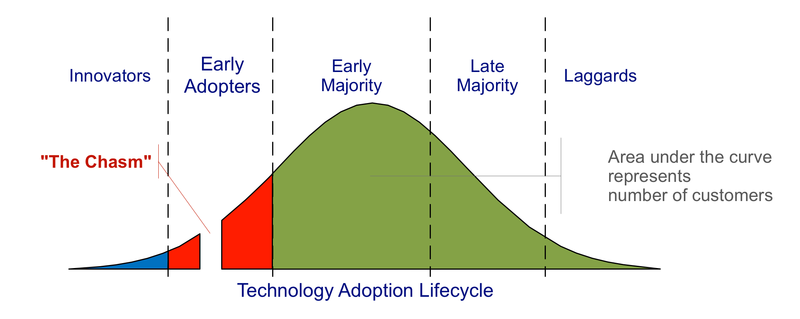
Geoffrey Moore’s 1991 book, Crossing the Chasm, has served as the marketing bible for tech startups from the time of its publishing until now. While he meant for it to be a guide for tech startups, I find that its concepts pretty much hold true for any startup with a truly innovative product (which is a bit redundant considering our description of a startup here).

What is critical is the customer adoption life-cycle Moore introduces and is shown below (thanks Wikipedia for the chart):

From left to right, this illustration reveals the 5 categories of customers you will encounter when you build an innovative product or service. Moore recommends that marketers should focus on one category first before moving on to the next. This is an exciting topic I will cover in more detail in another post, in the meantime, let me ask you to focus your attention on the leftmost side of the curve – the innovators and the early adopters.

These guys are the enthusiasts who will be excited about your new product because they believe in the potential of your new product. These are the people who are willing to look beyond the imperfections your new product WILL have because they see its promise.

Is your product a cutting edge web tool? Bring it to the über tech geeks to play around with. Is it a health product? Bring it to über health fanatics who will try anything in the name of fitness. Got an innovative marketing service? Bring it to an innovative marketing director who is known to try new things. For STORM, our early adopters were (surprising for us) medium-sized local firms who could make decisions fast and wanted to have an HR edge over their international counterparts.

Why bring it to them? Because they care, and will be more than willing to render their feedback, and most importantly, their time. Chances are, you will be ignored if you bring your product to customers in the other categories

So how do you find these people? Be an entrepreneur – research, be creative, and just do it. They ARE out there.

2. Gathering the data

If it’s a product, show them your MVP and then do one thing: shut up.

Resist the urge to render any input as this may affect the person’s experience. Just observe how the customer uses your product. For web services, for example, the suggestion is to just observe them while they go onto your site. As in be in the room with them as they visit your site for the first time. And then shut up. Observe: how do they navigate your site? What don’t they understand?

For services, it gets to be more tricky, as the MVP is likely to be invisible. You CAN still make them go through the service process by giving large discounts or incentives. One reader said his new service firm was going to do pro-bono consulting work just to get early feedback. That works!

After the customer experiences the MVP, then ask the simplest questions: what did you like? what did you not like? how could the experience be improved?

By this time, I am almost 100% sure you would already be realizing that some of your initial assumptions were wrong.

3) The Importance of Humility

In essence, you will have customers tell you that part or the entirety of your idea sucks.

If you are human, then this has to feel at least a tiny bit hurtful because it was YOUR idea and you devoted time and energy building your MVP.

Resist the urge which says:

“This guy doesn’t know what he’s talking about.”

or

“This guy is an outlier.”

or

“This guy probably hates me and is jealous.”

Listen to the feedback. Listen to the feedback.

Then be brutally honest with yourself and your team. Accept that some parts of your idea (or maybe even your entire idea) may actually suck.

Now, iterate!

(Know anyone whom you think just NEEDS to hear the content of Juangreatleap? Be a blessing and share NOW!)