At the age of 11, I sold cellphones at my uncle’s telecom store in Makati. When I worked for GK CSI, I sold everything from kamoteng kahoy, talong, and chicharon (no relation to Lapid’s 🙂 ).
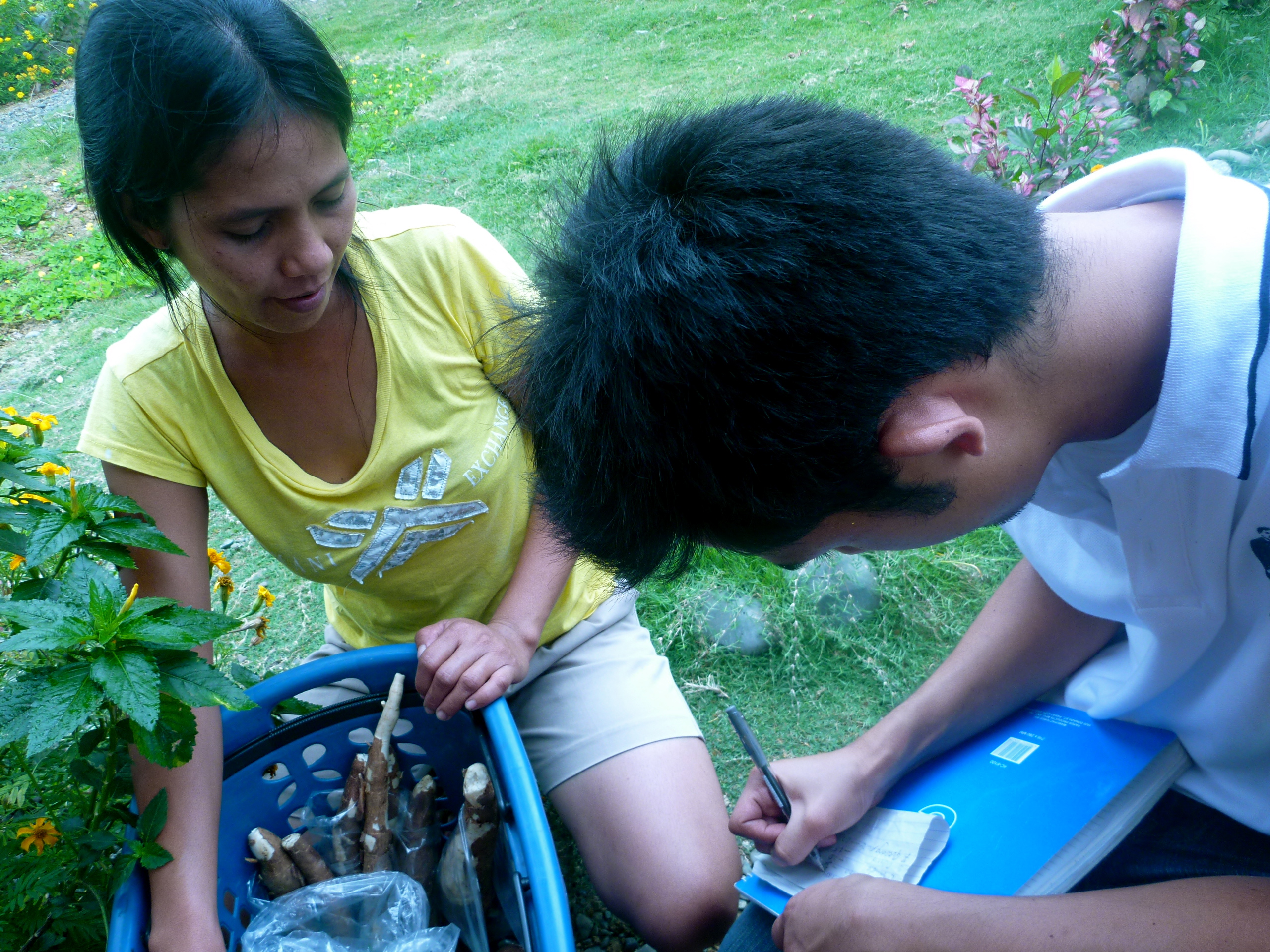
Me purchasing kamoteng kahoy from Ate Maricel at GK Enchanted Farm
For my first full-time job in the States, I sold consumer banking products. I was exposed to the world of cold calls and sales scripts. My personality wasn’t cut out for a “sales” job. Back then, pitching for me was like pulling teeth.
However, a job in sales taught me many things. It taught me how to use assumptive language, and never to make assumptions about a person based on his/her appearance.
I also learned how to pitch the sale to ALL customers who met the basic criteria. In my banking stint, one of the most successful salesmen in the region was selling credit cards. He never failed to ask every customer that he encountered about applying for a credit card. He wasn’t scared to ask, and most importantly, he wasn’t scared to hear:
That fear of hearing no, the fear of rejection, is what cripples people. It’s that fear of rejection that bogged me down. That fear which made me tiptoe instead of pushing me to run. I cared so much about preserving my image that it hindered me from reaching my full potential as a salesman. Sure, there were days when I overcame this fear, but it wasn’t consistent. I lacked a strong sense of purpose in my work and it made it even harder for me to overcome my fear.
I’ve since learned that communicating with a sense of purpose in my work and life is a powerful tool. It enables me to overcome my fears and move forward without dwelling on my past failures.
My mission nowadays is clear – to contribute to national building in the Philippines by starting up a Philippine enterprise to help myself while helping others. My sense of purpose gives me peace, and it can drive me to achieve highly improbable things, if I let it. While I still carry that fear and anxiety at times, my greater mission trumps the fear.
What are my sales tips, after all of these sales experiences and life realizations?
Embrace the power and significance of sales in your business. Without generating any sales, you’re not a business. As a result, it is very urgent that you sell.
Don’t feel guilty about selling. Selling is not a dirty thing. It’s a part of business. Remember, you are sharing value with your customer when you offer your product/service through a sale.
If you are confident in your mission, then continue to take that leap of faith everyday. In the end, we’re all flawed humans. If you compromise your mission and work because you’re trying to get everyone’s approval, it won’t happen.
If you possess a higher purpose that provokes you to think outside of yourself, then allow it to take over. You will speak with more confidence and move with conviction. The right people will gravitate towards that spirit that you exude.
Do not give in to the need to conform to the status quo. As an entrepreneur, you are a leader. As an innovator, you must distort the norm.
(This is the third of a 3-part post which talks about the tremendous lessons we can apply from closely looking at how the preeminent Startup Nation – Israel – attained tremendous economic success through the deliberate development of startups. Previous posts: part 1, part 2)
5) We Need To Just Ship It, Ship It Good
In 2006, in the height of the Lebanon War, missiles began to rain down on northern Israel. Understandably, the world’s most famous investor, Warren Buffet, was worried. The first company he ever bought outside the US – Iscar – had its plant and R&D labs in the north of the country and was a primary target. Eitan Wertheimer, the chairman of Iscar, called his boss and explained:
“Our sole concern was for the welfare of our people, since wrecked machines and shattered windows can be replaced. But I am not sure you understand our mindset. We’re going to carry on with half the workforce, but we will ensure that all the customers get their orders on time or even better.”
Afterwards, Wertheimer further reasoned:
“It took us a brief time to adjust, but we didn’t miss a single shipment. For our customers around the world, there was no war.”
Now, I don’t know about you – but that is amazing!
Sure, for some it might be carrying it a bit too far, but this best illustrates Israel’s commitment and mindset towards keeping its promises – especially to its global clientele.
Buffet, the Dumbledore of investments, obviously calculated this risk when he bought 80% of Iscar just 2 months before the bombing started. He knew the facilities could get destroyed in such an event – but he also knew that the value of Iscar lay far beyond the physical. More than anything, he was investing in Iscar’s people – their ingenuity and ability to keep promises. He was investing in their ability to ship.
Even in times of war.
In local news, I remember feeling quite shocked and scandalized during the recent Habagat episode when there were some BPO’s who were asking their employees to go to work despite the rains.
Looking at it from this perspective has forced me to at least reconsider that feeling a bit.
If we cannot keep our contractual promises, then how can we be trusted as a global partner? We just need to find ways to get it done.
People, if you have a startup, or are planning to put one up -remember this mantra: just ship. I can’t tell you how important this is for a burgeoning startup.
No excuses.
Just ship.
6) We Need To Adapt A Migrant Mentality
Israel is a nation of migrants. Foreign-born citizens of Israel currently account for over one-third of the nation’s population (think about that for a bit). Israel is now called home by more than seventy different nationalities.
Now why is this significant?
Simply put, a community of immigrants is almost always a community of entrepreneurs. A great number of the world’s greatest entrepreneurs are first or second generation migrants, living in a foreign land.
Why?
Israeli venture capitalist Erel Margalit explains in the book:
“A lot of it has to do with immigrant societies. In France, if you are from a very established family, and you work in an established pharmaceutical company, for example, and you have a big office and perks and a secretary and all that, would you get up and leave and risk everything to create something new? You wouldn’t. You’re too comfortable. But if you’re an immigrant in a new place, and you’re poor,” Margalit continued, “or you were once rich and your family was stripped of its wealth – then you have drive. You don’t see what you’ve got to lose; you see what you could win. That’s the attitude we have here – across the entire population.”
Now, obviously, we cannot artificially create an environment where suddenly migrants would come to Philippine shores by the millions to ignite entrepreneurship.
But knowing what the fruits are of the migrant paradigm, I can’t help but think – perhaps we can re-channel and use our own local context into a the type of desperation which breeds innovation. Perhaps we can draw from something else.
Our underdog mentality – the one we Filipinos seem to love so much? Instead of automatically thinking ourselves as inferior (which I write a bit about here), perhaps we can re-channel this into a chip on the shoulder which can fuel our drive to create something great.
Perhaps we can use the poverty our people are experiencing as added motivation to do a startup which can make a difference.
We need to feel that wall against our backs. True, circumstances dictate this. But attitude is also a key ingredient. We can DECIDE to feel a sense of urgency.
Bonus: We Need To Work For One Startup
And that of course, is our country.
In working with HR departments, I’ve come across a behavioral phrase that has been used a bit extensively in performance feedback forms of managers:
“Prioritizes the welfare of the company versus the welfare of his team.”
This is one thing the Israelis have learned to do.
It is certainly difficult. As a startup, it is very easy to adopt the mindset of “me versus the world.”
But perhaps the effort to incorporate a slight tweak can work wonders.
It’s us versus the world.
(Kindly share to those you think will find this useful!)
The Original Game of Perfection is a board game in which you have 60 seconds to fit all 25 shapes into their proper place. If the player does not complete the puzzle within the time allotted, the board pops up in the player’s face and all the pieces scatter.
I played Perfection for the first time last night, after seeing my 5 year-old nephew play the game. The simple concept of fitting shapes into their proper place seemed really easy. My nephew completed 15 pieces the first round. I completed 9 pieces.
I had a harder time than expected.
Me having a little trouble getting started
A concept that seemed so easy wasn’t in reality. The lurking variable?
Time.
Being timed made all the difference. The idea of time ticking…having 60 seconds to complete the puzzle got me flustered. My anxiety threw off my focus. I completed the task with a failing grade, 36%. Yet I strove for “perfection.” I never once questioned whether I could complete the task, but I did question whether I could make it in time.
Time is a key player in my journey of entrepreneurship. I know that I’m running against the clock and that eventually my resources will run out, if something doesn’t happen now.
I learned a lot about time, life, and work by playing the game of Perfection:
1. I learned while being a perfectionist has its benefits, I can’t act like a perfectionist, if I’m trying to urgently and sustainably build a business. If I play the role of perfectionist in this game, time will run out and the pieces will surely blowup in my face, just as it did in The Original Game of Perfection.
2. When you have a clear goal in entrepeneurship, you just have to get it done ASAP because if you don’t someone will beat you to the finish line.
3. As much as passion and inspiration are amazing catalysts for change and real action, the competitive spirit is a crucial ingredient to being an entrepreneur. I need to tap into that competitive side much more.
As The Original Game of Perfection has taught me. The 60-sec timer won’t stop ticking when you’re playing the game. I’ve learned from my mistakes and I’m playing the game much smarter from my first experience. This morning I played the game and I completed 19 pieces. Game on 5 year-old nephew!
(This is the second of a two-part post regarding the tremendous lessons we can apply from closely looking at how the preeminent Startup Nation developed. Part 1 can be found here.)
4. We Need To Have More Filipino Argonauts
In Greek mythology, the Argonauts were sailors and adventurers who travelled with Jason in search of the Golden Fleece.
In her book The New Argonauts, AnnaLee Saxenian writes, “The New Argonauts are foreign-born, technically skilled entrepreneurs who travel back and forth between Silicon Valley and their home countries.”
This “argonaut” concept of people coming back and forth from centers of global innovation, like Silicon Valley is a key component of Israel’s development. In Startup Nation, the authors describe several Israeli “argonauts” who would gain knowledge and status in their international companies, but have always intended to return. And when they do, they would become catalysts for Israel’s technological and entrepreneurial development. The book says Israel owes much of its success in this “argonaut” model, not only from diaspora in the Valley, but from quite a number of other countries as well.
I think Winston Damarillo is the clearest example of this here in our country. He resides in the US West Coast, but you’d regularly see him in the startup circuit here in the Philippines. In doing so, he transfers a ton of technology and insight back to the country. I think this is crucial. We need more Winstons.
I wrote a bit about our own diaspora in this post, and I’d like to make the same call again here.
To all our Filipino brothers and sisters around the world who have found success in their respective fields and are in positions of influence and knowledge – come back. I think its high time to seriously think about doing something for the country.
One very very common thread I felt while reading Startup Nation was the extreme sense of nationalism and giving back that these Israelis felt. Even while studying abroad, even while working in their foreign firms and achieving much success – they always knew they would come back and build something. (not all of them of course, but a significant number)’
I think this sense of nationalistic pride is found in so many of our countrymen abroad. Perhaps you have been biding your time. Perhaps you have been waiting for the right time.
I think now is the right time.
For the first time in my life, I now see a surge of foreigners going here. (hello, Matt) They are in startup events. They are looking for employment. They are looking to build here, and some have already built great startups here. (including multi-awarded Payroll Hero). It’s easy to see why.
The tables have turned. Asia is now the global growth area. The Philippines itself is in a state of incredible growth. It’s not only the “nationalism” carrot I’m dangling here, but amazingly, even the “practical” carrot.
You want to take advantage of this?
Come back.
Build something. At least look into it.
PS: I’m writing this series a tad longer than expected. I might need to extend this to a series of 3-4 posts, instead of the original 2-part plan.
PSS: A special request of mine? Please share this, especially to Filipino diaspora you know around the globe. What’s to lose?
Peter Cauton, Founder of Juan Great Leap, sharing a moment with his son, Joaquin
This past Saturday, Jan. 5, 2013, I sat down with Peter to experience Startup Saturdays first-hand. Initially, my initial vision for the interview was to ask as many thought-provoking questions as I could to get the insider’s scoop on the person behind Juan Great Leap. I sought to reveal a different side of Peter that showcased him as not just the inspiring founder behind Juan Great Leap, but also as an ordinary fellow.
However, as I was playing back the interview and transcribing his words something really clicked (it sometimes takes me a while to process things), I realized that Peter isn’t ordinary, and that we already know him. He’s already poured out his heart and soul to those that follow Juan Great Leap, and it shows in his honest and compelling answers.
Peter is many things: an entrepreneur, boss, teacher, mentor, husband, father, friend. This interview didn’t reveal any “different” side to Peter. It was simply inspiring. This is the Founder of Juan Great Leap, Peter Paul Cauton.
Juan Great Leap is known for the coffee talks you have with entrepreneurs on Startup Saturdays. What are the most interesting observations from your talks with entrepreneurs?
Peter: Well, there are several things. First, no two entrepreneurs are alike. Each entrepreneur has a compelling a story, with an emphasis on the word compelling. It’s not just that each person has a story, but every entrepreneur’s journey is a compelling one because there’s always a leap that’s involved.
When I get to talk to people, I always make it a point to ask them,
“How did you end up doing this?”
And there’s always a very real story behind it.
Secondly, and this is related to the first, I’ve experienced people really opening up about their stories, and you see how personal it becomes. It’s not just a job. There’s something of themselves that they pour into their venture. It’s a reflection of who they are as a real person and what they’re going through in life. For example, I met with someone who came to me about a problem he’s been having with his dad about inheriting the family business. It was a problem that’s always hung over his head and has been bogging him down in doing things.
Or a person who’s completely torn between his passions and what’s practical – which might sound pretty common. But this time, I get to hear what his wife is like, and see a picture of his son. I get to hear what his startup idea is. I get to feel his passion directly. Suddenly, his story is completely personal, unique, and I daresay, beautiful.
What is your opinion on taking the leap based on passion?
Peter: When you’re passionate about something everything else follows much easier. For example, if you have a hobby…let’s say you love following the NBA, you spend time on it, research about it, you know the players…it’s not work for you. You actually create competence from the sheer time and devotion you pour into it. In a sense, you get to learn the business side of it- the intricacies and details- because you spend more time on it…because you love it and it’s not work for you. If you’re passionate about the business and you’re pouring your heart into it, everything flows much faster.
Passion begets time, which begets competence. Without passion, it’s drudgery.
A few months back you met with a group about social enterprise. What interests you most about social enterprise?
Peter: A few weeks ago we were driving along Katipunan we saw a poor family literally living on the island in the middle of the road. Joaquin, my five-year old son, said,
“Dada, they’re having a picnic!”
When you’re exposed to seeing that and you really feel the gap between what you have and what they don’t, you can’t help but feel like something has to be done.
I see a very clear role between entrepreneurship and nation building and poverty alleviation.
When I talk to entrepreneurs, like earlier with Rex, even if it’s a more technical talk, I see a very clear link between entrepreneurship and the development of the country. Social or not, I think all entrepreneurs are crucial to building this country. If we can get more of our people – our very gifted people – to take those leaps and build great startups, we could dramatically improve the economy and make a positive impact on lives.
What are some of your favorite things about JGL?
Peter: Definitely the diversity. I get to meet and hear the stories of people I wouldn’t otherwise have bumped into working in my other startups. In the community, you have people like Raquel who is doing a startup focused on teaching. You have people who want to do tech and you who have those who are setting up service-based startups like a yaya academy.
How do you see Juan Great Leap as a Filipino Startup Movement?
Peter: There is a ton of value in letting people know about the tools and resources about doing a great startup. More than that though, I’d like to think that in JGL, there are heavy doses of passion and a certain spirituality mixed in. I’d like to think you can feel this a bit going through some of the posts in the blog. I want to help people find their mojo and place, and usually, finding one means finding the other. The usual result is that you get create something beautiful. Something that’s yours, too.
So it’s not only the technical part, the tools, but also the spirit of starting something that you love and the journey to make a living out of it.
What are you most excited about for 2013?
Peter: Lahat. Meeting more people. Getting to hear more ideas. Helping people out. Doing bigger and more events that touch more people. Setting up some sort of a school because I love teaching. Trying to bridge and connect people.
I love it when I see startups get the right mix of people with the right idea. It’s extremely fulfilling.
What are your top 5 books?
Peter: Very tough question.
1. Harry Potter by J.K. Rowling– this book got me into reading. Prior to reading Harry Potter, I didn’t read many books. Instead of appreciating books in school, the system of teaching made me hate reading. Rowling started my love affair with reading.
2. Reality Check by Guy Kawasaki- the first “business” book I bought. The book is very irreverent, unlike the business books I read in the past, which were pretty dry and scientific.
4. Tribes by Seth Godin – Actually, any Godin book post All Marketers Are Liars. I’m a fanboy, and it’s not just the hair style.
5. Bible– It’s a cliché, but I read this book the most, this is the book I often go back to.
If you had the choice to live in the life of any NBA player, who would it be and why?
Steve Nash because I like the assist. He scores, too, but helps other people on and off the court. This is different from my current favorite player, Kobe.
What inspires you to take the leap everyday?
God.
My own leap was such a profound experience for me. It changed me. I learned not to rely on myself too much. I’ve learned that the best way to make decisions is to truly discern – asking God what He wants for you.
I’m 100% sure that if it were just based on my own desire, I would still be in corporate. I allowed God to lead me to the decisions that have brought me to this place in my life and really, there is no place else I’d rather be.
The country we are talking about received more venture capital per capita than any nation in the world – 2x as much as the United States. They have more companies listed in the NASDAQ than Korea, Japan, Singapore, China, India and all of Europe combined. They’ve done this despite their small populace (just 7 million people), having relatively little natural resources, and being in a perpetual state of war (it is surrounded by its enemies).
It is Israel.
In their amazing book, Start-up Nation: The Story of Israel’s Economic Miracle, authors Dan Senor and Saul Singer tells the story of how Israel has recently achieved tremendous economic growth through the development of startups.
As someone whose passion lies in the development of Filipino startups precisely for economic growth and poverty alleviation, the book simply enthralled me and made my imagination run wild.
The book talks about innovation, about “battlefield entrepreneurs”, about the importance of survival mentality, nationalism through enterprise, about the critical role of diaspora, and naturally, about chutzpah.
The book talks about how a powerfully entrepreneurial culture made all the difference in their transformation into Startup Nation.
We HAVE to emulate their example.
Here are some the most compelling arguments and ideas which crossed my mind while reading the book:
1) We have to destroy hierarchical thinking
Precisely because they are surrounded by enemies from all sides, Israel requires all young men and women mandatory service in the IDF – the Israeli Defense Forces. Now, you might be thinking “joining an army?! this is the absolute LAST thing you want to do to challenge hierarchical thinking!”
But this is where it gets interesting.
The IDF employs a curious bottom-up culture where hierarchy is thrown out the door. Subordinates are actually encouraged to challenge their superiors. In fact, subordinates can oust superior officers through vote (!).
Miss Israel 2009, IDF soldier
Consequently, from a very young age, Israelis are trained to challenge the status quo and assert themselves – in extremely high-pressure environments.
Is there a better way to train would-be entrepreneurs?
With the combined experience of University AND a 2-3 year, one-of-a-kind stint in IDF (which the book explains through a greatly-named chapter, Battlefield Entrepreneurs), the Israeli 25-year old would-be entrepreneur has no global peer.
So…how can we start changing our culture here?
Our schools, by and large, teach our children to follow rules and singular ways to solve problems (multiple choice, fact-based learning, etc). Our companies, by and large, teach our workers to follow very defined job descriptions and kowtow to the boss.
This needs to change. We have to find a way to reward risk-taking and encourage doing things different, especially with our younger generations.
(Note – this school thing really worries me. My 5-year old was recently accepted in a big university, and when we were given the official introduction of what happens in school – I really second guessed this decision. I think our schools still produce graduates built for the industrial age – and the industrial age is dying fast.
Startup dreamers take note – the education system is just waiting to be disrupted – it is now starting in the US. Why not here?)
2) We need to embrace and use technology, regardless of our “field”
I talk to a lot of entrepreneurs who say “technology isn’t for me,” and that’s that. I think a quick dismissal of using technology is huge mistake. Technology is precisely what has made this world flat. Technology is what leveled the playing field for any entrepreneur in any part of the world to compete on a global scale. Why not use it? It is precisely what can take us to the next level.
Technology can be applied to ANY field, with wondrous results.
A budding social entrepreneur can say “I just want to help the farmers, I don’t want to be involved with tech.” Guess what? Hi-tech in Israel started with agriculture. Without much land (and most of it infertile) and much water, Israel was able to turn itself into an agricultural force, increasing its agricultural yield a whopping 17 times!
How did they do this?
Technology.
Are you a doctor who wants to build a startup? A musician? A publisher? An events organizer? A marine biologist?
Look hard at technology. Embrace it. It isn’t your enemy, and it can become your bestest friend.
How can technology allow you to do something different and new and innovative in my field?
(In Israel for example, you’ve got doctors working with engineers on a startup which aims to build a credit-card like device which aims on making the injection obsolete. The book lists so many of these “mashup” startups which combined expertise and technologies from different fields. Amazing.)
3) We Need More Venture Capital, Much More (and the government needs to get into the game)
The book is very very clear on the role of venture capital in Israel’s startup-powered economic transformation. They call it “Innovation Finance.”
I always try to encourage bootstrapping, and essentially, this was also how Israel started – with an awful lot of bootstrapped firms fighting for survival. But in order for us to scale our businesses on a global level? Venture capital is a crucial key.
Seeing the strategic role venture capital had in its development, the Israeli government started a program called Yozma (Hebrew word for initiative) in the 1990’s. The government investment $100 million in forming ten venture capital funds. A key part of the strategy was to have each fund represented by 3 parties: a young Israeli venture capital company (in training), a foreign venture capital firm, and an Israeli investment company of bank. To attract foreign VC’s, the Israeli government offered that its shares can be bought out cheaply after 5 years, if the fund was successful. This essentially meant that while the government shared the risk, it offered the investors all the reward – an unusually great deal.
The government did this not only to attract foreign capital, but to have the young Israeli VC;s learn about successfully managing venture capital from their successful foreign counterparts.
In a few years, this same fund has grown to around $3 Billion, all to support hundreds of Israeli startups and ventures. The Yozma program has resulted in copycat programs all over the world.
Is there any innovative Philippine politician, lawmaker, or national leader listening?
(and if you know anyone, please forward this to him or her)
If there are, let me tell you personally, startups are the key. We Filipinos LOVE technology. We are naturally innovative. We speak great English, the startup language. We can build great, globally-relevant startups.
Over the past year, we’ve seen fund sources sprout up from the business sector, all aiming to help startups. This is great news and has to continue. We have also seen startup-related initiatives by DOST, and a few other government sectors, but you know what, I think we might just need MORE help.
PS: If you know anyone who would resonate with this post or to whom this post would be pretty useful for, do practice some yozma and share! Who knows what could happen if you do?
This past Saturday, JGL had its first Startup Saturday of 2013 with Rex Marzan. We caught up with Rex on topics like funding, UX, data, family, and life.
It was awesome witnessing great minds like Peter and Rex bounce off ideas about the startup scene.
Peter Cauton and Rex Marzan at 1st Startup Saturday of 2013, Starbucks
Big thanks to Rex for educating a noob like me on the concept of user experience design. What a way to start the first Startup Saturday of 2013!
Startup Saturdays are definitely back with a bang in 2013! If you are interested in seeking advice and bouncing off ideas with Peter and I, please email him at peter@juangreatleap.com or you can also email me at matt@juangreatleap.com to reserve a slot for Startup Saturdays.
We look forward to building with you! Happy Monday!
This is a cool review of 2012 for the Juan Great Leap blog!
136 countries! 35,000 views! Glen Macadaeg as most frequent commenter!
Can’t wait for what this year would bring!
Here’s an excerpt:
4,329 films were submitted to the 2012 Cannes Film Festival. This blog had 35,000 views in 2012. If each view were a film, this blog would power 8 Film Festivals
I’ve written a couple of times recently that the amount of startup support that has locally sprouted over the course of just the last 12 months has been amazing.
One recent development has been the rise of the online Filipino startup magazine Homegrown.ph
There are a couple of articles I’ve written on the site (you can check the latest one here), but I highly encourage you to check out the other articles, if you haven’t yet. They are really quite helpful, especially for new startup founders. Topics range from the practical (How to renew your business permits) and strategic (Choosing the right team), to the the compelling (This season of resolutions).
I arrived at Rockwell. Got dropped off at Estrella Street. Was going to walk to the Power Plant, but this elderly gentleman asked me if I wanted a ride on his bicycle car. I was happy to hop into the contraption, as it saved me from the walk. It was an interesting experience to ride in the bicycle car, while this pleasant fellow peddled along the street.
While he was treading along, a car nearly hit us at an intersection. The man’s bicycle couldn’t keep up with the flow of traffic, but he didn’t fret. He brushed the incident off his shoulders like a true boss. After the 5 min bike ride, I get out of his cart and asked him,
“Kuya, anong tawag ulit sa bike mo?”
He replied with a smile, “Pedicab!”
I said, “Ah tama! Pedicab.”
I forgot about the pedicab. I couldn’t recognize the vehicle when I was riding in it, even though I saw so many pedicabs when I was last here. During the ride on Estrella, I was so preoccupied with thoughts that the term, pedicab, completely slipped my mind.
I couldn’t stop thinking about how the pedicab driver was being left behind with his use of old technology. While I definitely benefited from the pedicab, I feared that it would be phased out and the jolly man, who was so eager to give me a ride, would eventually be out of a job as development in the country continued.
Where would the man end up? What would he be doing, if he weren’t a pedicab driver? Would anyone even give him a chance to work?
That short ride in the pedicab really got me thinking…the experience resonated with something I was reading.
Earlier in the day, I was reading a passage from Startup and Change the World: Guide for Young Social Entrepreneurs by S. Dev Appanah and Sunit Shrestha.
In the section about Social Technopreneurship, Appanah highlights Professor Michael Porter’s words on innovation:
“Professor Michael Porter from the Harvard Business School argues that, ‘Innovation is the central issue in economic prosperity,’ innovation and technology can help the poor as much as the rich” (Appanah, 7).
Innovation will continue to change the world, and technology is driving that change.
I’m not a techie. I’m probably the polar opposite of a techie, but I do see the vast potential that technology can have on the poor and the development of this country.
While it’s only been a month since I’ve been exposed to tech startups in the Philippines, I can proclaim that the innovation of the Pinoy is outstanding. Pinoys can do so much with scarce resources, and many times, even better than those who have more resources available to them. The talent here is incredible. Countries like the US and Australia can attest to this statement, as big international firms are outsourcing the services of top Philippine talent.
Similarly, there is immense talent and innovation coming from the masses. Their creativity and resourcefulness in daily activities that may seem mundane is a demonstration of innovation at its finest. (You can check out this article I did for juice.ph last year, if you want to get an understanding of where I’m coming from.)
To all you game-changers, I’d like to make this plea: let’s NOT leave Juan behind in the process of innovation. We are a country of more than 90 million. Our greatest resource is our people. Together, we will build our nation.
As Professor Michael Porter points out, “Innovation and technology can help the poor as much as the rich.”
In order to move forward with every Juan, let’s be conscious of where that niche can be filled in a bright and developing Philippines.


 My mission nowadays is clear – to contribute to national building in the Philippines by starting up a Philippine enterprise to help myself while helping others. My sense of purpose gives me peace, and it can drive me to achieve highly improbable things, if I let it. While I still carry that fear and anxiety at times, my greater mission trumps the fear.
















 JUAN GREAT LEAP