Hope Is the Common Entrepreneurial Thread

I have interacted and talked to a multitude of startup entrepreneurs over the course of these last few years.

You can bet I have tried to figure them out.

What is the common thread?

What makes an entrepreneur?

There are a number of things which stand out: tenacity, hard work, execution, with good doses of people skills and creative problem solving.

You’d probably find these characteristic in a number of entrepreneurial books and blogs.

What I realize now though is that perhaps the most common thread is a bit more rudimentary. It isn’t a skill in as much as it is a paradigm, a state of mind, a way of looking at things.

It’s hope.

sunrise

All startup founders I’ve met are hopeful people.

It sort of comes with the territory.

Lean Startup author Eric Ries describes a startup as:

A startup is a human institution designed to deliver a new product or service under conditions of extreme uncertainty.

If you take this level of uncertainty and couple it with the sobering thought that up to 70%-80% of startups fail?

Well, you sort of NEED to be a hopeful person, right?

But there’s more.

Perhaps the best illustration of hope in the entrepreneur is the way she conquers Hope’s polar opposite – Fear.

“This will never work!”

“This is going to be B-I-G!”

“I will be out in the streets begging for food if I fail!”

“If this doesn’t work, I can just go back to corporate. No problem.”

“I will be laughed at!”

“I will be the next Zuckerberg!”

“It’s a recession. This is a very bad time to startup a company!”

“It’s a recession! There’ll be hundreds of opportunities to start a company!”

How we see what the future holds largely dictates what sort of risks we take.

A hopeful person will take many leaps. Even if some of those leaps fail, they’ll think well enough of the future that they’ll take even more leaps.

A fearful person might not take a single significant leap at all. (not realizing that stagnancy in this new, ultra-dynamic economy is the worst risk of all)

In fact, the very interesting thing is that a hopeful person doesn’t see risk at all. She sees opportunity.

opps

When you attend meetings of entrepreneurs, want-to-preneurs and startup owners, there is a certain energy that fills the room. It is palpable. Get these people together, and almost immediately, discussions about a better future happen – a new business concept, possible partnerships, new ways of working together.

This energy, this hope, is what I love about the startup scene and talking to entrepreneurs. I seldom saw this in my corporate stints. Hope is engrossing, uplifting, and contagious.

Want to put up your own startup someday? Perhaps one stumbling block is your mindset.

You just have to get rid of your dark glasses and look at the world with rosier lens. And you know what?

You CAN change a mindset.

Like love, hope is very much a decision.

How to Avoid The Marshmallow Career

marshmallow_test

In a landmark study done in 1972 by Stanford psychologist Walter Mischel, hundreds of children were offered a marshmallow. However, each child was told that if they could resist eating the marshmallow for 15 minutes, they would receive a second marshmallow.

Decades after, it was found that the children who delayed gratification (around a third of the 600 students who participated), were described as more competent, had higher SAT scores, and went on to have better careers.

A few days ago an entrepreneurial friend of mine posted a quick “Pera o Passion?” poll on his Facebook page. The last I checked, “pera” was leading.  It was understandable, but I have to admit, I felt a bit disheartened.

Quick money is almost always un-strategic.

Let’s talk about this overused word for a minute. For me, to be “strategic” means that decisions are always made to support a much bigger picture. To be truly strategic almost always means to defer gratification. Think Amazon delaying becoming profitable for so many years (CEO Jeff Bezos was barbecued in the media in those days). They were burning hundreds of millions to acquire customers year after year because they were after the bigger picture (a much larger community). This long-term plan paid off. Amazon is now one of the world’s most admired and successful companies.

I think very few of us  really think about our careers strategically.

Instead, most people eat the marshmallow.

A friend of mine recently reached out to me about career advice. He was explaining that he wanted out of the industry he was in, that he would never go back to it. A few weeks later, a high paying job became available in a company he really admired. I noticed it was in the same industry he was in. In a recent email, he was asking me for tips on how to get into the that firm.

Huh?

He’s eating the marshmallow.

We fall for it early. After years of not earning anything, we finally attend job fairs and get dazzled by the offers we get. Sadly, most people still decide to go to the highest bidder, where the assembly line starts and is built to keep you in.

As we get older, we then feel it:

This money thing isn’t as cool as I thought it would be. 

I’m earning, but I’m not living. 

What field/job can I be truly happy?

or even

Hindi ko natutugunan ang aking pagmemeron.

Quarter life, or even mid-life crisis, at its full hurricane force.

If we ask the people who voted for “pera” in that earlier casual survey 20 years from now, I’m guessing the pendulum would shift to the other side.*

So what am I getting at?

Young people. I’m talking to you. Don’t fall into this trap. Take it from us (slightly) older folks. Think about your careers strategically.

Repeat after me. Big picture. Big picture. Big picture.

Here are some tips on how to avoid the marshmallow career:

1) Take Time to Understand YOUR Big Picture

I think this is where a big chunk of the problem lies. We lack self-awareness. We don’t invest enough time understanding who we are, what we like doing, what our natural gifts are, and what we want to be when we “grow up.”

As some great military people once said “knowing is half the battle.”

Take time to assess. Ask friends about what your strengths and weaknesses are. Take personality tests. Ask people about other careers.

Granted, this won’t be automatic, as “finding out who we are” can take a long process. But I think part of that problem is, we don’t really put enough investment in consciously trying.

Try. Perhaps asking this simple question can help start the process: who am I?

Also, think about YOUR big picture. Not your parent’s. Not anyone else’s.

2) Work Backwards

Once you have a reasonable idea of your Big Picture, do a Covey and try to Begin With The End In Mind.

begin

What career move can you do NOW that will inch you closer to your Big Picture?

Since this is an Startup Blog, here’s my quick tip on what next career steps you can do if you want to own a business someday:

A) Go fulltime and take the leap! Startups are all about learning through doing. Anything else is a bit of a  compromise. Try naming a great startup which was done part-time.

B) Work for a startup. Next best thing.

C) If A & B are too unpalatable, you could: 1) get into sales – it might not be that sexy to some, but selling is an extremely valuable skill to develop in any startup, 2) get into the industry you plan to develop your startup in, the smaller the firm, the better, 3) get into anything which expands your personal network in a hurry.

3) Just Say No

Okay, you’ve got your Big Picture. You’ve got some semblance of a plan on how to get there.

What are you going to do when Company X offers you a big package from out of the blue because your friend gave a good recommendation?

Think Amazon. Think strategic.

If something tempting comes and shows you all the shiny things you can have now if you break your plan, well, just think of all the SHINIER things you could accomplish sticking to the plan.

This is easier said than done, of course. But possible.

4) Pray

By far, my best career advisor has been God. My best career decision-making process has been Discernment. I’ve always maintained that it was He who really pushed me into an entrepreneurial path.

Here’s an interesting thing.

I belong to a Community  which really encourages its constituents to pray, talk to God, and surrender to His will. This group has a disproportionate amount of people who have taken leaps from their long-standing careers into what they truly want to do. A longtime banker who has become a pre-school teacher. An longtime FMCG executive who now works for a foundation. Another longtime marketer who put up her consulting practice. A longtime IT employee who’s put up multiple small businesses. There are more. All of which would tell you they had the courage to take the leap because of prayer.

You should see their faces when they explain how happy they are in their chosen fields. Passion is always evident.

As is the lack of it.

(know anyone who will benefit and resonate from this post? be a blessing and share!)

self-awareness

*The big assumption of course, is that we are earning enough to cover our basic needs. Maslow’s hierarchy in full effect. 

One Awesome, Blessed, and Unpredictable Year for Juan Great Leap!

anniversary

When Pauline and I celebrate our wedding anniversary together, we usually find a fancy restaurant which satisfies one important criteria: it has to be conducive to talking.

Then we talk about the year that was. All the highlights. Good times and bad. What we thought God was saying to us. Afterwards,  satisfied with our summary, we talk about our hopes for the next year – and what we want to try to work on.

For this year, I was planning to have a big event to commemorate JGL’s first anniversary. However, due to circumstances (1-2 weeks being wiped out because of a nasty viral infection), I wasn’t able to plan it out properly.

I think it’s fitting though, that I get to celebrate JGL’s first year in a very simple fashion – through how it all started.

With a post.

So, like my annual commemoration with Pauline, let me just talk about the year that was, as well as my hopes for the future.

Matt was asking me the other day what made me write this blog in the first place. To me, it’s very clear.

I felt my whole entrepreneurial career was the result of intervention from God. I cannot and will not talk about my entrepreneurial career separately from the faith-process I underwent. There were more than a couple of very hairy moments, but by 2011, I just felt so freaking happy with my career! I was calculating that I would’ve made more money staying in corporate, but I just didn’t care. I was totally in love with being an entrepreneur and with what went with it. With this energy came two things: a) a humongous sense of thankfulness, and b) an unsatiable need to give something back.

At first, I wanted to write a book. That was taking a bit of time. So I said, “what the hey” and began this blog.

JGL started on November 29, 2011, with this post. I actually wrote that post early November, but I was afraid of posting it. Finally mustering the courage, I said to myself “what the hey,” and hit PUBLISH.

Then I just poured my heart out with post after post, hoping that at least I’d get to help even just a handful of people.

Then, something unexpected happened. I was expecting a few dozen hits in the first few days. Instead, there were a couple of hundred already. There were also a more than a few people I didn’t know who were reaching out directly asking for questions and advice. My heart was warmed. It turns out more than a handful of people were interested in JGL’s message. This strengthened my resolve to write more. To write better.

In three months, there was already a small community of folks interacting with me through the blog and through email. I figured, I NEEDED to meet them. I booked a small room in Astoria and opened up 40 slots. They were booked pretty fast. We held a pretty amazing event in Astoria, there was such energy in the room! I actually had to kick people out because it was getting late, so naturally, the conversations just continued along the corridors, and ultimately, into a very active Facebook Group.

This was also around the time that a reader, Glen, invited me to talk about startups over coffee. I was pretty busy, and my consulting background shrieked “you have charge for this,” but it was just out of the question. I met Glen, and we had a blast. Soon, I was meeting other people for coffee. This was the genesis of Startup Saturdays.

The energy of the event and these face-to-face meetings made me realize a lot of things. I had originally just planned to manage and write a blog – that was it. JGL was snowballing into something else though. I hadn’t bargained on giving up this much of my time and resources, and I had a ton of other stuff to do. But I realized this was something bigger than me.

I just had to give more.

By late August, we had our second event and attracted 200 people at the Ayala Technohub in QC.  Smaller events – geared more towards sharing and collaboration, were also being held (and wow, what energy is created when you bring in entrepreneurs into a room). I was also getting to meet a number of entrepreneurs, want-to-preneurs, and venture guys during startup Saturdays. There were startups being spawned by activity from the Facebook Group.

To scale, JGL needed to be managed more like a startup. I could no longer do everything on my own.

Naturally, I suddenly get this crazy email from someone from California who said he wanted to work for JGL so much that he was willing to take a big continental leap, face uncertainty, and swallow a paycut. It sounded familiar. I was crazy enough to give him a shot. This brings us to now.

I find it truly amazing that all this activity was the result of a reluctant post I published just 12 months ago.

thank you

Thank you so much for reading. It is any writer’s satisfaction to be read. Thank you for the time you take in reading these posts. Thank you for sharing them to more people.

Thank you for going to the events and participating. I know there are a million other places you could have gone during those times. You have blessed me with your presence.

Thank you so much for letting me hear about not only about your startups, but also your stories. Thank you for trusting me with them. It is a deep privilege for me to be able to listen.

For those in the Facebook Group, thank you for all the contributions and the activity! I keep telling everyone what a blessing that Group is. It’s become a startup founder’s resource and a quick market research tool. Fun people, too 🙂

For the JGL “core team” – Sherwin, Ryan, Orvin, Nicole, and Eric. Thank you so much for believing in the cause and your profound gift of working for free.  This is deeply, deeply appreciated. I hope to work more with you more this coming year!

For those who’ve started something as a result of some of the activity above, thank you for taking that leap. This means more to me than you will know. It’s ultimately what JGL is all about. And please, if you need any help, just holler.

Thank you, to the Maker of all things for making all this possible.

2013

For next year, there is so much planned. More events. More events with investors. Going out into the countryside. Talks on specific topics. Podcasts. I could go on and on. But you know what?

If this past year is any indication, we’ll probably end up doing something really very different – and much better – than anything I’ve planned or thought of.

I might have started all this with a post, but it’s really YOU who has taken it to levels I never would have thought of. It’s you who have shaped it into more than just a collection of blogposts.

JGL isn’t mine, after all. It’s yours. Happy anniversary 🙂

So what do you think? Where should we take it? What is it for you? What have you appreciated? What else do you need? Hit the comments and share, knowing there’s a huge chance for us to incorporate whatever good idea you may have! 

Startup Resources Galore From Steve Blank

Quick one. Just had to repost this. This is a tremendous resource for anyone who wants to know about how modern entrepreneurship and startups work. Assembled by startup guru Steve Blank.

Do enjoy reading it, learning from it, and most importantly, start building something out of it!

Saturday Night Gimmick!

It’s a Saturday night. I’m a bit tired coming from a party. The kids are asleep. Pauline’s on TV. After a full week, I’m on my bed wanting to relax and have my me-time.

Three things to choose from: a book to read, NBA 2k13, or surfing the web.

I choose to surf the web.

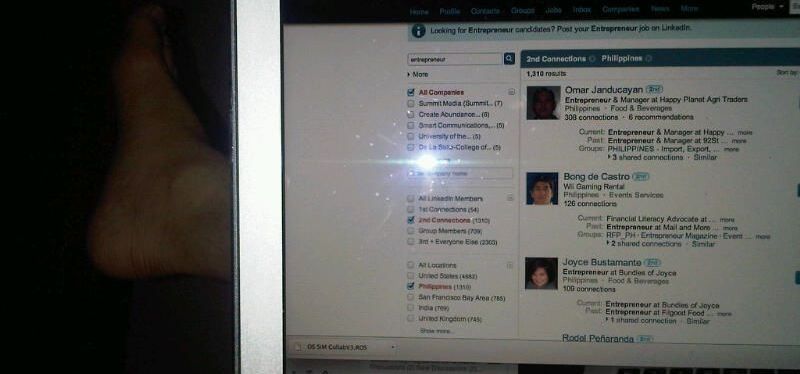
What do I end up doing? Going to Linkedin to recruit for some startup openings we have.

One way to look at it: that’s pretty sad, man! 

Another way to look at it: I find work fun, and I’m not trying to escape it. 

Work on something you love. It’s becomes a virtuous circle.

Yep, that’s my foot!

Updated Jobs In Our Startup Community – Apply Now!!!

(I’ve recently updated the jobs link with a host of different openings from our network. The page is copied below. For any applications, do send me a note at peter@juangreatleap.com) 

Below are the startup career opportunities in the JUAN GREAT LEAP (JGL)’s Startup Community, updated as of  November 22, 2012.

If you are interested in any of these, please  shoot me an email at peter@juangreatleap.com, along with a resume or Linkedin link.

All these jobs are STARTUP jobs, so expect the following from all of them: a) the job description is fluid: the job WILL change as the startup changes b) you will have a lot of freedom to create and leave your mark c) there is always a possibility for earning shares, d) things are pretty exciting, e) being part of the JGL Startup Network opens up all sorts of possibilities as far as career and learning are concerned. f) the job title is merely a placeholder – you can call yourself what you want (like, Ambassador of Buzz, Master Chief, Super VP, etc…),

I’ll be segregating this by company. For all the firms, one can expect an entrepreneurial culture that’s collegial, innovation-driven, customer-focused, flat, and fun!

Here. We. Go.

I. STORM

2013 in STORM is going to be a very special year for us.

As I mentioned in this post, STORM recently got funded in preparation for a big year wherein we will try to disrupt the market even more. We have a clear strategy in mind, and we shall do our dardnest to go for the gold.

A big part of this strategy is getting the right people to help us execute.

Here’s a list of the positions we need:

A) Two (2) Senior Marketing and Sales Executives

When we say “senior” here, we are talking about people with around 5-7 years of experience in marketing, sales, or business development. We need people who not only can strategize, but can be with us in the trenches when we execute. We need 2 leaders who are very independent, driven, results-oriented, and creative. We want people who are easy to talk to and like collaboration. Power-hungry jerks not allowed.

The two people to be hired will be leading 2 different, very strategic teams for STORM. (I’m not that comfortable talking about the nature of the teams here in the blog, so we can talk about it during the interview process.)

B) Marketing and Sales Trainees

The two seniors above need support. We need a couple of junior executives (1-2 years experience) who can help the team execute. One thing to remember with our structure, while the “juniors” report to the “seniors,” we believe that great ideas and insight can come from ANY PERSON in the company. Expect meetings and processes where everyone is a peer and anyone can jump in to contribute.

C) Senior PHP Programmer

A big part of our strategy is leveraging technology. We need a senior PHP programmer (at least 3-4 years programming in PHP) who can lead our technical development team. We need someone who can technically strategize and help guide us through key decisions.  We need someone who can lead. Most of all, we need someone who could execute.

D) PHP Programmers

We would be needing a team of junior PHP programmers with around 1-2 years of programming experience using PHP.  Experience in e-commerce and payment gateways a big plus.

E) Design/UX Expert

We need someone with great design sense who can help us create beautiful, buttery sites both on web and mobile. We need someone who knows html, css, and design tools like Photoshop and Indesign. Those applying would need to bring a portfolio of previous work. Fresh grads can apply for this post.

II. STRATA (in incubation)

Strata is an upcoming startup which will focus on providing Competency-based HR Consulting and Technology. We are VERY excited with the prospects of Strata. With very very minimal marketing, it ALREADY will have a client list and a very healthy revenue stream. (It has already generated around 2.5 million in revenue in 2012)

A) Marketing and Sales Head

While HR expertise here is not a requirement, we do need someone who can learn the HR universe and negotiate effectively with HR leaders. We need someone who will help build the marketing and sales structure of Strata, and work on the bottom-line. In the end, this person will hold tremendous influence over how Strata will develop and look like. We need someone who can own the startup and make it grow. Together with the CEO and the Senior HR Consultant, this person will form the core group of the Strata team. Very exciting stuff!

III. Juan Great Leap

Juan Great Leap is slowly transforming into many things: an online advocacy, startup lab, a startup community, even a bit of a startup school. Currently the only one “employed” fulltime by Juan Great Leap is me. I need a junior contributor who can help me develop all facets of the concept.

A. Junior Entrepreneur

I need someone who is reliable, has a lot of energy, a good writer, has supreme communication skills, is organized, entrepreneurial, and someone who is very very interested in startups. With that skill set, you probably command a high salary – and I am telling you now, this firm probably won’t be able to match what a corporation can give you. (largely because the labs are a long-term play) But I am also telling you now: if you are interested in startups, there is no other job opening that will give you as much learning as this one.

Being exposed to the deal flow (seeing and being involved in the formation of new startup concepts) alone is priceless.

IV. Mobile Academy

Mobile Academy was launched September of 2012 – a school which teaches both technical and non-technical people how to program in the mobile environment. Mobile Academy is already running its third class, is already cash positive, and is brimming with potential. It is seeking to hire its very first employee.

A. Management Trainee

We need a young trainee who can come in, contribute, and most of all, learn. The trainee will be involved in all aspects of the business: curriculum development, faculty relations, administration, finance, marketing, and sales. Take it from me, being involved with everything is the absolute best way to learn, and this is what the Trainee can expect. High potential fresh grads are welcome to apply for this position.

Tired of the corporate grind? Send me an email ASAP! Let’s build something!


5 Things I Learned in Raising Investment Money

You guys know that I’ve always advocated bootstrapping.

I will ALWAYS advocate bootstrapping as the way to go. But when someone asks me if she should raise money though, I never ever blurt out a “you should always bootstrap first.”

The real (sometimes frustrating) answer is of course, “it depends.”

It depends on whether your idea needs a lot of capital to begin with. It depends on the market. It depends on how defensible your position is to new entrants. It depends on your market adaptability rate.

Sometimes, it also depends on where you want to take your startup.

Our first bootstrapped startup, STORM, became profitable on around its 3rd year, then it just grew pretty fast during the next 4 years, all organically.

Then, my business partner Pao and I saw a new business opportunity for STORM, a new strategy dripping with potential, but one which  required a sizeable capital investment – a bit more than what the company could afford using its own funds.

So Pao and I talked about it. We came up with two initial plans:

Plan A: Go on our current organic trajectory (which wasn’t bad)

or

Plan B: Go for the new strategy by raising money and sacrificing equity.

Being the entrepreneurs that we were, of course we went for Plan B. BUT, we said that if we didn’t like the terms, or if we didn’t feel fully confident with the would-be investor, then we would do a Plan C and try to make it work ourselves. (nope, plan A was never considered)

So around a month ago, we began the process of raising money for our company. It was our second time to do so.

The very first time we tried raising money was back in 2004 when we started STORM. We failed to raise a centavo and resorted to try doing it ourselves (which in retrospect, was a blessing).

Around a week ago, we got the verbal go for a substantial sum – exactly what we needed to shore up operations in line with our new strategy.  More than that, we partnered with a great investor whom we felt could help us take the company to the next level.

Here’s what I learned from the whole process:

1) Traction Reigns Supreme

Traction can be defined as the startup’s history of actually making money. Which, you know, is what companies are supposed to do.

Traction means everything on the entrepreneur-investor negotiation table. Without traction, the negotiating power of the entrepreneur falls considerably.

The best asset any negotiator has in any negotiation process is the ability to walk away from the deal. Traction gives the entrepreneur the much-needed leverage to say no and find the best deal available. When we did our pitches to investors, we were able to show them 5 years of increasing profitability and a host of longterm relationships with substantial clients. We had no problem finding people interested in investing, our problem then became choosing who to partner with.

This is a much better problem than the former.

2) The Founding Team Counts

We’ve always heard investors say, “we bet on the jockey, not the horse.”

This is true. Investors will not merely give their time and money to anyone with a grand idea. The idea is secondary. Who the entrepreneur is is primary.

So you can bet investors will do their due diligence with you. They will check with their network for references. They will look at your past work. They will schedule multiple meetings with you to ascertain comfortability and working style.

In a very real way, the process is much like job-hunting. You and your founder team will need to be impressive.

3) Cast a Wide Net

I can’t think of any reason why your startup should not let as many people as possible know that it is raising money. Again this process is like recruitment. In recruitment, if you want to be able to get the BEST PERSON possible, you cast a wide net and consider as many qualified people as possible.

During the STORM process, we talked to VC’s, angels, friends, family, and went deep into our network for other connections. We presented in PhilVenCap (they meet in AIM every third Thursday of the month), posted on startup-related FB groups, talked to high net worth friends abroad, and told everyone we thought MIGHT be helpful that we were raising money.

The result? We were able to pool a relatively large number of investors of different backgrounds and strengths and get them to be interested with our cause. We also learned a lot, got a large number of useful contacts, and even potential clients. Oh, and in the end, we were also able to partner with someone whom we thought fit our needs to a T.

4) Look for Much More Than The Capital

Essentially, looking for an investor means looking for another founder. It’s important to remember this and not be consumed solely on raising the fund.

I’ve done numerous posts in this blog on why and how founder recruitment is crucial to the success of a startup. Partnering with the wrong investor can very easily doom your startup.

You HAVE to look at what the investor brings to the table. Will the investor be a meddlesome sort who will want to monthly reports and meetings (this can be CRIPPLING for a startup for the sole reason that these meetings end up being a distraction more than anything). Or on the other hand, will the investor just give you the money and contribute nothing else to the cause? A good investor choice is someone who will be there when you need her and not be there when you don’t need her.

Aside from the money, you have got to consider how else will a potential investor help grow the pie. This was the clincher with our own process in STORM. The investor we partnered with had much more to offer than just the funding.

When choosing an investor, you ALSO have to require multiple meetings to properly ascertain comfortability and fit.  Moreover, observe carefully at how interested the investor is with the business concept, NOT MERELY the ROI potential. This is crucial. If the investor is genuinely interested in the business concept (she comes up with new ideas, she gets palpably excited talking to you about the idea), then thats a good sign she will render real support when you need it.

5) Have a Plan, Then Execute Fast

Remember, the most important element a startup needs is not money, but TIME. (when you think about it, the money usually just pays for the time).

I can see how fundraising can prove to be quite the distraction, especially since you are talking about money and essentially selling kool-aid about how great your company is. It can be tempting to try and extend the process to try to see if you can get a better deal than what you have. An investor can also lengthen the process by dangling more money in return for a bigger pie piece. All this results in one thing: less time for your startup.

You have to be very clear on how much money you will need, how much equity you are ready to sacrifice, and who you are looking for in an investor. Then cast a wide net, talk to as many people as possible and then decide fast so you can go back to working on your startup.

Waiting breathlessly for a co-founder? Just start.

Off the top of my head, I could name 10 different people who cannot get their startup off the ground because of the lack of a co-founder.

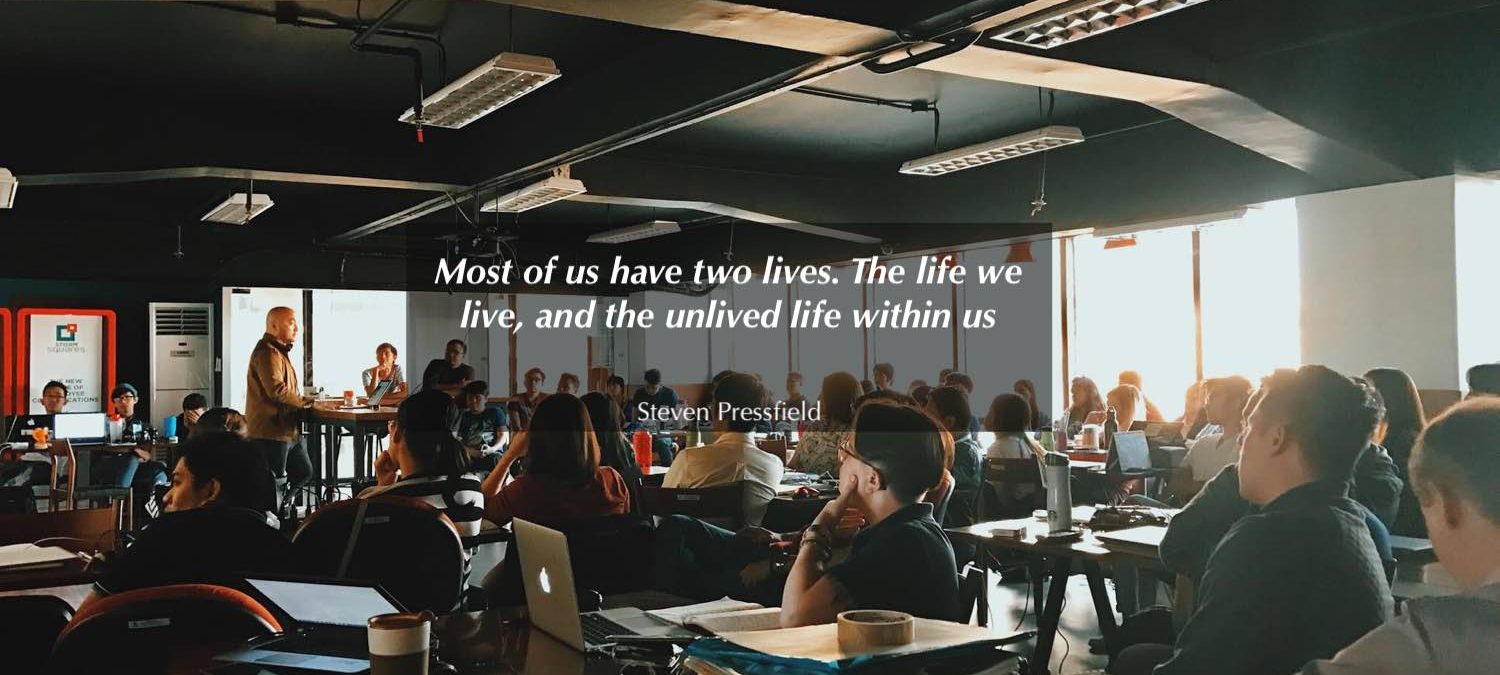
During the open forum of the last JUAN GREAT MEET in Briggy, there was a flurry of co-founder related questions:

How do you find the right co-founder? Where do you find the right co-founder? Is it right to co-found companies with friends?

What struck me during the proceedings was when someone added to the discussion (I think it was Joey Gurango): okay, so why would you need a co-founder in the first place? 

You know, it’s very clear for me why a co-founder is better than going at it alone: you want have someone to be with in the trenches, someone to discuss things with, someone who will be strong in the areas you are weak in. Because of these very powerful reasons, it’s quite understandable to expect someone to wait for the “right one.”

But only up to a certain point.

If you’ve already spent a considerable amount of time exhausting your network, getting to know even more people, looking under every rock you see, and you just keep hitting a brick wall, then it might be time to throw in the towel and get some work done. At some point, the waiting just becomes counter-productive, so just try to start.

Yep, alone.

For some, this might be a scary thought, as the assumption all along was to form a team.  But perhaps this has become some sort of a crutch, and excuse for you to put off doing what needs to be done.

It doesn’t need to be complicated. Knowing you WILL go at it alone, ask yourself, okay, what’s that next thing that my startup needs to progress?

Are you a someone with an idea who’s been searching for a technical partner for a year already? Then the next crucial “step” (the one you’ve told yourself you can’t do without a technical partner) is to build a prototype, right?

Just start. Create detailed specs – how does your app work? Ask around and canvass for freelance programmers who might do it for a fee. Try to look for and recruit the best one. Begin raising the money that might be required.

Perhaps you don’t need a technical solution just yet. Perhaps you can test the market out by creating a powerpoint mock-up and just doing a “demo” of your product to dozens of potential customers. The info you’ll get is guaranteed to be uber-useful.

I know it might sound intimidating because that “next step” would typically be the precise reason why you’re looking for a partner – the skills required for this next step might not be within your comfort level. But this is what makes an entrepreneur an entrepreneur – she learns, adapts, and just makes things happen.

So stop waiting and start doing. The ironic thing is, once you just go ahead and decide to start, you’re sure to encounter and attract even more people who are interested in what you are doing. Sometimes, the best time to find a partner is when you’re not looking.

The Dangers of Reverse Momentum

I haven’t written in around 2 weeks.

Last week, I had an excuse – I was bedridden for much of the time. This week though, I could’ve hammered out some posts earlier, but I just inexplicably refused to do so – it was like I was allergic to the keyboard all of a sudden.

Since I hadn’t written in a long time, it was sort of easier to keep not writing – and it seemed like such a chore to start.

It was reverse momentum! The more I didn’t move, the more I didn’t want to move.

I realize there were so many other aspects in my life that I’ve felt this way about: going back to the gym after stopping for a while, finishing a book I had started, getting back into daily prayer, eating the right food again, sleeping early again, and so on. Sloth does one other deadly thing: it begets even more sloth.

Perhaps there’s an item RIGHT NOW that you KNOW you need to be doing, but can’t seem to muster the effort to do so because its been such a long time.

Some of the good habits we’ve developed WILL end up getting challenged by reverse momentum at some point. If we give in, there’s a danger we lose the virtue entirely. We need to be stronger.

The important thing is to take a deep breath, embrace the resolve that you’re NOT going to let it win, and just do it.

APOLOGIES FOR THE RADIO SILENCE

Apologies for the radio silence these past few days, people. I was struck by a very very very nasty virus last weekend that has rendered me home and horizontal for the whole week. I tried to write, but quickly found I couldn’t form coherent thoughts and just merely looking at a digital screen made me nauseous.

Hope to be back to my normal blog routine by next week, though!

Thanks for the patience!

(Oh and yes, we found A TWO FOOT SNAKE in our kitchen this morning – what a week!)