Three days ago, I was feeling a wee bit nervous. I was set to undergo laparoscopic cholecystectomy – I needed to have my gall bladder removed.
I was admitted to the hospital at around 8pm, with my pregnant wife accompanying me. My operation was set at 10am of the next day. When we got to my room, I started unpacking our stuff when Pauline excused herself to go to the comfort room.
When Pauline got out, she had a smirky look on her face. “I have something to tell you,” she said.
“What is it?” I asked, totally not prepared for what she was about to say.
“My water broke.”
Life just threw us a curveball.
We smiled to one another, chalked it up to God’s timing and sense of humor, and then went to work. We split a set of phone numbers and called a lot of people:
The nurse’s station to ask for a wheelchair to take Pauline to the Delivery Room.
My surgeon and anesthesiologist to cancel the procedure.
My healthcard to cancel the process.
The admitting section to cancel my admission and to process my wife’s admission.
Our parents to tell them about their new, impending grandchild.
Our friends to extend prayers and include not only me, but mother and baby.
Then it was off to the races. I started going around the hospital to fix the paperwork, and then Pauline was wheeled to the delivery room. Soon, I was called to the delivery room myself.
In just over 2 short, exhilarating hours, I was a father to my newest startup, Siena.
Curveball.
You know it’s coming. You don’t know when. You don’t know how. You don’t know in what shape or form. But yeah, you know it’s coming.
Something that changes everything.
Yes, you can try anticipating it, resisting it, or even “risk managing” it. You can even try crying over it with the hope it goes away if you cry hard enough (hello, recording industry!).
My advice is to apply JUDO on it. Embrace it. Move with it. Flow with it. Smile.
While the startup is highly vulnerable to the curveball, it also has to realize that it DEPENDS on the curveball. Entrepreneurs and startups are created when they pounce upon a thrown curveball.
Are millions of people suddenly buying millions of apps over mobile? Pounce.
Did a big regulation just change? Pounce.
Are the buying habits of young people changing? Pounce.
Or better yet…
…you could tackle a truly tantalizing possibility:
How can you throw the curveball instead?
(Subscribe to Juan Great Leap and get these posts through your email!)
Great news here for our burgeoning startup community!
Our country is widely regarded as a producer of some of the best professionals in the world. Certainly some of the most enterprising and innovative. Developing impactful startups should be second nature to us.
Twitmusic should be the tip of the iceberg – but it’s up to us.
C’mon people! I’m calling YOU out.
You with that brilliant idea that’s been cooking for a while now.
You with those marvelous execution skills which are wasted in the bowels of a 2000-man corporation.
You with that passion burning that’s been so afraid to get out of the comfort zone.
You.
STOP wasting time.
Start something.
(You don’t know exactly where to start? Send me an email at pcauton@yahoo.com, let’s have coffee…)
Serial Entrepreneurship Definition: Running 2 or more startups at the same time. Some definitions involve creating startups in succession, but for the purposes of this discussion, let’s limit the term to the simultaneous management of 2 or more startups.
A number of the startup founders I’ve been helping recently have told me that apart from the current startups they are involved in, they suddenly have an idea for another one. Then they begin telling me about the other idea.
What I’ve consistently said was:
STOP! Concentrate on your first, startup concept first – presumably your best and biggest idea. Anything else is a distraction.
Of course, all this time, I’ve been waiting for someone to say,
Heeeeeey, wait a minute, you’re not practicing what you preach! You’re involved in a number of startups!
Guilty as charged. Serial entrepreneurship is a path you can take a long look at.
Just take heed of the following items:
1) Initial success begets success.
I started my second company, Searchlight, a full 5 years after my first company, STORM, was founded. It was only after STORM’s success that I had the confidence to try forming another firm. And even then, I studied the Searchlight market for almost a year before plunging in. I applied everything I learned from STORM in my experience in Searchlight – starting ultra-lean, having a clear focus, getting good people. In other words, I NEVER would have succeeded in Searchlight and the newer firms had I not initially succeeded with STORM.
I started Searchlight as an experienced entrepreneur – and that made all the difference.
2) You have to accept that the time you spend in one startup is the exact time you rob in the other.
Time is a zero-sum game. Your startups need as much time as it could from you – your full attention. If you have two or more, then it is quite obvious that ALL the startups in question would not be as successful as it would have been had you given it your full attention.
This is a reality I live with. How big could STORM be if I dedicated my full-time and effort to it? Searchlight? Stream Engine? I would never know.
3) If you insist on going serial, it helps greatly to have startups in related fields.
STORM is an HR services firm. The biggest reason I thought about putting up Searchlight is because our own clients were bugging us to do executive search. Like STORM, Searchlight is an HR services firm. So in running the two firms, there is a lot of dovetailing which happens. For example, the target market for both firms are the same. Almost ALL of Searchlight’s initial clients came from the STORM network. The numerous efficiencies created in having related firms mitigate the effects of item no. 2 a bit.
The next firms I was involved with were services firms as well. It is only very recently that I am finding myself involved with products, but even then, these would be technology-related products – an arena I am pretty familiar with.
4) It HAS to be in your DNA
Like with any career decision, you have to look deep within what you really like to do. What I have discovered about myself is that I find it difficult to focus – I need to be involved with different things at the same time. Another thing that I have discovered about myself is that I absolutely love the challenge of the startup process – putting together the RIGHT people with the RIGHT ideas, and then going to war with my team in the trenches. And I guess I like the risk involved – the whole David vs Goliath thing. It’s a bit masochistic, but I do love it, the challenge of it, the excitement of building things.
5) My biggest serial secret is simple – Paolo De la Fuente, Maan Pamintuan, and Gino Caparas
Paolo, Maan, and Gino, help me run STORM, Searchlight, and Stream Engine, respectively. That’s the secret, that’s how I manage to be involved with these startups and have time for my other endeavors, like Juan Great Leap, Bizkitchen, and even more startups.
The secret is finding great people.
Have you guys read Gladwell’s Outliers? Remember his criteria about being “gifted” or being an “expert” in your field? Gladwell challenges the notion that giftedness is genetic, and cites that gifted people simply spend the requisite number of hours honing their craft. 10,000 hours, to be precise. I was just calculating – I’ve spent MORE than 10,000 hours in recruitment. That was a blessing, in retrospect.
I may not have 100% batting average, but this learned skill certainly helps me in being more efficient in finding great people I can build things with. You have to be able to love networking, building relationships, and envisioning how people would do in specific roles.
The corollary to this secret? Once you FIND a great partner, you have to be very willing to SHARE equity/ownership/control. This might be easier said than done for some people.
The control aspect is pretty tricky. When building a company from the ground up, the experience you garner is that you control everything, precisely because you manage everything. In choosing to be involved with different things however, you HAVE to cede control at some point.
1) A new idea dawns upon you, and you are exhilarated. You cannot stop thinking about your idea. You begin thinking of the steps you need to make to make your idea happen. You are on a high.
Then sometime after, something happens. A seed of doubt plants itself in your consciousness. Suddenly you see holes in your idea which you haven’t seen before, and you begin to realize how difficult it would be to fill them. You begin to realize you might not have time for all this. You begin to think of the huge scale of work you have to do to accomplish your idea. Soon, you conclude that your idea wasn’t so “hot” after all, and chalk it up to “momentary foolishness.”
2) You have a huge project you need to do that’s absolutely vital to your dreams, your fulfillment, or your passions. It could be finally writing that book, or pursuing that startup idea, or creating that app, or pursuing that killer project idea you’ve always wanted to do in your corporate job. So you set the stage. “When I get home, I will lock myself in my room, face my laptop, and start on my project at 7:30 pm sharp.” Then you start. Oddly, despite all your motivation, you CANNOT start. You do check your email. You check your Facebook page. Then everyone else’s. Twitter. Youtube. You take a bath first. You find yourself doing everything humanly possible EXCEPT that particular thing you WANT to do. Finally, it is 12:00 midnight and you are exhausted. So you say to yourself, tomorrow! And the cycle begins anew.
3) New Year comes and you have 2-3 resolutions which you want to do. Perhaps it’s losing weight. Controlling your temper. Quitting a vice. So you begin the year right. A mere two weeks pass and you succumb to the status quo…telling yourself it isn’t so bad in the first place, and that perhaps you’ll try to change again in a couple of months.
Familiar?
Isn’t it funny that most of the time, we KNOW what the next, crucial step in our lives would be – that one thing which we know would make a dramatic impact in our lives. We KNOW what to do.
Isn’t knowing half the battle already? It all then boils down to just doing it right?
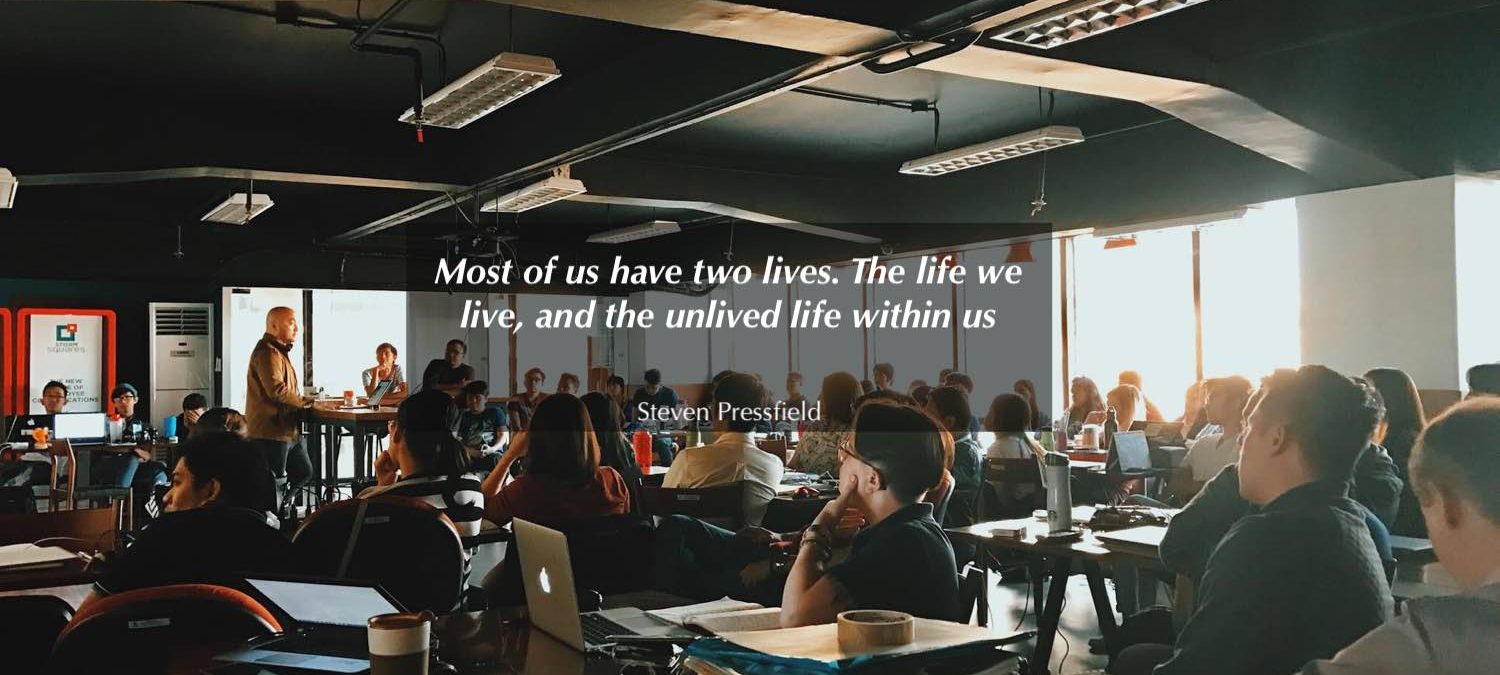
As soon as we try though, we find that something opposes us. Self doubt. Fear. Procrastination. Distraction. Analysis paralysis. In his two landmark books, War of Art and his follow-up, Do the Work, author Steven Pressfield calles it The Resistance. He explains:
…there is a malignant presence that exists to block you. It rises up against you to stop you from doing what you most need to do. This force is the Resistance.
And, as Pressfield puts it:
The more important a call or action is to our soul’s evolution, the more Resistance we will feel toward pursuing it.
Can you recall a time when a great opportunity or idea came your way, and you find yourself ON THE ROAD TO TOTALLY BLOWING IT?
I remember getting the idea for STORM way back in the early 2000’s, but it was only in 2005 that I actually got around to looking for partners and telling them about my idea. I KNEW it was a good idea, and I KNEW I needed partners to pull it off, but it still took me years of dilly-dallying before I put my intention into action. I would start thinking it might be embarrassing to tell my friends about it. That my idea might not be worth anything. Resistance.
Sometimes the task is so simple, like “send an email to this big potential client,” or “talk to this person about her performance” and yet I would find myself doing so many other things to put it off. Or sometimes I would tell myself to sleep earlier because I want to begin my day right by praying and going to the gym very early in the morning. Yet, I would find myself at nights reading unimportant stuff on the internet, watching TV, playing Skyrim, needlessly analyzing my fantasy basketball lineup, or even cleaning my room. And then waking up late.
Isn’t that crazy? When something is of crucial importance to you, there is really an inexplicable force which descends, sabotaging and paralyzing you. Resistance. Pressfield continues:
Resistance’s goal is not to wound or disable. Resistance aims to kill. Its target is the epicenter of our being: our genius, our soul, the unique and priceless gift we were put on earth to give and that no one else has but us. Resistance means business. When we fight it, we are in a war to the death.
For startup founders and would-be founders, this knowledge is absolutely crucial – because The Resistance has killed more startups than we can count. We read everywhere that the biggest stumbling block for startups isn’t financial, nor product related, nor strategy related. The biggest killer of startups is the failure to start. The biggest reason for this failure to start? The Resistance.
It doesn’t get any easier when you start, either. You will find the Resistance going at you full force. Complete freedom with time and effort makes the Resistance doubly dangerous for the startup founder as well. There is no supervisor, nor camera, nor company deadlines to tow you back in line.
It is your battle. And everything is at stake.
Amidst all the entrepreneurial and startup-related book I have read in recent years, Pressfield’s twin books have made such a remarkable impact on me. Just recognizing the existence of the Resistance, that there is such a thing – and it is what has been sabotaging my efforts – have made me more sensitive to the Resistance’s power in my life. As Pressfield writes, Resistance acts like a True North – when you feel it working, you already know where to go: the EXACT opposite of where it is trying to lead you.
Oh, I need to stop writing this blogpost to check on Facebook?
I continue writing this blogpost.
You’re saying I don’t need to call this client now because it might be a bad time to call her, just wait for tomorrow?
I call the client.
Just another 5 minutes of Skyrim, perhaps one more area to explore?
I close the console. (or more recently, I placed the dang thing where I can’t touch it)
Just do it.
This sort of thinking has actually led me to one of the most creative periods in my life. Ever so recently, I was wracked with doubt and fear and the Resistance about this blog, some of the startups we recently founded, or even doing Juan Great Meet. In all cases, I recognized the Resistance, harnessed my competitive nature and told myself “hindi ako magpapatalo.” (I will not be defeated)
(The interesting thing is, the more “practice” you have in resisting the Resistance, the better you get at doing it.)
Buckle up. Get ready. If you want to follow your dreams you’re going to have to fight for it.
The runway is a great metaphor often used by startups to describe the cash flow required to keep operations afloat.
Let me elaborate:
Cash is king for a startup: without it, a startup cannot exist. Burn rate is the rate we spend the money, with which we can then estimate how long we can go (the runway) until either one of three things happen: 1) lift-off (profitability), 2) crashing, or 3) refueling (raising more investment). Since startups are often fairly complex and difficult to operate, you can’t just expect to have a short runway before lift-off. You have to plan for it.
I’ve met too many startup founders who just proceed with jumping in without planning this in detail. The leap is a great one, but it has to be planned.
Hmmmm… I think the best way to describe this is by using a story. Let’s try to imagine then…
Our main character, Mario (28 and single), has been in the corporate setting for 10 years now. Mario works fulltime as a project manager for a big IT firm. He’s been planning to put up a tech startup for quite sometime now, and has been working on his startup idea part-time. His partner, uhm…Luigi (30, married with 2 kids), is a genius with Ruby on Rails. Mario and Luigi have been working on their startup concept “E-career Mo,” a new job portal concept, for 6 months now. Luigi has the beta version ready, but they have been dilly-dallying on when to actually launch, because to do so would mean someone would need to manage customer questions, someone would need to collect money, someone would need to gather feedback, etc…
Realizing Luigi would have difficulty going fulltime because of his family situation, Mario takes the challenge on and says: (to the tune of the Chariots of Fire theme) I WILL TAKE THE GREAT LEAP! FULLTIME IT IS!
Mario tells Luigi of the great news and they are both pleased. There and then, Mario and Luigi pledge 40K each as initial capitalization to E-career Mo. Soon, the startup is launched!
Mario and Luigi agree that Mario will be paid 30K per month. Luigi feels this is a bit too much, but then thinks about where Mario came from (Mario was paid P60K a month in his day job), and then considers that Mario is his friend, so he eventually agrees. They both think, “Our concept is great! It will surely take us less than 2 months to be profitable!”
So they start. The E-career Mo makes around P10,000 in the first month. Then P12,000 in the second month. Cash flow per month looks like this:
MONTH ONE
Initial Cash: P80,000
Total Expenses: P38,000 (30K – salaries, 8k – other expenses)
Revenues: P10,000
MONTH TWO
Initial Cash: P52,000
Total Expenses: P36,000 (30K – salaries, 6k – other expenses)
Revenues: P12,000
MONTH THREE
Initial Cash: P28,000
By the end of month two, Mario was so scared that he’d have nothing by next month’s end. He doesn’t even get to consider the modest increase in revenues from month 1 to month 2. Panicking, he quickly accepts a job at another IT firm. The E-career Mo portal goes on “We are working on the site” mode, alienates its first few customers, and dies a quick death.
Ok. So I’m sure you’re now enumerating how stupid Mario is and all the things he did wrong. You’d be surprised though at how many entrepreneurs take the leap this way – thinking about the startup and not thinking about himself. While the startup was planned, the LEAP was never planned from the onset. You have to plan for the leap. Carefully.
YOU, the founder, are the most important part of the startup. You have to plan and think about what happens to you. Remarkably, the founder sometimes forgets about his particular role as he gets too caught up in the excitement of building. Instead of building and then creating contingencies, create contingencies AS you build.
Let’s take a look at another way Mario and Luigi could have gone.
In the alternate universe, Earth X, Mario begins talking to Luigi about his startup idea, E-Career Mo. Luigi loves the idea and agrees to partner with Mario. Mario then brings up that they should be fiscally planning for the startup as well. Mario and Luigi agree that at some point, Mario needs to go fulltime. Luigi estimates he can finish a beta version in 6 months. Mario then computes carefully what the LEAST AMOUNT of salary he can survive on will be. (he calculates this at around 20K) Mario then agrees to save 30K per month for the next 6 months. Luigi pledges to save around 5K per month as well.
In addition, Mario also creates contingencies: if at the 5th month of his leap fulltime, the burn rate is still above 15K a month, then he will have to look for a fulltime job already. If the burn rate is below 15K a month, then he will try looking for weekend tutoring work to supplement his income.
After 6 months developing the beta, Mario takes the great leap and says, I WILL TAKE THE GREAT LEAP! FULLTIME IT IS!
The initial capital raised sums up to P210,000. Mario gives himself his planned 20K salary. In this alternate reality, the runway is a lot longer – and this makes all the difference. Mario can wait it out until he hits profitability. The months look like this:
MONTH ONE
Initial Cash: P210,000
Total Expenses: P28,000 (20K – salaries, 8k – other expenses)
Revenues: P10,000
MONTH TWO
Initial Cash: P192,000
Total Expenses: P26,000 (20K – salaries, 6k – other expenses)
Revenues: P12,000
MONTH THREE
Initial Cash: P178,000
Total Expenses: P25,000 (20K – salaries, 5K – other expenses)
Revenues: P17,000
MONTH FOUR
Initial Cash: P170,000
Total Expenses: P26,000 (20K salaries , 6K – other expenses)
Revenues: P21,000
MONTH FIVE
Initial Cash: P165,000
By the fourth month of operations, E-career Mo is making close enough to cover Mario’s salary and the unexpected costs. By the end of the year, E-career Mo creates enough revenue that it hires Luigi and 2 other employees to support operations. Startup success!!!
I know the story is simplistic and leaves out a lot of detail. There are some key lessons we can learn from the two Marios though:
1) Sacrifice
Mario took a hit and sacrificed P30,000 a month as investment money for 6 months. You can bet he tightened his belt and made lifestyle sacrifices. If you realize you are too attached to your lifestyle that you cannot sacrifice your attachments and luxuries so you can aid your startup, then this might not really be the path for you. Entrepreneurial startup founders treat their firm like their babies – they will do anything to make it succeed.
2) Account for surprise expenses
If you notice, one thing Mario 1 failed to do was account for the miscellaneous “other” expenses. From printer ink, to furniture, daily messenger rental fees, to legal notarization, these add up pretty fast. In your calculations, create a buffer precisely because you WILL spend more than you think you will.
3) Create contingencies triggered by specific fiscal milestones
This is a biggie. Mario 2 created specific contingency plans – looking fulltime or part-time work if the burn rate was below or above 15K. This contingencies help you not only mitigate, but understand the risks better.
Renowned entrepreneur and investor Paul Graham describes this in his blog as:
Ramen profitable means a startup makes just enough to pay the founders’ living expenses. This is a different form of profitability than startups have traditionally aimed for. Traditional profitability means a big bet is finally paying off, whereas the main importance of ramen profitability is that it buys you time.
It buys you time. It makes your runway longer. Not only that, but it gives you enough confidence to finally say, “Hey, I don’t need some corporation to live my life!” I remember feeling this way. It was confidence-boosting, empowering, and inspiring – feelings you absolutely need to carry on.
5) Do It Yourself
I know it’s tempting to outsource services such as payroll, accounting, recruitment, etc…, especially if you think these are “non-strategic.” But for the sake of lengthening the runway, it makes a whole lot of sense to do it yourself first, or perhaps you can pursue “X-deals” with providers.
6) Watch Your Hiring Costs
If you absolutely have to hire, consider the Runway. Perhaps you could reward using equity, or a higher future salary. Startups cannot afford to get mercenaries – you need people who are in it for future benefits, not immediate ones. It is easier to explain to this type of person that you could give him much higher pay in a year – but now, you sort of need to lowball him to give the firm a healthier chance. If you hired the right person, he will understand.
Primed for lift-off? Make the runway a serious project.
(Like the content of Juan Great Leap? Subscribe now and never miss a post!)
Definition: money available at the present time is worth more than the same amount in the future.
So, simply put, we’d rather have money now than the same value in the future. The same thing holds true for action. Let me posit an integrated theory then:
The Time Value of Action:
Definition: action done NOW is worth more than the same action done in the future.
This blog is a testament to this sort of thinking. The original idea for this blog was that I had wanted to make a book chronicling and documenting the various things I was learning while running a startup. That thought started in the middle of 2011. I had created a table of contents already. I knew it would take a significant amount of time for me to finish the entire endeavor, as I had to go at it chapter by chapter. I was thinking I’d be done by 2013 with the pace I was doing.
Then I stopped and thought, why not do the same idea, but through a blog? This way, I could publish the chapters as I was writing them. So with a small investment, I put up this blog by late November of 2011 – and it has been such a huge blessing and gift for me. If I had waited for myself to finish all the chapters of my intended book, it probably would not have launched at all!
There is great value is action done now. The more time you allot to make a decision, the less the impact is.
Is there a decision you are deferring and deferring? Stop and just choose an option. Chances are, your decision to do it NOW makes it a better decision REGARDLESS of the option chosen.
A good plan, violently executed now, is better than a perfect plan next week. – General George S. Patton
(Is there someone whom you think would greatly benefit from the content of Juan Great Leap? Bless someone by sharing now!)
We were around 40 people packed in the Chelsea Room of Astoria. I started out with profusely thanking everyone who came.
I gave a short talk entitled, “The 5 EPIC fails which almost did us in,” which detailed the 5 worst mistakes we’ve ever done in our startup – these were also pretty much the 5 biggest lessons we had to learn.
Incidentally, the five were the following:
1) Bad hiring
2) Failing to listen to customers
3) Failing to think big
4) Saying yes to everything
5) Failing to plan for our own obsolescence
Here’s a short excerpt regarding hiring:
After some Q&A with me, we proceeded to the highlight of the night!
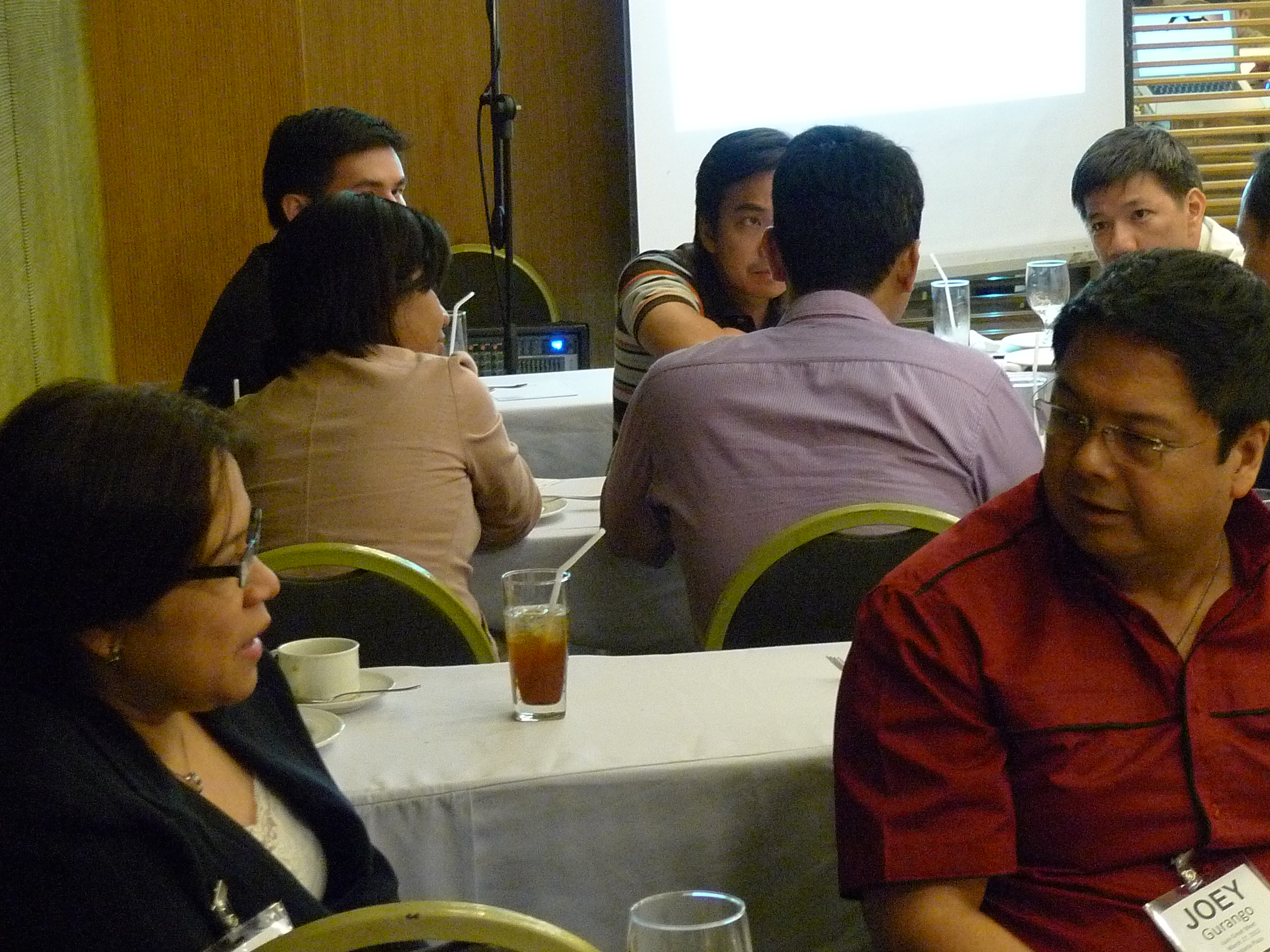
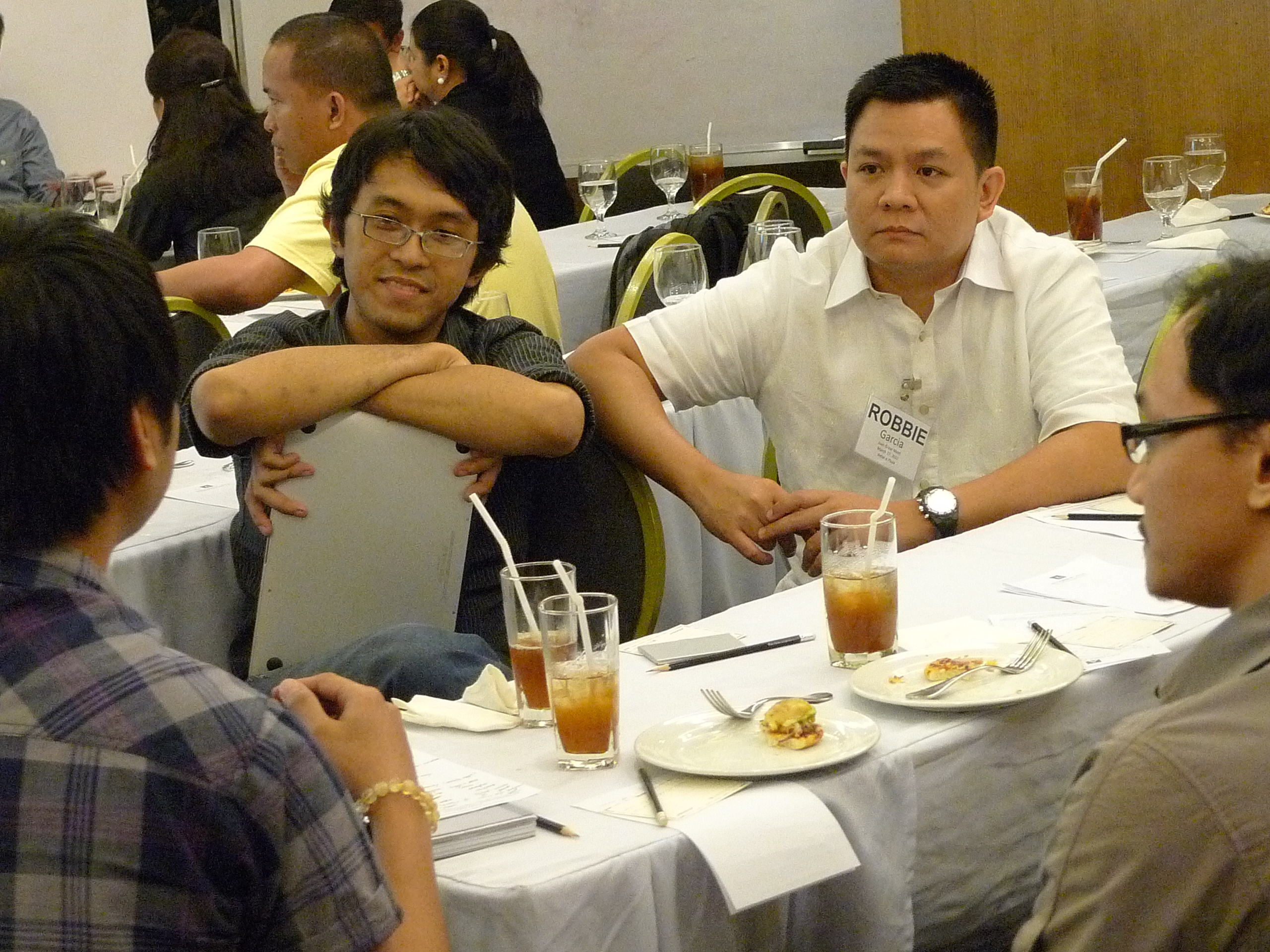
The group was divided into 6 subgroups. Each person had to answer the 2 questions: 1) What is the biggest challenge you are facing in your startup process, and either 2a) What help do you need? or 2b) What’s the best advice you could give?
Since a third of the group already were doing their startups and around two-thirds of the group were in the process or didn’t know where or how to start – the conversations which ensued were scintillating. Interestingly, the random groupings somehow turned out to be the best configuration possible – the right people met with the right people.
The room just had an unbelievable vibe and energy – people were talking excitedly about their plans, their startups, and advice. More importantly, people were doing resolutions: to start something, to help one another, to help push the cause further. So many exciting plans were laid out.
In the end, I had to kick people out of the room because we went way way beyond the allowed venue hours! That didn’t stop people from conversing along the corridors, however 🙂
Was going to do my event update post tomorrow, but I couldn’t help post something right now. Amazing night! Thank you so much everyone for your passion, your energy, and your time!
I was so inspired by everyone’s stories and learned so much!
Two people just backed out due to sudden schedule conflicts. We now have two slots open. If you are interested in going, please send me an email at pcauton@yahoo.com before 12:00 noon tomorrow. Do send it in ASAP so I can reserve your slot.
Event’s on at 7:00 pm tomorrow at the Chelsea Room, Astoria Plaza.
I had always believed and said to people that God was at the center of my life.
Only, I realize now that for most of my adult life, that was mostly just lip-service.
Yes, I would go to Mass every Sunday, quickly pray before sleeping (especially when I needed something), and always tried to do the right thing. Me and God were “good,” I thought.
In the meantime, the decisions I made in my life never involved Him. I would go from job to job never thinking about what God would want from me. I formed relationships in my life with nary a thought on faith. I had always been fiercely independent, leaving my parents’ house to forge my own path as soon as I could’ve. This would partly explain why decision after decision would involve only what I alone felt and thought. I would buy what I want, spend my time doing what I wanted, did what I want. It wasn’t really God who was at the center of my life, eh?
Not that I thought there was anything wrong with how I was doing things. This was no prodigal son story, right? I mean, I wasn’t really doing anything inherently wrong. But when I think of it, I ended up straying from the right path anyway. I was so intent on following my own way I just went around in circles. I conquered my corporate professional dreams, but felt empty. Left to my own devices, I found myself alone, frustrated, and confused. No, I wasn’t leading a ruinous life. I was, however, leading a mediocre one.
In some ways, I think this can even be more dangerous because mediocrity tends to subtly creep up on you. I can see how some people would only realize one’s presence in the mediocrity mire after decades have gone by – but you can even chalk up this late realization as a blessing. Some people never get it.
I guess life phase-triggered crises occur when we realize that the decisions we have made has resulted in a life that’s missing something, and existential desperation sets in. You can call it a search for meaning, or purpose, or pagmemeron, orsaysay, or happiness, or joy, or peace, or even searching for yourself.
All along though, I realized I was searching for God. My infinite hole could only be filled by something, someone infinite.
It was only a few years ago that I truly, fully realized this. It was when my heart caught up with my head. So I resolved not to waste any more time. (why do we waste so much time?)
I had always heard holy people on TV say repetitively “Do you have a personal relationship with God?!” It was only recently that I truly understood this.
If I talked all the time with my close friends, got to know them better, and read their updates, I figured I would do the same thing with God. I endeavored to talk to God everyday during prayer, get to know Him more, and read His teachings.
I endeavored to make Him the center of my life. As in REALLY make Him the center of everything in my life.
This of course, includes career choices.
At first I thought, huh? Really? Careers and God don’t seem to mix. I had never encountered God in the corporations I had been in, save perhaps for the obligatory prayer said before Christmas parties. No one has ever told me to “pray,” when I asked for career advice.
But aren’t “careers” so inextricably linked to WHY GOD PUT US HERE ON EARTH?
God uniquely made each of us, endowed us with a specific set of gifts, for a purpose. And you know what? I bet that if you just find that purpose, more than anything, it would make you incredibly happy. So I prayed to God fervently to lead me to that purpose.
My big mouth.
One day, I found myself in a very difficult career decision point (detailed here) that put everything that I had resolved to do for Him against everything I held dear. It was one of the two most difficult decisions I’ve ever had to do.
In my gut, I knew it was a seminal moment. The decision I made here will determine how the rest of my life would unravel. To the world, it was a blatantly clear decision. To my God, it was a clear decision as well: Take the leap. I will take care of you.
It took guts which I didn’t have, but I took the leap no other career advisor would have recommended.
It was difficult going through that process, but God showed me a career path I never would have thought of in a million years – building startups. And oh boy, I can’t tell you how wonderful the fit is between what I do and who I am. In finding God, I had found myself.
Another interesting side effect is that my life was suddenly integrated. You see, before I would live a life divided into silos. I had my life at work, my family life, my love life, my life with my friends, and so forth. I noticed I was a different person in each silo. So during the times when worlds collided, I would feel very uncomfortable at the risk of being “discovered.” I don’t know if this makes sense to you. I didn’t do anything wrong, but I was projecting a different self, probably because I was trying to live in accordance to what each “world” expected of me. This has all changed. I am now one person. I feel integrated, complete. And the necessary foundation for this was and is, God.
A couple of weeks back, I posted this on a particular online forum. I was told by a reader that he had trouble believing how faith can determine the success and failure of a business endeavor. Friends, my whole happiness with where I am career-wise is a result of my faith and nothing else. The whole “business endeavor” would not even have existed if God had not intervened.
Not only can faith and work mix, but I would posit that NOT doing so would lead to something incomplete. The easiest, most direct way to find yourself is through God.
Of course, you can always do something part-time for God, like build houses, or help street kids, and stuff. This is all good, right? Think about that phrase though: part-time for God.
Hey God, you are my everything! I would give PART of my time to you!
Why not the alternative? I mean, you don’t necessarily have to be a priest or something, right? Why not be a full-time politician for God? An full-time entrepreneur for God? A full-time lawyer for God? A full-time website designer for God? The important thing is you follow that voice which calls within. Then you can still build houses and minister to street children in your spare time.
So, how exactly do you know what God wills for you? Three quick suggestions: One, it would help if you TALK to Him for starters, right?! Take a designated 30 minutes (say, 6:00am-6:30am) of your morning to pray. Everyday. Can’t overemphasize this. Second, search within yourself for your DEEPEST desires. I can guarantee it isn’t money. Our deepest, most intimate desires were put there by God. He sometimes can talk to us through our desires. Third, notice what sort of work you do makes time speed up remarkably fast. Notice what work you do brings you complete joy that you can do it for free, that you would PAY someone for you to do it. What did God put in your DNA?
Be warned though, that oftentimes in your journey, you will find that there will be a conflict arising between what God wants and what can bring in money.
So is following God truly strategic then?
It will depend on what you determine to be your ultimate end goal is.














 JUAN GREAT LEAP