(This is the 5th post in the series 6 Steps to Startup Launch. You can find the introductory post here, and the previous post here.)
After getting feedback from your customers about your MVP, it’s a simple matter of following the feedback, right? Of course, there is always more than meet the eye (ugh). Let’s go through some product iteration guidelines!
1) Don’t just blindly follow the feedback, reflect
You need to take a step back, reflect carefully about the feedback, and determine how you want to use it in changing your MVP.
No, there isn’t a formula as to how this can be done. It all depends on your particular product, market, and feedback results. This is why it’s always a good idea to have domain experts on your founding team – it would be the perfect time to ask them what they think of the customer reaction.
Actually, the challenge here sometimes is finding the time to reflect, as startups often prove to be hectic creatures, where the entrepreneur manages everything.
Force yourself to take that step back.
2) The more, the merrier
So when you collect the data and manage to iterate your product accordingly, isn’t it time to launch?
Well you’re in better state than you were pre-iteration. Still, you mitigate even more risk if you gather more customer feedback about your newly minted MVP 2.0 and do even more cycles.
Lean Startup author Eric Ries says that “Startups that succeed are those that manage to iterate enough times before running out of resources.”
Iterate then as many times as you can, as often as your time and resources will allow you.
3) Be conscious about time
During the iteration process, be very conscious of the time. Knowing that you are burning through resources as you are iterating, there needs to be a conscious effort to iterate and transform things as fast as possible. As a prime mover in your startup, you have to be extra conscious on developing a culture of speed in your workplace. Work hard, work fast.
4) Delay everything which doesn’t validate your product vision
Remember that at this point in the process, the purpose of the iteration is to validate assumptions, not to create the most complete product ever. Consequently, you should focus less on feedback about complementary add-ons – and instead focus more on feedback which talks about your core product assumptions.
Customer wanting delivery services? Ignore first.
Customer who wants to use your product on his I-phone (your MVP is on Android)? Ignore first. (When Google Chrome was first released, it had no Mac compatibility)
5) Don’t forget about price iteration
The price is part of your product. This part of the business can be extremely tricky, and you do not want to flip-flop on your pricing post-launch. Remember to evaluate your pricing model carefully as part of the iterative process.
(This is the 4th post in the series 6 Steps to Startup Launch. You can find the introductory post here, and the previous post here.)
There are some entrepreneurs who feel they can totally shun the customer research process and instead feel they can rely purely on their product instinct. Then they quote Steve Jobs, who famously said that “Customers don’t know what they want until they see it.”
The Apple G4-Cube looked nice, but bombed.
Well for one, chances are, you are not Steve Jobs. Two, Steve did do a ton of product research: Apple 3, The Lisa, and his Next Computer, even the Apple G4 Cube computer (done after he returned to Apple) were complete, utter failures in the market. I’m willing to bet he learned a TON of things about the market from these failures which he applied in building the successes he forged his legacy on. He used huge failures to hone his product instinct. Three, using the MVP (minimum viable product) process does indeed SHOW the customer the product, as opposed to pure focus groups, which was what Steve was pertaining to in this quote.
So, unless you are willing to gather data by actually spending millions to launch a product which hasn’t gone through customer feedback, let’s continue with STEP 4: Gathering Customer Data (on your MVP), shall we?
Let’s tackle some key insights:
1) Bring your MVP to Innovators and Early Adopters
Geoffrey Moore’s 1991 book, Crossing the Chasm, has served as the marketing bible for tech startups from the time of its publishing until now. While he meant for it to be a guide for tech startups, I find that its concepts pretty much hold true for any startup with a truly innovative product (which is a bit redundant considering our description of a startup here).
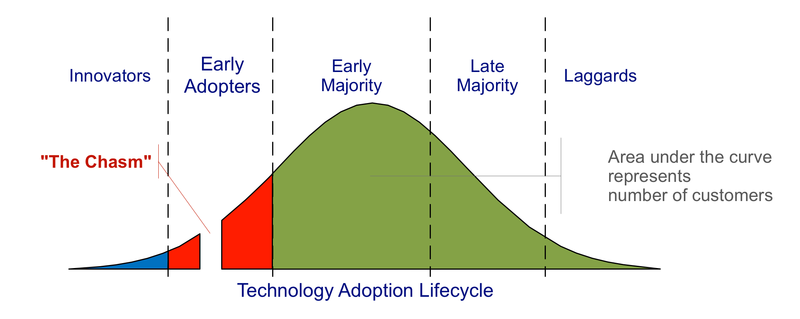
What is critical is the customer adoption life-cycle Moore introduces and is shown below (thanks Wikipedia for the chart):
From left to right, this illustration reveals the 5 categories of customers you will encounter when you build an innovative product or service. Moore recommends that marketers should focus on one category first before moving on to the next. This is an exciting topic I will cover in more detail in another post, in the meantime, let me ask you to focus your attention on the leftmost side of the curve – the innovators and the early adopters.
These guys are the enthusiasts who will be excited about your new product because they believe in the potential of your new product. These are the people who are willing to look beyond the imperfections your new product WILL have because they see its promise.
Is your product a cutting edge web tool? Bring it to the über tech geeks to play around with. Is it a health product? Bring it to über health fanatics who will try anything in the name of fitness. Got an innovative marketing service? Bring it to an innovative marketing director who is known to try new things. For STORM, our early adopters were (surprising for us) medium-sized local firms who could make decisions fast and wanted to have an HR edge over their international counterparts.
Why bring it to them? Because they care, and will be more than willing to render their feedback, and most importantly, their time. Chances are, you will be ignored if you bring your product to customers in the other categories
So how do you find these people? Be an entrepreneur – research, be creative, and just do it. They ARE out there.
2. Gathering the data
If it’s a product, show them your MVP and then do one thing: shut up.
Resist the urge to render any input as this may affect the person’s experience. Just observe how the customer uses your product. For web services, for example, the suggestion is to just observe them while they go onto your site. As in be in the room with them as they visit your site for the first time. And then shut up. Observe: how do they navigate your site? What don’t they understand?
For services, it gets to be more tricky, as the MVP is likely to be invisible. You CAN still make them go through the service process by giving large discounts or incentives. One reader said his new service firm was going to do pro-bono consulting work just to get early feedback. That works!
After the customer experiences the MVP, then ask the simplest questions: what did you like? what did you not like? how could the experience be improved?
By this time, I am almost 100% sure you would already be realizing that some of your initial assumptions were wrong.
3) The Importance of Humility
In essence, you will have customers tell you that part or the entirety of your idea sucks.
If you are human, then this has to feel at least a tiny bit hurtful because it was YOUR idea and you devoted time and energy building your MVP.
Resist the urge which says:
“This guy doesn’t know what he’s talking about.”
or
“This guy is an outlier.”
or
“This guy probably hates me and is jealous.”
Listen to the feedback. Listen to the feedback.
Then be brutally honest with yourself and your team. Accept that some parts of your idea (or maybe even your entire idea) may actually suck.
Now, iterate!
(Know anyone whom you think just NEEDS to hear the content of Juangreatleap? Be a blessing and share NOW!)
(This is the 4th post in the series 6 Steps to Startup Launch. You can find the introductory post here, and the previous post here.)
So you have your idea and you have your team. Now all that’s left is to start, right?
To your credit, a lot of you will say, “not yet,” because you know that a blind leap is risky. You know that those who purely rely on gut and instinct are either foolhardy or have oodles of money to spare.
“Look, before you leap.”
And so lot of us startup founders find ourselves looking first. We do a lot of “market research” and get info about market share the competitor’s 5-P’s, and the like. Some of us even do surveys which asks questions like:
“Our product is _______. It’s great because unlike what’s in the market, it’s _______. Will you buy this product? Y or N?”
For most of us, a large number of people saying “Y” is enough to say, “Let’s invest a huge chunk and get this baby going!”
However, there is a huge gulf which exists between this sort of survey result and the actual reality of customers opening up their wallets. It’s presumptuous to assume that just because one million customers are currently using ABC product with this feature set, they will immediately jump to your product because you think you have better features. They might say they will buy your product in your survey, but how they WILL act might be different.
Look, going to the customer for input is exactly the right thing to do. There is way to do it much better though – don’t give them a survey which asks them to IMAGINE the product. Give them an ACTUAL product to try out.
THIS is the minimum viable product – your MVP.
The MVP was popularized by Eric Ries in his book, the Lean Startup, which focuses on software products. (buy it NOW) There is no reason though to limit the concepts to just IT. You can apply the MVP to any product or industry.
The idea is to think of the MOST BASIC features your product should have. This can prove to be tricky because we live in a features-heavy culture and the temptation is to cram our product with features. Resist this.
List the most basic features of your product/service. Got it? Now cut these features in half. With your new list, try to create your MVP. Why limit your features? Because every feature is an assumption you have to prove. Rather than go to the customer with 30 assumptions, just go with five essential ones and listen for the customer to tell you what features he or she wants.
Ideally, you can come up with a “bare bones” version of your product. For example, if you want to build sales tracking software, perhaps you can do a bare, working version of the system. Selling a new type of sandal? Create the prototype. For StreamEngine, our MVP’s are the videos you can see on the website.
Do remember that the MVP isn’t necessarily a minimum product, though. For some cases, it will be impossible to do an actual prototype without actually spending. In this instance, you have to get creative.
One of my favorite startups, Dropbox, faced this when they launched a couple of years ago. They didn’t have the resources to create the actual online service yet. So what did they do? They created a video. It wasn’t the actual product, it was a demo which used mock-ups. The video worked though. It increased their beta waitlist from 5000 to 75000. More importantly, it validated an assumption. Contrary to what people were saying (you have a million other cloud-storage services around), people were willing to buy their product. Be sure to read this Techcrunch post on how they did it.
Validate your assumptions. I can’t stress this enough. Your MVP should help you do this.
Remember, to mitigate risk, it’s best to do this step BEFORE you launch, BEFORE you commit to anything significant, like money, or quitting your day job.
Once you have your MVP ready, it’s time to bring it to your customer.
So how exactly to you do that? Isn’t it a misnomer to have customers at this point? What will you ask them?
All this and more in the next post!
(Know anyone whom you think just NEEDS to hear the content of Juangreatleap? Be a blessing and share NOW!)
(This post is part of the 6-Steps to Startup Launch Series. Introductory post is here. Step 1 is here.)
Very first question: do you really need co-founders?
Short answer is: no you don’t. You can own 100% of the equity. If you need people, you can instead hire them. One of the entrepreneur/VC’s I follow, Mark Suster, recommends starting this way. I’ve also encountered entrepreneurs here in the Philippines who absolutely will not relinquish any equity under any circumstance. One of the startups I founded, Searchlight, was a deliberate attempt go through startup process by myself, in a grand experiment of sorts.
So do I recommend going at it alone?
Nope.
Why?
One key reason is that startups often become quite multi-faceted – almost immediately, it will require skills from you which are simply not strengths.
You then will need other people who complement you. (complEment, not compliment, just making sure ) The reason STORM works is because Pao and I complement each other very well.
I provide the HR domain expertise, Pao makes IT systems. STORM creates HR-IT systems.
I talk about going for ideas all the time, Pao is the voice of reason.
I sell. Pao makes.
I am all over the place. Pao focuses.
And so whole we ended up creating gets to be much greater than the sum of our parts. By myself, I can never do the things we do in STORM. This is why you should never get clones of yourself. A strong, complementary founding team can move mountains.
Note: You do have to be the same with regards to values though. As different as we are on skill sets, Pao and I are so aligned when it comes to principles. We both agree in treating employees as partners, we are both God-driven people, we are both very family-oriented. Because of this, it becomes easier to create a more aligned, powerful workforce culture.
Yet another reason for not going at alone is simply that it just isn’t as much fun.
I don’t know about you, but I love working with great people – solving problems, arguing, discussing, creating. I love that I am a part of great teams. This is where going at it alone can be bummer. When I started Searchlight, I immediately felt this. Yes, it was a thrill of sorts to be completely accountable for everything – but it was weird to just think things by myself when I had to solve a problem or strategize. This is why I’m rethinking the Searchlight experience to possibly bring in more partners. (anyone out there who’s interested in the executive search business? 🙂
Oh, and employees you hire can never fully share the startup experience with you. You will end up looking at stuff from different perspectives. It’s different when someone co-OWNS it with you.
If you’re somewhat a super-Swiss Army knife mega entrepreneur who’s also a bit of a loner – then yes, you can pretty much put up a startup by your lonesome, it might even be faster.
But for the rest of us? Bring in co-founders!
Let’s now tackle some fundamental questions about co-founders.
1) How many?
The quick answer is that it depends. One of the things I do is I break up a business opportunity into its key areas, then I try to look for people who would fill those key roles.
STORM is pretty much a combination of HR and IT. There were early iterations, but this quickly settled into me and Pao.
When I was trying to find that founding team to do a UI/UX consulting firm, I figured we needed to have a user-experience person, a design person, then I figured I can do the selling. I experimented with a few iterations with this one.
I suggest you bring in as few co-founders as is necessary though, as too many heads can quickly become counter-productive. The trick then becomes finding people who can fill in multiple roles. If you identify 6 roles, try finding them in just 1-2 more people – don’t bring in 6 founders.
Easy? Of course not.
From experience, I’d say 2-3 co-founders in a firm is ideal – decisions are much faster, there is less lost in the translation, increased accountability, and the best ideas win out.
2) Does doing it with friends benefit?
One thing I’ve had to learn in my years in HR was to properly assess friends when they applied in the firms I worked in. I had to push my biases aside and be very objective.
This is even MORE crucial in startups. I’m sure all of you have heard of friends fighting in their joint business exploits. This almost always boils down to one reason: one friend didn’t live up to expectations.
Remember those crazy things you did in high school? Isn’t it just so easy to put something up with friends? It’s exciting, there’s no feel-out process, and of course, you feel that you can trust friends easily, and therefore jump into things more easily.
This isn’t about high school escapades though. It’s war. In war, you want the most qualified generals.
If your friend is the best qualified person out there, and if she complements your own skill set, then go on right ahead.
Those IF’s are just huge though. Evaluate objectively.
3) Is a pre-nup possible?
Where rich ex-wives happen.
If there’s one more thing Kobe Bryant and Michael Jordan have in common, is that they both failed to do a pre-nuptial agreement – so both lost (Kobe just about to) half of their huge fortunes because of their respective divorces.
Is there any way to do a prenup in startups? This would seem so practical.
Fortunately, the answer is yes. This is called vesting, and it should be something all startup founders should agree to.
Vesting involves not getting your stock immediately, instead, it is distributed or “vests” over a period of time. A classic model is a 3-4 year vesting period with a 1-year “cliff”.
Three years means that you will have 100% of your stock after 3 years. Vesting is usually linear: 25% vested after 1 year, 50% after two, 100% after three, etc.
The “1 year cliff” means that you don’t vest anything the first year, but you get 25% on your one-year anniversary.
The idea behind this is to prevent rewarding partners who just disappear or cease contributing. This is a great insurance policy.
Friends, finding the right co-partners(s) is the MOST important aspect of startup life. You may find out your idea may suck, or that your strategy isn’t working – all these things can be overcome by a strong team. When it’s the team that’s the problem that it gets to be debilitating. It’s very very difficult, to recover from drafting a non-functioning co-founder – someone you cannot so easily get rid off. The effect on your company can be incalculable.
The best way to solve this problem? Avoid it entirely.
Pick a few people. Evaluate ruthlessly. Vest.
(Take a leap and join the movement! Subscribe to the email newsletter to join the forum!)
This is the 2nd of a series of 7 posts about the steps to launching a product. You can find the introductory post here. Step 2 is here.
So you want to launch a startup.
First thing to do is to pick out an idea. Its sounds simple, but I do know that for a lot of us, this can be pretty challenging – its either we have too many ideas or none at all. The secret is to choose to commit. If you have too many ideas, and its already bogging you down, force yourself to commit to a few ideas and eliminate those you feel lukewarm about. For those who feel “none of my ideas are exciting,” I find that this is usually a confidence thing. You have to take a deep breathe, box out all the negative thoughts from your head, and choose. I don’t think you would be reading this blog if you didn’t have some ideas in mind.
The 3 circles exercise, detailed here, can be quite useful in helping you finalize a pool of ideas you can seriously consider. Remember, it is extremely important that you select a field which 1) you are passionate about, 2) which people will pay you for, and 3) something which you are genetically great at. Using the 3 circles, you might end up with something like this:
“great web design”
or
“baking marvelous cookies”
or
“finance auditing”
These are actually still pretty broad categories to consider building a startup around.
So focus on researching on your field of choice, with the intention of narrowing down your idea further. Why do you need to narrow down your idea?
Let’s say you are an artist who wants to start a web design firm. Go research. You’d find out that there are different subgroups and services categorize under web design, such as html programming, flash design, logo design, CMS set-up, site optimization, social media design and management, “clean” site engineering, etc…. They also service different markets: corporate, the government, small businesses, individuals, etc…
Understand all of this. Research. Use these services yourself. It’s important to understand the entire industry. It is only when you understand things – and the gaps between things – that you can truly innovate. It’s tough to innovate with the wrong assumptions.
Then, niche.
Unless you are a gazillionaire, it would be difficult for you to just go after the broad market and take on every single one of these services. Since you have limited resources, the wise thing to do is to divide and conquer. You have to go after a more specific subgroup. Besides, its way easier creating a name for yourself as the best in _______, rather than a generic supplier. The more focused you are, the more likely you can create something worth noticing. You have to niche and niche some more.
This was the process when we were cooking up Streamengine. We could have gone broad and created a “one-stop shop” of web services. But this was expensive, and not so strategic. So we focused on videos, then we focused some more and decided to do online videos, and then focused some more on motion graphics videos. This is what we want to be best in – online motion graphic videos for businesses. I think this is a much better strategy than targeting everything.
Whats important to remember is to get out into the world when you do your research. It’s tough to “just rely on your gut” that there is a huge market. Talk to people. Talk to veterans in the industry.
If, after your research, you realize that your idea of choice wasn’t as hot as you’d thought, then congratulations, you can cross it out of your list and move on to the next idea in your pool.
Remember that ideas are cheap, so don’t spend more time than is necessary in this step. Step 2 (co-founders) is far more important than this step. That’s up next!
(Know someone who might appreciate the content of Juangreatleap? Be a blessing, don’t hesitate to share now with just a few clicks!)
This 6-step process is heavily influenced by my own experiences, and 2 canonical entrepreneurial books: Steve Blank’s 4-Steps to the Epiphany, and Eric Ries’s Lean Startup. Both obvious recommendations.
Again, please note the differentiation here between a startup and a small business.
Here we go.
For a lot of us beginners, our idea of a startup goes like this: we have an idea, we build a product, market it, and then wait and see if it sinks or swims. So essentially, we take a guess and see if it works. This process IS risky, because if you invest a lot of money in the product development and the marketing, and it fails, that’s it – you’ve lost. In a way, it is also egotistical, because you THINK you know what the market wants, and go to market with it. This was actually how we started, and I wouldn’t recommend it.
There is a large difference between: “Oh, if we only get 5% of the market, that’s a million customers.” and that million people ACTUALLY opening their wallets to buy your products. You have to explore that gap.
You can largely mitigate the risk by testing out your idea with actual customers and iterating accordingly.
Here are the steps. I will cover each of them in detail over the course of the next 6 posts. Links will appear below as the posts are published.
When we think of launching a startup, its mostly about art. Steps 1, 2, 3, and 6 are all about art: the art of picking a business opportunity (step 1), the art of selecting your founders (step 2), the art of actually creating a working product (step 3), and the art of selling a product (step 6).
Steps 4 & 5 basically incorporates the scientific method into the process. Your MVP becomes your hypothesis, and you basically test it out during step 4. Using what you will learn, you now iterate – and calibrate your MVP. Then test it out again.
You create something of value to people. Once value is recognized, money is exchanged. That’s it.
This is my problem with the endless get-rich-quick schemes of the world: they make you focus your eyes on the money first.
Think Rich. Millionaire’s club. Financial freedom. ALL focused on the cash. Or lack of it.
So HOW exactly do you make it?
I remember being entranced by the “think rich pinoy” movement. It basically tells you to get passive income through real estate rentals.
I convinced my family to devote a large amount to buying 2 condo units, that we could rent out at a profit. Worked for the first year, then the tenants left. Then Anne Curtis went out selling condo units in a new nearby SM condo. Moreover, it turned out this wasn’t “passive” at all. We needed to maintain the unit. We needed to aggressively market the unit. We needed to monitor tenants. Oh, and one more thing – I am not really into real estate. I have ZERO passion for it. So what now?
So, coupled with my dwindling lack of passion for my corporate day job, I had ANOTHER job I had no passion for. The units are available as we speak. (call me if you are interested, seriously – they’re near SM North Edsa, very strategic)
Why was I suckered into this? Because the lure of money is strong. My focus was directed on making money above all else.
You see a lot of “entrepreneurial” gimmicks advertise this way. People showing off their Lamborghini’s (cringe), or people talking about how they made their first million in a month selling to their downlines and just passively reaping in the rewards.
Wrong. Wrong. Wrong.
The focus should be on creating value. When value is created, the money will come after.
When it boils down to it, what is value? Value is simply helping people. All the companies in the world are about helping people. The moment they focus on making money rather than helping people, value is lessened and ultimately the company suffers (eg. Enron).
Sure, financial literacy is very important, but if the focus becomes merely stockpiling assets for a profit as opposed to focusing on how the assets will actually help people – then it’s easy to miss the point.
And what is it with this whole “passive” bit? This just irks the hell out of me. What is the value being communicated here? That work is something to be avoided? That the trick to life is to find ways to reap the fruits without working? Isn’t there something wrong here?
One thing I’ve learned: work is an integral part of who we are. Look at the most successful people on earth. They love what they do. Look at them carefully – it’s not about the money. It’s love of the game.
One of the more entertaining entrepreneur books I read last year was “Anything You Want,” by Derek Sivers. In the book, Sivers talks about how he founded CD Baby. He talks about how he just wanted to help struggling musicians solve a problem. He shunned the big contracts with big record labels. Said no to them. He just kept at helping artists while keeping his vision pure. How does this story end? He ends up selling his firm for 22 million dollars, and then giving most of it to charity.
So forget about the money momentarily first. Focus on helping people. Focus on solving a particular problem. Relentlessly. If you do that, believe me, the money will come. Think about all the great startups that were developed over the course of the last few years. Now think about the problems they solved for you.
I remember being so anti-Apple early on, listing down the things Macs couldn’t do. Then my friend Elmer convinced me to purchase an I-pad. Changed my life. I never went to National Bookstore again, as I was introduced to the world of e-books. And Amazon’s Kindle on I-pad. I could pre-order a book and get it the very day it got released. Then I also noticed I wasn’t watching a lot of TV anymore, but instead found myself consuming videos on the tablet in bed. No more awkward surfing-with-the-laptop-on-my-chest while in bed as well. Now I’m a fanboy, and they’ve got me for life. Why? Tremendous value.
The startups I’m involved with try to focus on helping out as well: STORM focuses on helping companies solve the problem of rewarding employees better. Newly formed Streamengine seeks to help solve the problem of explaining processes better (through video instead of text). Newly formed Cloudexterity will help startups solve the problem of finding a trustworthy source to develop apps.
Its simple really. You want to make money? Establish a business model which helps people. Solve problems. Want to make the ride sustainable and meaningful? Choose to work on something you are passionate about.
How will your startup help people? What problem out there will you solve? Focus on these relentlessly and THEN the money will come.
(Join the Juangreatleap movement and learn more about startups! Subscribe to the blog now to get the newsletter and join the forum)
A long time ago, I read the bestselling book by Jim Collins, a book which a lot of you are probably familiar with, Good to Great.
I have forgotten everything about the book except his 3 circles framework. Jim illustrates that for good companies to become great, they have to exist in the “sweet spot” of 3 overlapping circles. While the book was really made for large corporations, and used data mainly from large corporations, I realized how applicable the “3-circle” framework is for startups. I use this framework extensively in startup product development.
My simplified version of the framework looks like this:
So let’s say you’re deliberating on what startup idea you’d like to pursue, and you have a few ideas you’re evaluating. This framework then becomes extremely useful. Each of the elements are crucial.
Some scenarios:
1) You have an idea you are passionate about, and can do it brilliantly, but people probably won’t pay you to do it.
Then this is simply a hobby, not a business. I could be the very best in the world in naming every G.I. Joe character who ever existed and recite their complete profiles, but the likelihood of me getting compensated for this skill might not be so hot.
Here’s the interesting thing here though: because of the internet, you can now easily find people with similar passions as you have. If you can build a related skill-set to world-class levels – the internet makes it so much easier to find a market. So say you’re the world’s best in restoring action figures, there’s a better chance of finding a market now than there was pre-internet.
2) You can pursue something you are passionate about and people will pay you to do, but you aren’t so good at it.
Then at some point your startup will fail, because consumers don’t like settling. This is still a pretty good spot to be in though, because your objective becomes clear – you have to build competence.
3) You can also choose to work on something which you are really good at, and people will pay you for it.
If you leave your corporate job and form your startup under these circumstances, then this is really jumping from the fire into the frying pan. This is really the corporate assembly line all over again. It’s actually a bit worse, because it will be harder to extricate yourself from the situation. So while this is tempting, it’s a recipe for frustration and zombification. Don’t.
One important thing to consider is that startups are typically composed of more than one founder. So it becomes more interesting (and fun) to tackle these questions.
What are we passionate about? What will people pay us to do? What are we collectively awesome at?
For all those calories...you HAVE to use the planner!
From 1:00pm to 6:00 pm every Friday afternoon, all Storm employees are required to work on a pet project of their choice.
We call this “Innovation Friday.”
The endeavor isn’t exactly original. I know Google employees need to devote 20% of their time on a personal project of their own.
The difference here is the forced schedule. At 1pm every Friday, you have to drop what you are doing to work on your thing. No official project timelines are moved or extended – so you have to be able to keep your usual work commitments with half of a weekday removed.
People love it though, and adjust accordingly.
What strikes me is how different the projects are – from each other and from the “official” work which they are doing. We have a QA analyst doing office beautification and ergonomics. We have a programmer doing SEO work. We have our HR guy doing a podcast project.
The early returns have been great – people are engaged and productive. I’m excited to see the results.
The big difference here is the commitment to the cadence: every Friday afternoon people are required to drop everything and work on their personal project. If we made the rule an ambiguous: “devote 4 hours of your week to a project of your own,” I doubt if it would have been as effective.
Commitment oftentimes needs structure.
You want to lose weight this 2012? Spend more time with your family?
You can surely see how creating a “sacred” time for exercise or time for the family can work.
Why not do the same for launching your startup?
You can do something like spending 800pm-900pm working on your startup – and making this time sacred. You just drop everything. You can use this time to evaluate your startup ideas, research, talking to potential partners, talking to potential clients, and just honing your business model. For those who are married with kids, I’d recommend early in the morning before working.
(I’d advice against using the time from your day job to do this work though. Not only does this comprise an integrity compromise, but if you get caught, you can get fired. )
It’s difficult, yes. But similar to any worthwhile habit you want to develop, you tough it out the first month or so, and then it becomes easier.
My first startup, STORM Consulting, started as an idea in 2005, I talked about it with around 10 people – all potential co-owners I targeted – mostly in Starbucks. I then narrowed the field down from ten to two people and began building the foundation of the firm with my two new partners.
A recent startup, StreamEngine, (site is still in beta) which is launching this January, started when I talked to potential partners – mostly in Starbucks (some in Seattle’s Best).
A chunk of my time now I’m currently using by talking to different people regarding different ideas – all in coffee places and dining areas in the metro, 30-60 minutes each, mostly after hours.
You want to know where to start? Talk about it with someone. Get that idea of yours out of your head and into a conversation. To properly nurture ideas, they need to be out in the open, where they can grow, receive feedback, and get the attention they need. The more you talk about it, the more your idea will become real, more palpable. Energy is generated, momentum is generated – both critical elements in launching a startup.
Ideally, you are also using this process to recruit for potential partners. This is very critical, because once the incorporation is done – you essentially become married to your partners. Listen carefully: Who is excited about your idea? Who can help you take your idea further? Is this person DIFFERENT than you in key areas (ideas, skill set, network)? Is this person SAME as you in the key areas? (values, principles, work ethic)
So you want to start? Grab a cup with a friend tonight!
(Join the Juangreatleap movement and learn more about startups! Subscribe to the blog now to get the newsletter and join the forum!)












 JUAN GREAT LEAP