Thoughts on the 4-Hour Workweek

I bought Tim Ferriss’s book years ago because the title reeled me in. (it was also a bestseller and I’m a sucker for bestsellers – amazingly, it’s still topping the charts up to now)

Really? 4 Hours of work? Sign me up now!

It’s a quick read which can be summarized in the acronym DEAL.

Basically, it says:

D – Definition (find out what you really want)

E – Elimination (applying the 80-20 Pareto principle on work hours, Tim concludes that you get 80% of the benefits through just 20% of what you actually do – so the solution? Find out what the useless 80% is comprised of and eliminate them)

A – Automation (building sustainable, automatic income using stuff like Google Adwords, automation, etc… and then using outsourced virtual assistants to free yourself from the day-to-day minutiae)

L – Liberation (the endgoal. this means you’ve freed yourself from the confines of set geography and time using E & A successfully)

Throughout the book, Tim talks about his fascinating travels and adventures (even becoming a kickboxing champ by thinking out of the box and bending rules). After reading the book, I remember feeling energized and telling myself, “I want to do that! I want to go around the world and just spend 4 hours on my job!”

After five years and one great entrepreneurial leap, I find myself saying, “No, I don’t want to do that anymore.”

I think the underlying assumption of the book is that you WANT to escape. That actual work is something demeaning – you have to escape it and minimize it as much as you can. Then you can go off and live out your adventure.

But what if I told you work CAN be your adventure? Would you still want to escape from it?

I remember reading in a Seth Godin book about this incident where he was in a resort on some island, and he got his laptop out and began to work on some stuff. He said some people were looking at him with faces saying, “Look at that poor guy, he can’t escape from his work.” Then Seth said something like, “You don’t understand, unlike you, I don’t have anything to escape from, I love what I’m doing!”

I think we ALL need something to work on, more specifically, something to BUILD. The problem isn’t work per se, but the type of work we are choosing (yes, choosing – no one’s forcing you to work on that zombie job) to do. Majority of us are just miscast. Find something you love. Find something you’d choose to do in a resort. (and yes, now, more than ever, working on a passion IS a practical choice)

Yes, it’s good to dream of going around the world, but let’s separate the desire to travel with the desire to escape.

Funny thing is, if you would look at Tim’s accomplishments now, you’d see he’s published multiple bestselling books, is an avid angel investor, and promotes his personal brand through different media.

I’d bet he’s having the time of his life working much, much more than 4 hours a week.

Scaling Your Caring: How You Can and Why You Need to

A few weeks ago, my wife posted “what’s a good ramen place?” on her Facebook account. We love ramen and wanted to find out if anything new was out there.

She was besieged with a score of answers. She got the usual suspects – like Ramen Bar and Ajisen Ramen.  Then we noticed an answer which was met with near-universal approval from her friends – Tamagoya Noodle House. Apparently, it was a small, obscure ramen place in Antipolo which gets crowded fast.

Best value-for-money ramen experience ever!

(How can we say no to that?! Resistance = futile)

And you know what? We went and just loved it. We’re now frequent customers.

More than ever, we have been consulting Google less and less and our friends on our social networks more and more. We are now doing social searches. Social media has transformed everything. Armed with networked mobile phones with high resolution cameras, experiences can be shared automatically and spread out like wildfire across multiple social networks. (this is a large reason why being an entrep now is so enticing – we do a good job and people spread it around)

I can attest to this in a very personal way. STORM has never had a marketing executive. How do we get leads? Word of mouth. These last two years have been record-breaking for STORM. Why? Social media-powered word of mouth.

On the other end of the spectrum, most brands are now on the social networks as well. Did you just have a sucky customer service experience? You can now post them on brand pages and broadcast it to the world. You can write an open letter to the President and post on Facebook. If it was an especially nasty experience, it WILL get spread and force a company to react.

The power has come back all the way to the consumer. Every person is now a powerful voice.

In this 2.0 era, there is now NO CHOICE but to treat every customer like royalty. We have no choice but to deliver truly authentic customer experiences. We cannot put parrots on our customer service teams anymore. We have to deliver on every promise and empower frontliners to truly HELP, not merely to placate. Just check this out for an example of how NOT to do things. How to properly do things? Check Zappos out. They are amazing.

I have a million customers! How can I help every single one?

Social media plus hustling. Answer every inquiry like a human being. You know, when I think of it, when I call to complain about a service, I usually just want to be heard and have the assurance someone is actively helping me out. What I hate most? Scripts.

(Oh, and if you have a million customers you can afford to hire a good team to take care of customer service.)

If we make mistakes, we have to live with the fact that they will be public – but we can show the world we can rise to the challenge of getting better (and the world WILL love you for it – they can relate).

Guess what? This forces us to be better firms. Forces us to create better products and services. Forces us to step up.

Big Brother is there not merely for the Carabuenas of this world, but customer experiences as well.

But defending our brand is just the tip of the iceberg!

Stop for a second and imagine…you can talk directly to ALL your customers!

That is an amazing thought. Think of the dialogue you could create. Brand loyalty. Are you the CEO of a startup? Think of what your consumers would feel like if you made friends with some of them over social media. Think of the free market research you can do. Think of the cross product marketing you can achieve.

It’s a brave new world just dripping with opportunity.

Social Enterprise Updates, Startup Saturdays, and August 29 Keynote Clips

It’s been an awfully busy last few days for Juan Great Leap. I just want to loop you in with some important updates:

1. Cowboy Social Enterprise Planning

Last August 25, twelve Juan Great Leap readers took part in a “Cowboy” Social Enterprise Advocacy Planning held at the fourth floor of Amber Place in Pasig. The office was still being renovated, so the group went cowboy and just sat on the floor. Amazingly, almost everyone brought food to share with the group.

It was a very fruitful planning session. The group obviously shared the same passion as far as trying to make a positive difference for the country and its development. The prevalent theme was “starting small and thinking big.”

Ultimately, it was decided that an event be planned sometime November which will shed more light into social entrepreneurship and hopefully spur more people to explore founding one.

Do you want to help out? Please just email me at peter@juangreatleap.com so I can invite you to the current online discussions being done.

2. Startup Saturdays Slots

I usually talk to 2-3 entrepreneurs / would be entrepreneurs every Saturday morning, at the Starbucks in SM Masinag in Antipolo around 10am. The next open slots are for Sept 8 (1 slot free) and Sept 22 (3 slots still free).  I’ve thoroughly enjoyed the chance to meet and share ideas with so many good people. Suffice it to say, this is free. If you want to reserve a slot, just send me an email at peter@juangreatleap.com

3. August 29 Keynote Clips

I spent the weekend editing the footage of the August 29 event. Found below is an abridged version of the keynote address divided into 5 videos. Apologies as the audio isn’t so clear. I’ll be sharing the keynote address, but I won’t be sharing footage from the great panel discussion we had – I do want to create a clear advantage for people who go directly to the events.

Here they are: (ADDENDUM: If you’re watching ONE video, choose the third one – Peter)

Opening Prayer, Starting Out, and the Birth of Juan Great Leap

Money and Meaning Do Not Have To Be Mutually Exclusive Anymore

The Practical and Philosophical Reasons Why You HAVE To Start With A Passion

The Modified Three Circles and How We Can Easily Build Rovios

If You Aren’t a Samurai, You’re A Rice-Picker

Juan Great Time on August 29!

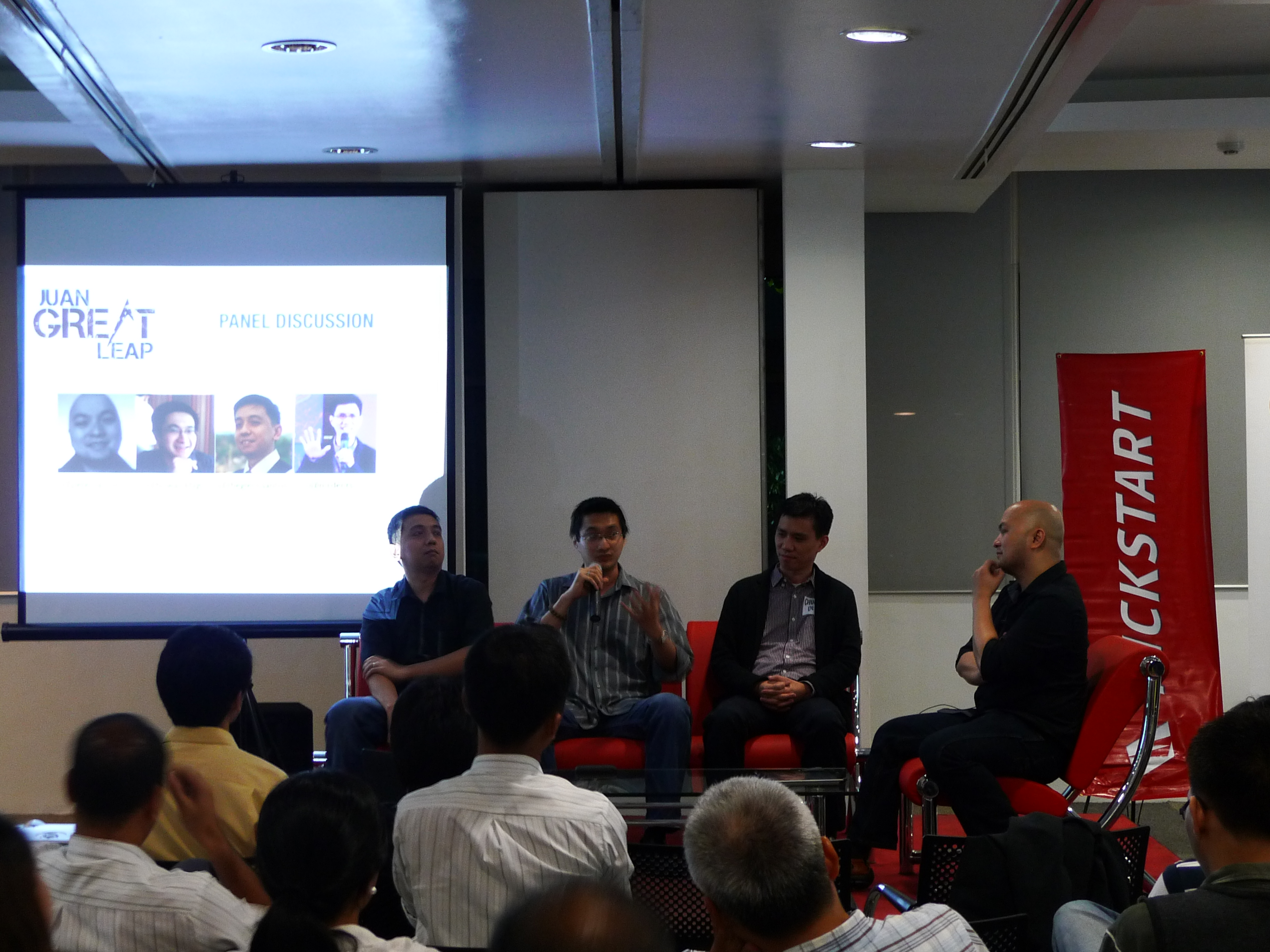
Reminiscent of August 8, it was once again raining hard, traffic was bad, and some people were missing that crucial u-turn along commonwealth leading to the Technohub, but that did not stop around 200 people from turning the Ayala-sponsored Juan Great Leap Startup Event into a rousing success.

Thank you.

Thank you so much to the Ayala-TBI team and Globe for sponsoring the event. Michi, Tina, Carl, and Rhea were amazing to work with on the ground. Special thanks to Carl for making the 200+ nametags by hand. 

Thank you to the amazing, amazing panelists. Howard Go, Denton Chua, and Glenn Santos were everything you wanted in a panel: differing opinions, thought-provoking answers, and excellent delivery. Special thanks to Denton (and his wife Anne) for celebrating his birthday with us, Juan Great Leap – style!

Thank you to all 200 people – and now I feel I know most of you  – for gracing the event.

As to what happened, let me post here recent blogposts from people who attended:

Ryan Salvanera’s blog 

Rachel Davis’s blog

Also Twitter reactions here.

Personally, I had such a blast! I actually had trouble sleeping last night because of the resulting adrenaline rush. It’s such a thrill for me to meet and hear the stories of different people. Thank you for trusting me with your stories. It was great seeing people from the first Juan Great Meet and how some of them have progressed with their startups (let’s go Katipunan Craft Beer!) It was also a thrill seeing some people I’ve met in Startup Saturdays in the room.

I was overwhelmed with the response, and I’m even more inspired to reach out and help more people.

Thank you for this honor and privilege.

Now, let’s strive to take even more leaps for Juan! Seeya in the next event!

August 29 Juan Great Leap Startup Event Is Just Around The Corner

Just a quick reminder! The August 29 event, Ayala Foundation Presents: Juan Great Leap, Transforming Your Idea Into Startup Success is definitely pushing through next Wednesday, August 29, 630 pm at the Ayala TBI Offices at the UP-Ayala Technohub in Diliman, QC.

Again, two quick reminders for those who are got reservations! Nametags (by tonight) and taking that tricky service road as you u-turn along near Iglesia ni Kristo/Tandang Sora. Do try to leave your offices as soon as you can so we can start on the designated time.

Super excited to meet all of you on Wednesday!

Can We Call Them “Finish-Ups” Instead?

At this time last year, I was looking around our Southeast Asian neighbors with startup-scene envy. Why wasn’t our startup scene as vibrant?

What a difference a year makes.

In just one year, we’ve seen a couple of Startup Weekends, the rise of Twitmusic, the launch of Kickstart and Ideaspace, a booming economy, Streetfood Tycoon, co-lab amenities – all of which were made more all the more prominent by a rabid social media environment fueled by internet-savvy Pinoys.

I think everyone will agree though – this is just the tip of the iceberg.

I am excited at the thought. Giddy, even. We have so much potential as a people, and I really, really think startups will ultimately be how we can lift this nation up.

Hence kindly allow me this sobering reminder, then:

Startups require an incredible amount effort and perseverance to pull off.    

With the increased number of people trying to start up, I also see a number of people taking this for granted, acting as if it can be done with minimal effort, minimum quality, and very often, minimal research.

Perhaps the term “startup” has something to do with it.

After all, it’s relatively easy just to start a “startup.” As the cliché goes, though: it’s a marathon, not a sprint. It’s how you finish which will be crucial, where the wheat is separated from the chaff.

You know, we have a chance to do some amazing things. If there is any time in the history of the world, we have got to go for it now.

But like everything in life, there is a price, right? We KNOW that already. For us to mean it when we say stuff like “let’s put the Philippines on the map,” we need to bleed for it.

You want to fulfill your dreams? Startups are ANYTHING but a shortcut.

You want to take a leap and start? There’ll be an awful amount of bumps and bruises along the way.

Over 92% of startups fail. (very interesting link) If you don’t do the hustling necessary to finish, 8% becomes zero. You’d have NO chance. None. Zip.

So…c’mon everyone!

Let’s own up to the challenge. Let’s pay the price. Let’s refuse to build pwede na firms, but rather invest in the effort necessary to build great firms. Let’s put the Philippines on the map by giving her our all.

She deserves it, after all.

BizKitchen Launches Its Newest Startup: Mobile Academy!

BizKitchen is proud to launch its newest firm: Mobile Academy!

Founders Macky Cruz, Howard Go, myself, and my STORM co-conspirator Paolo dela Fuente built Mobile Academy with one thing in mind: to give creative-minded and ambitious people tools in building the next great mobile app.

We see no absolutely no reason why the next Angry Birds or Instagram couldn’t come from the Philippines!

I want to take you a bit through how this company was made, in the hope of somehow providing some insight.

The need: We saw a pretty clear need in the market: there was a dearth of good mobile developers, in particular iOS developers. Not surprisingly, there was also a dearth of iOS training providers.

Idea Development: The need was clear, but we wanted to be something much more than a run-of-the-mill training provider. First, we decided we wanted to get the absolute best faculty we could have. The best of the best. Ultimately, this was going to be the difference maker, so we needed to roll our sleeves and recruit like the Pied Piper. Second, we noted a number of modern learning theories we wanted to incorporate in the curriculum. In particular, we wanted to incorporate theories centering on learning by doing and learning through community. Third, we wanted to help not only the programmer, but the non-programmer as well.

Idea Refinement: Our recruitment efforts were rewarded. We ended up with 6 great, great iOS faculty members with varied backgrounds: startup owners of successful mobile development firms, a couple of CTO’s of larger companies, successful indie app creators. Most importantly, these guys can teach. We were calling them “iOS Avengers” at one point. What a blessing.

Working closely with the iOS Avengers, we developed the curriculum carefully. Designed with lesser lectures and much more exercises, the curriculum slowly took form. We incorporated a “demo day” at the end of the course, where participants would get to present their “app-thesis.” We incorporated a mentorship program. It took awhile with very passionate founders and faculty, but soon, we had a rough curriculum – our minimum viable product.

Idea Testing: Would the curriculum work? Woud the non-programmers mix well with the programmers? How many days would it REALLY take to deliver the material? One way to find out. We released our MVP to a limited number of people. We spread the word with some of our friends in the mobile development industry – we were going to do a pilot! In just a couple of days, we filled the 12 slots with participants. Our Batch Zero. Starting July, we held classes every Saturday in STORM’s conference room. We were very conscious of surveying the each participant at the end of every session.

Funding: At first, we went around trying to raise money from different sources. If you could imagine, fixing up a nice-looking Apple training facility would require a significant sum. However, investors wanted a grand portion of the equity, and as entrepreneurs, we just couldn’t agree to the terms being handed out. So we did some creative financial planning and got the number down to a more palatable amount. Then the founders just plopped the sum.  Mobile Academy is a totally bootstrapped startup.

Iteration: We tweaked and iterated the curriculum after gathering data from every session. We are still tweaking and iterating the curriculum. We will always tweak and iterate for the better. It has come to a point though where we feel quite comfortable with what we have for a soft launch.

Like all startups, Mobile Academy will need a lot of care, time, and feedback. I’d appreciate any help and/or feedback regarding this new baby. Just email me at peter@juangreatleap.com if you got some. Also, if you like the concept and think its a good idea, please do give us your support by liking MA on Facebook  and following us on Twitter.

Thank you so much.

So…Are you interested in making the next great mobile app? Whether you are an experienced programmer or a total newbie, Mobile Academy is the game-changer for your career! Apply now!  Classes will start on September!

You HAVE To Get On The Internets

Jump in!

I’ve always worked in the technology sector. My first startup was a technology startup.

Ironically though, it was only last November that I started blogging on WordPress. It was only a few months ago that I got into Twitter. It was only this year that I became pretty active in Facebook. I’m now dabbling with MailChimp, thinking about Path, and waiting for the iPhone 5 to get into Instagram and Pinterest, as my Blackberry camera just sucks.

I’ve always read at how powerful social media was. I’ve always agreed. But I never truly understood. Til now.

If you are on the fence on going all out with social media. I hope this post pushes you to one side: dive in!

The only regret I’ve had with going all out in social media is not diving sooner.

What dawned on me was how it wasn’t about the technology. It was really, always, always about connecting with people. After a few months of hammering out posts, I was amazed by some of the people whom I ended up connecting with: people all over the world, long lost friends whose work was aligned with mine, executives of big firms, startup founders of all ages and backgrounds.

Social media has democratized networking, and it is amazing!

The other great thing I found out? Despite all the Carabuenas and Sottos which occupy the headlines, the world is filled with GOOD people. People who want to help. People who go an extra mile to thank me for a post. Sincere people. Brilliant people. Some of whom I work with now on some truly exciting projects.

Best thing about it? It’s all freaking free! (well, a couple of dollars for my WordPress account)

Got a startup? Get into social media immediately and craft a strategy. This is one thing that STORM has GOT to improve on (but Stream Engine has done pretty well) Whatever the problem is: recruitment, customer service, product development, seeing how people think about an idea, marketing, sales – social media ALWAYS can be used to great effect.

Corporate lifer? Get into social media immediately. Think about it. What’s the first thing people do when they get your resume? They Google you. They look at ALL your social media accounts. If for example, you were in sales and you have a blog where you passionately talk about your craft. You also use social media in your selling. All things being equal, wouldn’t these factors give you a leg up over the competition? Your resume is found not only in Linkedin: nowadays your entire social media presence IS your resume. 

So let your voice be heard and dive in.

Besides, check this article out.

The Insane Difficulty of Finding Your Purpose In The Cubicle

I am of the belief that EACH of us has a unique, special purpose on this earth. None of us were accidents. I believe that God designed each of us with a particular role to fulfill.

And until we find this specific purpose, we will be feeling that something is missing. We have to search purposively. Settling is extremely wasteful.

Fortunately, we have access to a lot of clues.

We can find clues in the gifts we were given. We can find clues in our innermost desires. We can find clues in the things we do where time ceases to be a factor.

This is why I personally find the entrepreneurship process such a religious experience. Done right, it starts where your heart is. Done right, it starts with introspection – what is my passion? In this process, you ultimately find yourself  grappling with the question – who am I?

It then becomes a grand quest: of trying things out, of making mistakes, of not only finding out who you are but developing and creating who you are.

I think this is very difficult to do working for another firm. Not impossible, of course, as I know extremely fulfilled individuals working in corporations. Difficult though. Why? Because more often than not, rules and structure hamper you from truly spreading your wings.

Or more simply put, it’s tough to live out your dream when you’re riding on someone else’s.

I remember as an HR practitioner preaching “alignment” of company values with individual values. You know what?They can never be perfectly aligned. Your goals are bound to be different from that of a 100,000-man multinational present in 20 countries.

If you follow your passion as an entrepreneur though, I think you are MUCH MORE LIKELY to find your calling.

Did God carve out your DNA with an interest in fashion AND also of dreams of helping your countrymen solve poverty? I highly doubt it if you could scratch your existential itch anytime soon going from one multinational firm to another. Or, you could do what Noreen Bautista did when she founded Jacinto and Lirio.

I have a passion for helping people, writing, and creative ideas. I thought I’d be able to scratch my own existential itch as I went from company to company in a ten-year career in human resources. It was only through the experience of founding my own startup, STORM, that I saw a glimmer of what my purpose was: to help people start their own startups. I highly doubt if I had been able to find this career if I stuck it out as a corporate HR practitioner.

Stop settling. Stop hating Mondays. Stop doing nothing about it.

Leap, and chances are, you’ll land where your heart is.

BOOK REVIEW: The $100 Startup – It’s Awesome

Can you really make a business out of your passion? 

Can you do it by spending the least amount of money?

Author Chris Guillebeau interviewed hundreds of “micropreneurs” who are making a very comfortable living pursuing their passions in order to find out the answer to these two questions.

According to his book, The $100 Startup, the answer is a resounding “YES!”

I think this is a great, great resource for people who aren’t so much interested in the “I WANT TO CREATE THE NEXT FACEBOOK!” startup, but those who simply wish to make a comfortable living by creating a business around their passions.

The book is replete with examples from entrepreneurs from all walks of life, along with their stories on how they made successful, satisfying, entrepreneurial leaps without requiring large investments or specialized expertise.

After reading very “technical” startup books like Lean Startup and the Entrepreneur’s Guide To Customer Development, this was a joy to read, with Guillebeau using mostly memorable stories to explain concepts. There were also A TON of practical tips and suggestions for the entrepreneur on how to grow her startup. What I remember in particular were his suggestions on how to effectively launch a product, comparing the process with how a big-budget movie is released. (by the time a big movie comes out – we’re always giddy with excitement)

This book is for you if: 1) you are thinking of making the leap and have a plan 2) you are thinking of making the leap and you can’t decide on a plan, 3) You are a relatively new startup owner (1-3 years) 4) you are desperately tired of the corporate rat-race.

I think this is a good “First startup book” for someone who is thinking of taking the leap.

For veteran start-up owners, you can probably skip this, although there are a number of interesting ideas you can probably incorporate.

Posting this on the same day as the last post because they are quite related.

Happy reading!