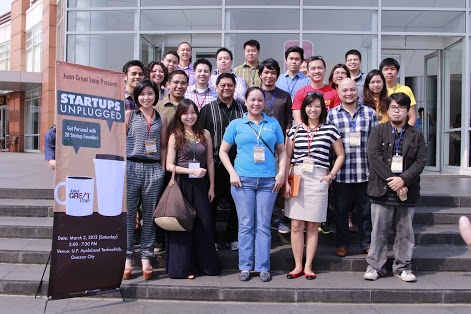
I just closed the main pitching activity at the recently-held JGL Open Coffee activity and told everyone to gather at the hallway of 47 East to take a quick group pic.
And so we did.
After that, I told everyone it was free time.
You can probably imagine what happens next.
Wondrous chaos.
People began to just talk with one another. Small groups of 2, 3, and four people began to form.
Energy filled the room.
And then, incoming senior student Danny Moynihan unassumingly enters the room.
He quickly introduced himself to me, and then apologized for being late (he was from the south and got lost).
He then asked:
“Is the pitching done?”
“Yes, it was a few minutes ago.”
“Can I try to pitch?”
“Uhm…alright, let me try gathering them”
I then tried shouting: GUYS! CAN WE JUST GATHER QUICKLY FOR A QUICK PITCH?
…
I shouted again.
It was no use though.
People were very much INTO their conversations.
So I told Danny: “Sorry bro, it’s going to be tough to gather them like this.”
“Can I try, though?” Danny asked.
“Be my guest.”
Danny gathering people at the adjacent room
After around 10 minutes, Danny miraculously got some of the people sitting down in an adjacent room, with half the people still having small conversations in the hallway.
Then, he got up on an elevated part of the room.
Then he proceeded to do what had to be THE LAST THING I’D EVER THOUGHT I’D SEE IN AN OPEN COFFEE EVENT.
You just have to see it for yourself: (go full volume)
Of course, by the time he finished, EVERYONE’S EARS were glued now glued to his every word. He then calmly gave his pitch. (and got more than a few people interested)
Now THAT, I thought, was pretty entrepreneurial!
(Lesson here: NEVER miss a JGL OPEN COFFEE session 🙂
In this early 2005 interview with Mark Zuckerberg, the Facebook founder described Facebook as:
“I mean, I just really want to see everyone focus on college and make a really cool college directory product…there doesn’t necessarily have to be more…”
Zuck was intent on just focusing in colleges. He was ecstatic with his 3 million users.
Then, somewhere along the way, he realized he was sitting on a goldmine. Now? He’s just passed his first BILLION users.
Sometimes, all we need is a fresh look at our business to experience an epiphany.
Pao and I experienced the same thing in STORM around 2 years ago. (at a lesser extent than Zuck, obviously) We were making most of our money off of the monthly retainer we were charging our clients for using our flexible benefits system. It was evergreen. It was paying the bills. We were okay.
Then we that saw our online Flexible Benefits system was enabling a particularly large amount of transactions per annum.
Epiphany.
It was time to change our business model. We wanted to do it fast, so we went for broke and raised investor money (for the first time) to allow us to go after our strategy. Hard.
What is the big-league alter ego of you current startup? Is there a Superman your Clark Kent can become?
The greatest enemy of a business owner is complacency. Even at the peak of your company’s powers, you should always ask yourself – how can I do things better? These new tools coming out – how can I use them to power my business? How can this idea be BIGGER?
You need to think about it carefully and plan.
Thinking of doing a bakeshop? Perhaps you can be the first social-media powered bakeshop – where you can tweet people that they HAVE to come over – because a fresh batch of pandesal is about to be taken out of the oven. (can someone please do this – freshly baked pandesal is just heaven)
Are you a database programmer who wants to put up a business? Instead of doing database consulting, perhaps you should look at big data opportunities in different industries and try to look for a real-world problem where data can be a solution. (there a lot – recruitment, cellular data, enrollment data, government, etc…)
The moment was captured. So real, honest, and simple. It illustrates the warmth and vibrancy of a growing community that supports and is open to collaboration. To all the leaders and feeders in the startup community, may this video fuel your spirits 🙂
I remember texting Peter right after my interview with Joey Gurango, which was just days before Startups Unplugged. In my text, I asked Peter about what he thought about posting an uncut version of Joey’s interview on JGL. The reason for my suggestion was that after my interview with Joey, I was completely taken aback by the incredible knowledge that he was sharing with me; even though I wasn’t a techie, Joey’s stories resonated with me and schooled the heck out of me. Everything Joey shared with me just seemed so important, so I wanted to post everything that he said. While I must admit, I’ve omitted some parts of the conversation to be practical, this is still a very raw version of what Joey shared with me. I hope this piece will allow Joey’s stories and insights to speak for itself. The other portions of his story will be coming soon! In the meantime, sit tight and allow the sublime to take its course.
Joey Gurango of Gurango Software
When did you start and why?
Joey: My first business was in 1981. I was at the University of Washington and I did a pizza delivery business. Out of necessity, I figured that most college kids living in dorms were too lazy to go down to the pizza place to get their own pizza, so I just setup a phone and gave out fliers. Then, I waited for people to call me and ask for an order. I had Dominos, Godfather’s, and Pizza Hut menus and they [the customers] would call and tell me what they wanted. I’d put a 15% surcharge on whatever they ordered, but I would get their money first (Joey chuckles). The pizza delivery business was actually my first real business. My first real tech business was in 1984. I had worked for apple computer for a little over 2 years. The Macintosh just launched, and I got this idea to make something called desktop furniture for the Macintosh. So with that I started a company with some money because back then it was really expensive to build injection mold productsby the mold. Everything was going great…and then in 18 months we went bankrupt, so that was my first experience.
Why’d you guys go bankrupt?
Joey: ‘Cos we spent more than we made. Real simple. We were making a lot of money. I think the first 6 months, we had over $1 million in revenue. But then the next 6 months, it didn’t quite reach a million dollars. Then after that, I decided that I didn’t want to be in hardware anymore. I started my first software company… that was 1987…Match Data Systems. I started that doing excel custom programming. In 1991, I decided to move the company back here [Philippines]. By then Windows had come out, so we moved from Macintosh to Windows. We were one of the first, as far as I know in Asia, that were doing Windows development work. One thing led to another. In 1999, by then we kind of branched out into ERP software, a company called Great Plains software acquired us, so we become Great Plains Philippines. Two years later, Microsoft acquired Great Plains, so I become a Microsoft employee. Then, I stayed with Microsoft for two years in 2001. I’ve basically had three jobs in my life. My first job was with Apple computer. My second job was with a training company for less than year. My third job was with Microsoft. Then I started my first software company and haven’t really worked for anybody else, until my company was acquired, so technically I was working for a multinational company, but it never really felt that way, which is why I left.
Why did you move back to the Philippines?
Joey: My first company did custom software development. First for the Macintosh. We did a lot of excel work…a lot of data base programming for the mac. The problem was, since we were doing a lot of excel work, I would train these fresh grads on developing for the graphic leisure interface, and then because Microsoft was really heavy into doing Windows development back then, they kept hiring them away from me. Microsoft would give them double the pay. I was getting frustrated because we were losing programmers in the US. Our office was literally a 5 minute drive away from Microsoft headquarters. At the time, my brother was visiting the States from the Philippines. He says, “You know we have programmers in the Philippines?” “Really? Do you even have PCs there [in the Philippines]?” I said. He replied, “Oh yeah! We have dBase programmers.” So that’s when the idea struck me that I could have the company in the Philippines and continue servicing my US customers. And it would be cheaper, and I wouldn’t have to worry about losing these guys because nobody else would hire them because we were doing stuff that nobody else was doing. That’s why I came back. We were doing offshore outsourcing before it was even a term.
What experiences or skills from abroad did you find most valuable for starting up in the Philippines?
Joey: The one thing I’d say it’s not really a skill or experience, but more of an attitude. Through the years I’ve realized that the only difference, in general, between people in the countries like the US and here, when it comes to things like business and startups, is not knowledge, skills, IQ or EQ, but the big different shader is the willingness to risk and face failure. In the US, it’s not a big deal if you’ve started a company or even failed for that matter. My first real company went bankrupt after 18 months. We raised $250,000 in investor funds to start that company and in 18 months it was all gone. We never gave the investors back a single cent. Nobody was coming after to me trying to have me assassinated. There’s no shame in it. There’s no social stigma with that type of failure in the US. If I were to say what was the most helpful thing was to bring that mentality over here. Compared to most of the local technical guys, I was pretty fearless. I was willing to buy stuff that nobody else would consider. However, I’ve come to learn that taking the entrepreneurial path is not that risky. If you do it in the right way –like all the things I’ve learned just in the last five years- if you know how to do business modeling, practice lean startup and customer discovery, test and validate assumptions, it can be quite low-risk. It’s still not as low-risk as getting a job and a consistent paycheck, but it can get pretty close. I think if I knew what I knew today, it [the business] wouldn’t have gone bankrupt, but I would have shut it down a lot sooner. Now I can say that it’s not really that risky to be an entrepreneur, if you know how to do it right.
It’s OPEN COFFEE TIME again this March 23, 930 am at the 47 East Facility at Loyola Heights.
We’re inviting all startup-minded folk – veterans, startup newbies, and especially those who wish to take the leap – to drop by this awesome venue to both learn and network!
For those new to this monthly gathering, the format of OPEN COFFEE is pretty unique – everyone will have a strict 2 minutes to make a pitch. A pitch could be ANYTHING – a business idea, a call for advice, a call to partner, a recruitment pitch, etc…
(Well, anything EXCEPT doing a hard sell of an existing product or service)
And as those who’ve been to past sessions can attest – these sessions are AWESOME.
Do reserve your slot by clicking on the Eventbrite button below:
As per tradition, we shall be holding the event in a startup-related venue.
This time, it will be in a newly constructed co-working space near the Katipunan University belt – 47 East. (I was there a couple of days ago – it looks fantastic! Pictures below.)
I’ve been trying to push myself to blog Post Startups Unplugged, and share all the instances of serendipity that truly made this miracle happen. However, I thought that it would be more effective if I were to cut to the chase about what I actually learned from it all. Here it goes! These are the 5 things that I’ve learned from Startups Unplugged:
Ask and you shall receive.
I had no shame in asking sponsors to join Startups Unplugged. This is how I usually got in contact with a sponsor:
A kind individual would give me a business card of XYZ individual from XYZ organization, and I’d literally call that person on the spot, even it if was the direct line of the CEO. It might sound too crazy or too bold, but it was a highly effective approach; about 80% of the sponsors that I talked to agreed to sponsoring the event.
Don’t get me wrong, I know that I had a sweet pitch for sponsors because of the incredibly awesome line-up of entrepreneurs that graced us with their presence for Startups Unplugged. The point I’m trying to convey in sharing this experience is to highlight that the simple act of asking makes all the difference in whatever you do. Making that conscious effort to ask is the catalyst to making deals happen.
Set your mind to work with purpose.
As with all startup journeys that start without any capital, it has been a rough and bumpy road. Moreover, as an inexperienced junior entrepreneur, I felt like there were things that I just didn’t think of or understand. I told myself if all else failed in my move to the Philippines, the one thing that I was determined to do was make this event happen. Because I had this mindset, I was able to do things outside of my usual self.
Facebook Ads Work.
On average we would get about 200 views for posts on our FB page. When Peter paid for promotion on FB, the views shot up to as high as 10,000 views. While it’s a big bummer that non-paid posts spark limited visibility, paying a little extra to promote does make a huge difference.
Evenbrite is an awesome tool for event registration!
I recall getting into a heated discussion with Peter after his recommendation to use Evenbrite for JGL’s Open Coffee. Using a type of registration, in which participants would print-out tickets to attend a coffee chat, just didn’t make sense to me. Eventually, I realized I was wrong about it (Sorry Peter 🙂 )
Eventbrite makes it really easy for event organizers to keep track of attendees. In addition, it allows them to easily communicate with attendees and send attendees updates about the event and post-event activities. Eventbrite is truly a dynamic tool that makes event registration clean, simple, and easy.
Don’t Do it Alone!
As tempting as it is to play the role of superman, don’t do it! When there is a strong purpose or cause to what you are doing, people will gravitate towards you. Be open to people’s help and goodwill, and build together!
I’ve written about this matter extensively in this blog – I can’t over-emphasize how important finding the right partner is. In fact, I think I can say that for my case, this factor has been THE biggest factor determining a startup’s success or failure.
I recently wrote an article for homegrown.ph summarizing what I think are the most important items to consider. Do check it out here.
In a lot of ways, it was like launching a startup.
The concept (sorta-kinda-like group speed dating) had never been done before and it was either going to be AMAZING or a complete, fiery DISASTER. No in-between.
We thought it was a great way of creating better impact with a larger crowd than the usual conference/panel format. It was like holding a candle to a moth. We had to do it.
It now fell on the capable shoulders of Matt Lapid to execute.
So how did it go?
People coming inPrayer, The non-keynote, and instructions
At around 230, we started with a prayer, a sorta keynote (I felt totally unworthy doing a keynote, so I instead just went with some reminders), and then I painstakingly went through with the instructions – which were crucial.
First bell – transition, 5 minutes.
Second bell – settle down, 1 minute
Third bell – start, 20 minutes
Five rounds of this.
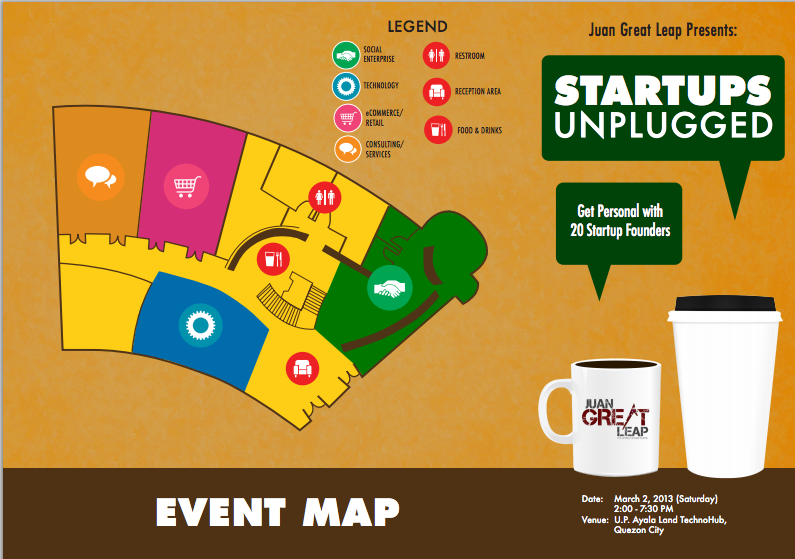
The first bell sounded and people began going around with their maps (which people were also using as checklists).
Second bell sounded. People were settled in their chosen areas.
Third bell sounded. No need – people were starting!
And there it was – energy!
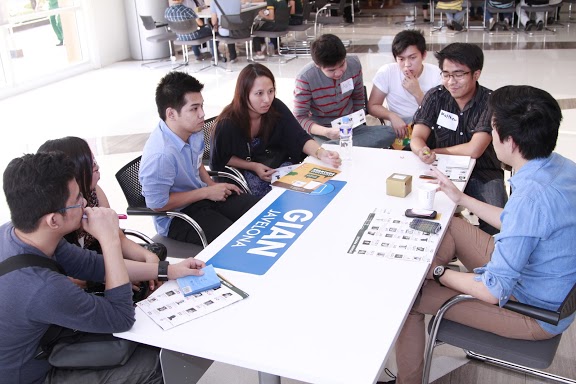
I walked around the designated areas. People were nodding heads. Entrepreneurs were passionate.
Odell “I could’ve gone on for more rounds!” Ramirez of LoolooLuis Buenaventura of Infinite.lyI managed to sneak in one of Maoi’s sessions – she’s brilliant! (plus, i think she can do stand-up comedy)Multi-awarded Anna Meloto-Wilk explains her journey with Human Nature
Soon, the second and the third rounds were commencing. I started to allow myself to smile while walking around – we had managed to pull of a unique, amazing event!
It was evident how much people were LEARNING from the format and these marvelous entrepreneurs.
By the fifth round, the entrepreneurs were visibly tired, but incredibly, still just as passionate. It was amazing to see them give so much. EVERY entrepreneur wanted to make each of their answers (even if some of the questions repeated) as unique and as special for the person in front of her asking.
Renelyn Tan Amazing event by @juangreatleap this afternoon. Thanks for all the inspiring entrepreneurs who shared their experience.
Yas Coles Great way to spend a Saturday afternoon: meet startup superstars to get going. Looking forward to more @JuanGreatLeap
Kazumi Shiroma “Be shameless with failure, be critical when you want to help.” -Reese Fernandez-Ruiz | Well spent Saturday afternoon with@JuanGreatLeap 🙂
For those who attended, let me repeat the most important thing: I hope you not only learned from the experience, but I sincerely pray that you USE whatever motivation and/or information you were able to garner.
SPECIAL THANKS TO:
Our major sponsors:
Ayala Foundation: Thank you so much to Michi and her team for the beautiful venue, all the logistical help, and introducing us to some of the entreps!
Kickstart: To Minette and her team – for all the help and support! If you have a startup and you need funding, you have GOT to talk to Minette and her team.
Co.lab: Especially Chesa for helping us design the whole event, and for lending us Danella, who agreed to celebrate part of her birthday weekend as one of our awesome 20 entreps!
Velprint: For all your printing needs, be sure to check out the awesome, high quality work which Velprint can provide.
I’ve been getting a quite a few emails asking startup questions.
Here’s one of them I was just about to answer, then my brilliant wife suggested, “Why don’t you answer it through a post so more people can benefit?”
I love my wife.
Reader Ken asks:
1) What are the principles behind a successful start-up entrepreneur?
One can write whole books just talking about this topic. But if I were to offer a distilled, admittedly shoot-from-the-hip answers, they would be:
a) Find a good great partner. Don’t go for more than 3 people in your founding team. 2 is zen: maker/seller.
b) Business model > product.
Obviously, the product is crucial. But how will you generate a scalable business from your product? You need to look at your business model. How do you build your business model? Check out Steve Blank’s FREE startup lecture at www.udacity.com
c) You have to embrace failure. It’s a prerequisite to success. You have to develop thick skin.
d) Learning > Money now
e) Find good great employees
f) Go fulltime. This is one of the huge learning points I’ve absorbed over the last 2 years. If at least one of the FOUNDERS (not employees) isn’t fulltime, then it would take an honest-to-goodness miracle for your startup to succeed. The most important element your startup needs isn’t money. It’s time.
2) What are the best practices in internet marketing?
I can’t claim to be any expert here. You can go ask my good buddy Ben Francia. Ben? Any 3-4 key principles to remember?
3) How difficult (or easy) is it to get a business loan?
Very easy if you have collateral. Extremely difficult if you are a startup with no collateral.
Funding from angels/VC’s/incubators? There are a number of these now. Getting a bit easier if you have the right product and the right team. The price to pay? Equity.
If I were you, try your best to bootstrap everything first. Seek money from family/friends. Find a way to do the business by yourself and generate traction/revenue.
Traction makes EVERYTHING easier and give you a lot of flexibility.
4) If you were to start all over again, what could you have done differently?
The truthful answer: none. Its corny, but I think everything happened to me at exactly the right time.
One thing that I think maybe could’ve helped? Starting earlier. Starting earlier would have meant I would have learned FASTER, plus I wouldn’t have had risked as much as I did.














 JUAN GREAT LEAP