Soon, we had more products than we had people! While each idea was an innovative one and made a BIT of money for us, what we mostly produced was a boatload of mediocrity. Instead of making one GREAT thing – we did a number of inspired but UNDEVELOPED products.
So channeling our inner Steve Jobs, we killed all our horses except for the biggest one, the one which put us on the map – flexible benefits.
It’s been a great decision.
My STORM business partner Paolo and I made a little experiment though. Among the dropped products, we decided to pursue the next-most promising (and profitable) one, and spin it off into a startup.
Wary of committing the same mistakes again, Pao and I swore we won’t be involved operationally in this new one. So we then looked for TWO MORE co-founders for the would-be firm: a Pitcher CEO and a DOM (Borrowing Maoi’s awesome definitions). Pao and I would only continue to be involved on a board level.
A few months after?
Strata.ph was launched. What Strata wants to do is to disrupt the way companies manage their people through an online platform which manages competencies.
Within the first few months of operations, it has already managed to secure lucrative b2b contracts. Using the standard of “How much time does it take for the startup to make its first million,” this, by far has been the most successful startup I’ve been involved in.
How has Strata.ph done this?
Here’s why it worked:
1) Fulltime founders
Really quite crucial. Self-explanatory.
2) Sharing the STORM marketing database
Storm and Strata have the same target market.
So instead of Strata calling clients on the phone and asking:
Good afternoon! I’m _____ from Strata. We sell an online competencies platform. May we talk to your HR Director? (pause to listen)
Uhm, no he isn’t expecting my call.
Hello? Hello?!
We can instead call clients on the phone and ask:
Uy, Jun how are you? How are the kids and their first days in school?” (pause to listen)
Sounds good! Kamusta naman ang flexible benefits ninyo? (pause to listen)
I’m glad to hear that! Tawagan mo lang ako kung magkaroon kayo ng problema ha.”
Dude, do you remember that sister company I told you about? The one doing an online competency framework? Would you have some time this week to meet with them?
This is a BIGGIE.
3) The board knows the market and the business – from a startup perspective
Pao and I are members of the Strata board. Who better to help the CEO and COO of new HR technology startup than another CEO/COO pair who run a successful one?
So where does this all point towards?
I’m now looking at the remaining dropped STORM product lines with a glint in my eye.
Does anyone want to help me put them up?
There are 3 HR ideas I want to pursue and build startups above.
Here’s who I need (it should be pretty obvious if you’ve read the above):
1) I need people who can commit FULLTIME or if you’re working fulltime, someone who is SERIOUSLY considering a fulltime leap.
2A) The first idea has something to do with training and development. I need 2 people for this one. I need a pitching CEO, and a STATISTICIAN – someone who loves numbers and analysis.
2B) The second idea has something to do with recruitment. For this I might need 2 people as well people. A pitching CEO (ideally someone with recruitment background), a tech guy who knows how to build web products.
2C) The third idea is an OD consulting play. It ALREADY has a pitching CEO, I would need a partner for him – preferably a someone with an OD background.
3) I need people who will LEAD and be accountable. I need entrepreneurs.
These people I’m looking for will really be STARTUP FOUNDERS. I will not be involved directly in operations, so it’s up to you to build the company.
If you’re interested, send me a line at peter@juangreatleap.com. Do attach a CV and a cover letter as to why you think you’d be a great fit.
WHERE: 47 East Compound, 47 Esteban Abada Street, Loyola Heights, QC (Right in front of the MCDC school)
It’s that time of the month again!
For those who’ve been to one of the sessions, you already know how awesomely helpful open coffee is when it comes to networking, validating ideas, and finding opportunities are concerned. I’m excited to see all the familiar faces!
For those who haven’t gone – you just have to check out for yourself what all the fuss is about!
STORM transferred to its newest office a few weeks ago.
I love it!
It’s brightly lit, incredibly functional, spaceous, and comfortable to work in. There are no “manager” rooms. There are whiteboards and wallboards everywhere, and multiple spaces for different kinds of meetings.
Pictures below!
The main reception areaOur main hallwayTech and QA work areaThe pantryConference Roommarketing/sales/hr working area
Looking closely, you would also see rather peculiar items in the office:
Like this old restaurant-style chair…
Try spending 8 hours working on this steel chair
And of course, our infamous “orange chair.”
No, you wouldn’t want to see this in a high-resolution picture. Yep, its THAT grimy.
These “artifacts” belonged to the very first Storm office – the one-bedroom condo where I lived. The bedroom became my house – everything else was transformed into the office.
(how I wish my old hard drive didn’t crash so I could’ve shown some pictures here)
I always joke around the office that we have to throw these chairs away, that I would designate them as prizes in our Christmas raffle for the poor soul who would end up “winning” it.
That restaurant chair there was donated by a friend of ours who closed down a restaurant. Nope, those chairs don’t have ANY bend on them. They are as uncomfortable as you can imagine.
That orange chair was the only comfortable chair we had. It was also a donation from someone who already had it retired in their home stock room. (Of course we still had to sit on the hard chairs – this comfy chair went to our first employee – our programmer) (Hi Angela =)
Truth is, I would want these items around for as long as they would hold up. They’re continual reminders of our journey. It’s a reminder of what we went through and who we are. Of how incredible Blessed we are. Actually, this is what I feel when I walk around the office. It’s not “wow, we have a nice office,” rather, it’s “wow, we’re pretty blessed!”
You see, back then, we had nothing.
We had no experience in running a firm, no mentors, no “donations” from any relatives, no MBA’s, no high QPI’s, no funding, no fancy methodology, no automatic clients referred by a powerful relative. We just had 2 things going for us: an idea we believed in (flexible benefits), and a powerful desire to see it through.
Then we just leapt and committed.
This is partly what fuels my passion in telling you to do the same: I really believe you can do it. Perhaps all you need might be a little push. Hopefully, this can be your push. Trust me, you don’t need any of the above-mentioned stuff. Anyone who tells you otherwise is wrong.
Don’t wait. Leap.
(Do visit us at 602 Centerpoint Building, Julia Vargas cor Garnet Streets, Ortigas Center! And if you have anyone in mind who might especially appreciate this post or will find it useful, do click those buttons and share!)
Fear has been my constant companion all throughout my startup career.
I remember feeling I might be laughed at as I was about to present my idea to potential partners or investors.
I remember that crippling feeling. That extreme doubt I felt when I was about to resign from my fulltime job.
I remember hearing all the “no’s” in this journey, the disheartening voices and fearing they actually might be right.
I remember delaying the first-ever post of Juan Great Leap (JGL) for weeks for fear other people might judge me.
After developing several startups (both successes and utter failures), and the unexpected growth of the JGL audience, you’d think I finally would be free from fear’s clutches.
It’s still there.
I’m still scared things might not work. I’m scared people will laugh. I’m afraid of what other people might think. I’m afraid a new startup idea might flop.
The difference now is, not only have I learned to live it, but I have learned how important it is to EMBRACE IT, especially in today’s business climate.
Let me explain.
Continuous Innovation Is Now a REQUIREMENT
The industrial age is dead and dying, along with all its guarantees (being an employee of one firm for life, worry-free retirement, etc…).
Innovation is the new currency.
Innovate or DIE. (RIP: Kodak, the big-label music industry, the dodo, etc…)
Companies know this.
Witness how ALMOST ALL companies have “innovation” as a company value, or how billions are poured into R&D.
This is true for both companies andof people.
For example, programmers now cannot invest too heavily in being an expert in one platform. HR people are finding out that job descriptions are getting obsolete (or at best, very high maintenance) because they change all the time. The best corporate managers are those who are able to maintain excellence despite getting deployed to handle very different things and cope with a diverse set of problems.
It had never been done before. It would be a logistics nightmare. There were so many questions. Would people hear one another? What if nobody came – this was something very different, so people might not immediately see its value.
It was either going to be work splendidly, or it would crash and burn. There was little in between.
While we were talking about this. A familiar feeling made itself known to me.
Fear.
This was the precise point when I knew we HAD to do this group speed dating thing.
Reverse Spider Sense
Spidey’s spider-sense tells him if he is in any immediate danger (spider sense tingling!). Fear has become something of a reverse spider-sense for me. If it tingles – there is opportunity!
Now, when evaluating opportunities, I LOOK for that fear.
Is the fear in me?
If there is no fear, then it could mean either of 2 things:
1) I am not interested in the opportunity.
Subconsciously, I already know I don’t find (or at that moment I am not finding) the opportunity presented interesting. Perhaps because its not within my realm of expertise, or perhaps I just think it isn’t feasible for me.
Possible scenarios like this would include: someone inviting me to invest in a startup in a field I don’t really understand that much, or listening to a salesperson pitch a product I have no use for.
2) There isn’t a great deal of risk
If there isn’t a risk, then I am not too worried about it. Chances are great the possible returns won’t be so hot, either. I can say yes to the opportunity, but it won’t really keep me up at night imagining the possibilities.
Possible scenarios like this would include: someone wanting to give me a 1% share for a startup in return for monthly advice, or doing maintenance work in the office, or choosing what tiles would suit the office bathroom.
But if there IS fear?
Then I probably would be asking a LOT of questions about it. I would be nodding or shaking my head vigorously. I would be up – a lot of times all night – thinking of the pros and cons.
If there is fear, then I know that my subconscious is HIGHLY considering this course of action. It ALREADY knows if the opportunity in question is internally feasible for me or not. I wouldn’t even feel the fear if it were OUTSIDE my capabilities. (see #1 above) Fear tells me there is a possibility I can pull it off.
I ALSO know that this would be something WELL WORTH doing, or at the very least, worth a much longer consideration time. Fear is a sign that the returns would be awesome.
This could involve pursuing a huge pivot for our firm, or pondering the high cost of a GREAT hire, or asking someone to be key member of the founding team or the board, or doing a sales presentation to the CEO or the MANCOM of a potential huge client (not really a decision, but an opportunity nevertheless), proposing to my wife, saying goodbye to my decade-long HR career, or even me in my room, musing about a potential strategy.
Fear has ceased to become crippling. It has become my friend. It can be your friend too.
Hoooh! My friend, Your Friend…Whatever Peter! I’m miles away from that! I’m afraid to even tell my friends I’m thinking about starting something!
It’s a process (like EVERYTHING worth its while), will NOT come overnight, and there are no shortcuts.
Here are some tips that may help:
1) Surround yourself with healthy risk-takers (don’t know anyone? go to startup events, go to open coffee – LOOK for healthy risk-takers)
2) Fail
In some ways, this might be like swimming. The only way for you to learn is to dive in.
There is one HUGE thing that happens when you fail – YOU REALIZE ITS NOT THAT BAD.
Because of our primitive survival instincts, we pre-programmed to assume the WORST. (OHNO, I will be out on the streets if I fail! I will be the laughingstock of the barkada, nay, the whole country! Woe is me! WOE IS ME!)
It’s not that bad.
Of course, I’m not saying you should DELIBERATELY fail – but try doing things out of your comfort zone. Perhaps you can try starting the thing you’ve always wanted to do but always feared, but do so by…
3. Starting with smaller risks
Start with low-risk items, and gradually proceed with bigger ticket risks.
Got an idea?
Level 1: Do a powerpoint (not so risky)
Level 2: Invite close friends and present your idea (a tad risky)
Level 3: Invite not-so-close friends you think would be an expert on your idea and present (riskier)
At this point, you’re BOUND to get some negative comments / rejection already (this ALREADY could be felt as a huge failure for some people)
Level 4: Recruit a Co-founder. Among the people you’ve talked to, do a formal proposal saying that you are DOING the idea and you NEED their help as a partner (risky)
Hey guess what – you’ve started a startup!
(Know anyone who would appreciate this post? Hit the buttons and share below and share!)
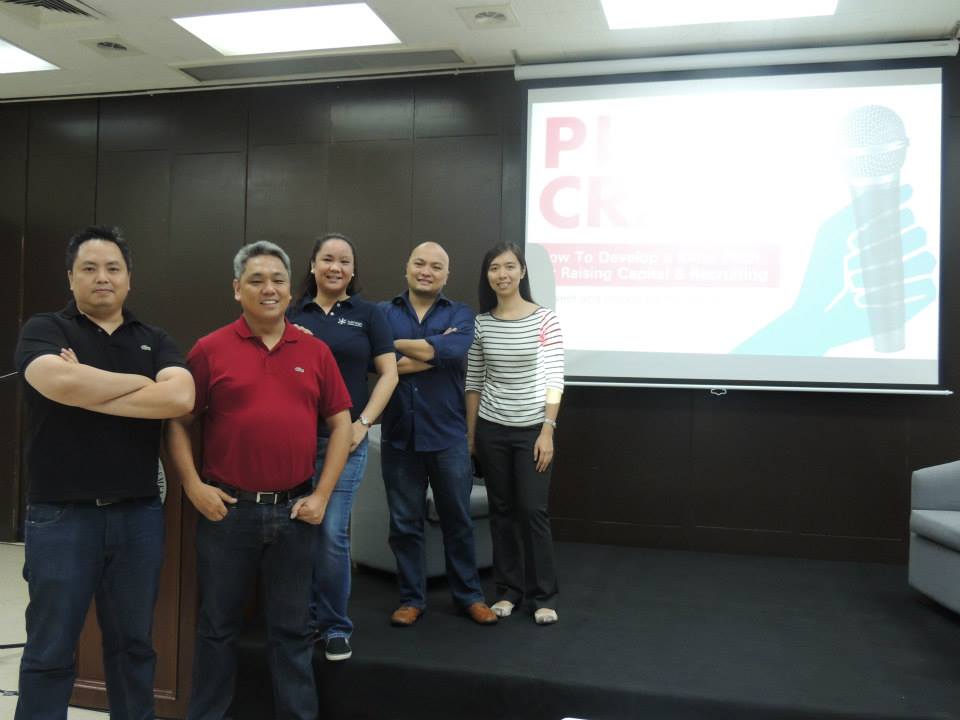
(from L-R) David Cruz, Richard Cruz, Maoi Arroyo, Me, and Karen Hipol
I had a great time at the Pitchcraft Event last Saturday at AIM. With nearly 70 people, there was a lot of energy in the air. Most importantly, I saw there was a lot of learning happening.
Just a quick summary of what happened, for those of you who missed it:
First, Karen Hipol of Carillion Partners (yup, she of the $100 million fund) came in to give the first talk: WHAT should the pitch contain. Then, Maoi Arroyo of Hybridigm delivers the second talk: HOW the pitch should be given. After a short break, the panel/simulation activity began. First a panel of experts are introduced: technology serial entrepreneur David Cruz, AIM professor and entrepreneurship expert Richard Cruz (not related to David), and Karen Hipol. The panel and the audience are then shown 5 selected pitch videos from Shark Tank. Both the audience and the panel are given a chance to chime in after each video. Finally, the audience is asked whether they would want a chance to do REAL pitches to a select group of investors in a post-event happening in 2 weeks. (14 volunteered)
Here are some of my observations and musings, post-event.
A) Entrepreneurs are willing to pay for LIVE!
This was the first Juan Great Leap PAID event, so I was paying a lot of attention as what would happen. Scores of people would attend our free events, so I was wondering what would happen if we attached a price tag.
I asked this precise question (would you pay P1000 for a startup course) to our JGL newsletter recipients (thank you for ALL the respondents!), and while the majority said yes, there a number of people who said entrepreneurial people (the target market) would find a ton FREE content on the web and will not pay. I found this to be a very credible argument – so I was eager to see what would happen with our own “MVP” which Pitchcraft represented.
3 weeks of marketing yielded 70 people.
There is still a large number of people who would want to learn LIVE! from experts – even entrepreneurs. I guess there is still something with a LIVE! learning session – the learning is more palpable, you learn with a community, you can network (with both audience members and the speakers), and when the content is good – there’s just a larger chance of not only education, but inspiration (try watching a training video for more than 10 minutes – even if the speaker is really good, I doubt if you’ll get the same impact).
Same reason as to why we still go to concerts even we could just download past ones.
I’m pretty happy with this development – not because I will be able to earn from it (I don’t earn anything from JGL activities), but because we can give you BETTER events and even more value-adding activities down the line.
B) Paid Tickets Magically Make Flakers Disappear
Yes, the last 2 JGL big conferences attracted around 200 people, but also had around 400+ signups. No matter how much I begged for people NOT to flake because the tickets are finite (someone will LOSE a slot if you flake), we still encountered a bunch of them. Our monthly open coffee attracts 60-70 people with around a 50% flaker rate as well.
Flaker rate in Pitchcraft? ZERO.
It’s a pretty predictable stat, but still, this makes me think.
I’ve always vowed to make what we do here free and as reachable to EVERYONE as possible. But this flaker thing is making me think. Open Coffee, because of what it stands for, will ALWAYS be free. But now I’m thinking the big conferences might actually benefit from say, a very reasonable P300 fee. (Tell me what you think!)
3. The Community Thing Is Just Awesome
It’s sappy, but it really warmed my heart to see so many JGL “regulars” learning at the event. I mean, for a number of these guys, I KNOW their stories, and where they are, and what some of their struggles are, and I just KNEW they got a lot of value.
Jode, Ricci, Tet, Mano, Burns, Luis, AJ, Alex, Romylee, Randy, Albert, Rona, Kath, Grace, John, and all the others whose names I have forgotten (because I am simply the worst “HR” person alive as far as name-face association is concerned) – thank you for supporting not only the event but JGL as a whole. I pray that we may always deliver what you guys NEED to take your ideas/startups to the next level.
4. Maoi is the REAL DEAL
Quick, think of the best stand-up comedian you know.
Now, think of the best teacher you’ve ever learned from.
Now proceed to COMBINE these.
THAT is the Maoi Arroyo experience. In a delectable mix of irreverence, wit, timing, experience, entrepreneurial knowledge and wisdom, she gave such a memorable talk that must have been exhausting to deliver (thank you, Maoi). You HAD to be there. (you can ask ANYONE who attended how this went)
(If you have a biotech/natural science-related idea and you need someone to help you get to the next level, do reach out to Maoi NOWand get Hybridigm to help!)
Pitchcraft is on for tomorrow, and I’m really excited for all the learning we’ll be doing! Last day to register! (You can also register during the event as well) Attendance is at around 70 people now. See you tomorrow!
A few weeks ago I felt I was representing the startup world when I was trying to convince a high-caliber fresh graduate to try out the startup life. (Let’s call him “Gary”)
Yes, while he had several tempting, lucrative offers from MNC’s, any of which would’ve dwarfed whatever salary offer any startup could’ve given, he was also deeply intrigued by the startup life and was involved in several startup-related activities on campus. Moreover, he had enough of the “I-want-to-do-something-different” streak in him that I allowed myself to hope: “Hey we have a chance.”
Soon enough, I got a text message from him a few days after…
“I decided to try out my luck in corporate first.”
Along with the obligatory…
“But Peter, I know this isn’t really for me. Maybe in a 2-3 years, I’ll try it out in a startup. Maybe sooner.”
I texted him some well-wishes, but in my mind, I just sighed.
I knew there was a great, great chance the startup world just lost another talent. The chances of Gary coming back in a year or two are as close as the Charlotte Bobcats (now Hornets!) winning the NBA title.
How do I know this? Here’s a very simple answer.
Gary will be given an ungodly salary as a fresh grad. This will make him feel good because a) he can afford a more luxurious lifestyle b) his friends will say “wow, ang yaman mo na” to which he’ll reply, “ito naman oh, hindi naman” while secretly smiling inside during the whole conversation.
It is SO EASY to get used to the more luxurious lifestyle, ESPECIALLY if you aren’t used to it. (this also forms part of my theory as to why you also have a lot of rich folk doing startups – they wouldn’t be sacrificing much) In 2-3 years, after 2-3 more salary increases, would YOU give up this lifestyle to work for a startup where you will work DOUBLY hard and get paid CONSIDERABLY less, with no guarantee of success? (oh man, I might’ve chased away more people)
“Why are you even dismayed?” you may ask. Yes, I know a huge majority of people won’t choose this road less travelled. Most people aren’t built for it.
Yeah, I know.
It’s just sad to witness and feel this statistic first hand. Especially when I KNOW that if you do have that itch within you, these days are the best days in history to follow your startup dream.
Alright. I concede.
For the present time, I concede that corporate will have their way with 99% of graduates, even with those like Gary who have great startup genetics. I concede that for the present time, these Gary’s would spend not merely 1-2 years, but will be sucked in corporate life until they inevitably feel either a quarter life crisis (5-7 years down the line) or even a mid-life crisis (10+ years down the line).
Fine.
This article is for all the Garys in the world who are in corporate – people who have sincerely thought of putting up their own thing, but for one reason or another (hello, fear and need for security!), have chosen to go (or remain in ) corporate. This article is meant to help prevent your entrepreneurial spirit from being COMPLETELY stamped out.
We still need you to make that leap down the line, Gary.
Calling to mind the multitude of people I’ve interviewed, the people I’ve asked to form startups with (who have since agreed or declined), my own leap from the corporate jungle, and the decade-plus years I’ve spent trying to get people into corporate (from my previous life in HR management), here’s a list of the things you need to be cognizant of in the corporation.
If you imbibe them, it can make it almost impossible for you to make that leap.
1. Don’t get used to corporate routines
Ask any startup entrepreneur about their schedule and they will tell you very quickly – every day is different. There is no discernable pattern. I could be in knee-deep recruitment in one instant, cleaning the bathroom in another, talking to a lawyer in the next, and then diving into product development right after.
An entrepreneur does THE MOST IMPORTANT ACTIVITY that needs to be done, now.
This is quite crucial because a startup is in the SURVIVAL game – it cannot afford to have its founders waffling on the most urgent matters that need to be done – just because “schedule” doesn’t dictate it.
A corporation shoves schedules in our faces. Be here at this time. Check emails at this time. Every Monday mornings, we have a team huddle. Every 15th and 30th, you need to send out this report.
There are daily, weekly, monthly, and even annual routines.
For example, in my HR life before, I already knew that during the 1st quarter we would be very busy with salary increases. 2nd quarter – recruitment and the company outing. 3rd quarter, midyear evaluations. 4th quarter, final evaluations, and the Christmas party.
When I got out of corporate, the first adjustment I had to tell myself was: I didn’t need to do particular things at particular times. (this took me weeks) I could just do WHAT I FELT was most important.
2. NEVER conclude that excessive politics are a natural characteristic of all firms
I’m sure you’ve heard the saying “as long as there are people, there will be politics.”
Sure, I agree.
But there is an obvious level wherein the politics become detrimental to an organization. Like you know, when a clear-cut RIGHT option is not chosen just because of politics. (undeserved promotion for a undeserving bum who kisses the boss’s ass, anyone?)
No, it doesn’t need to be that way. Great entrepreneurs understand that the RIGHT idea/choice has to take precedence over anyone’s ego or personal agenda – and they build their companies accordingly.
A big company can survive the instances of repeated bad decisions due to politics. A startup can’t.
3. NEVER Race With Speedy Gonzalez
I wonder how many people own iPhones and Samsung Galaxies by opting to take on big monthly plans they can’t afford and don’t really max out?
Why do this? Well, because everyone else is, right? We have to keep up with our peers – nay, be ahead of them!
This is Speedy 🙂
Ah, the rat race. Corporations perpetuate this sort of culture very very strongly.
Think about it. Don’t all manager-level employees need to have a car plan? Isn’t the own condo-car dream package THE standard dream among yuppies? Why do salary increase days trigger the highest incidences of chismis in an organization?
The rat race. We focus on whatever everyone else is getting.
I remember when I left corporate, I surrendered my Nokia Communicator 9800 (or whatever – it was a yuppie status symbol at the time) to the office. With my much smaller startup salary, I was scouting for which phone to buy. To my horror, I realized I now could only afford mid-level plans and be able to secure a “low-tech” cellular (gasp!).
I was thinking to myself, “but what about my productivity?! I NEED a smartphone!”
Well, it didn’t bother my productivity one bit. I saved a couple of thousand pesos per month as well, which was crucial in my own leap.
Repeat after me:
I DON’T need a top of the line smartphone, a car, a condo, P250 meals, P150 coffee, a P50K+ laptop, or a blazing FIBR connection, or whatever it is my peers are obsessing over.
Let these be items be your rewardwhen your startup is profitable, and not be obstacles to profitability.
4. NEVER Adopt The CYA Mentality
“Hindi na namin covered yan.”
“That’s not my responsibility.”
“It failed because ABC happened, and all ABC’s are under this other department.”
CYA – Cover Your Ass. I absolutely HATED this when I was an corporate.
NEVER make this a habit. Might as well pour gasoline on your startup and light it up. (this will do less damage to your startup than a team of unaccountable founders)
A little accountability, a little “guys, it’s my fault” goes a LONG way in building a culture of embracing responsibility.
Remember, these things start from the guy on top. Once your employees see YOU owning up, it’ll be easier for them to do the same.
5. BE WARY of the Loss of Risk Appetite
Because innovation involves doing something new, it connotes carrying some degree of risk-taking. This is something that OBVIOUSLY should be a part of a founder’s make-up and outlook. If a certain innovation is good for the firm, then an entrepreneur would ALWAYS consider it immediately.
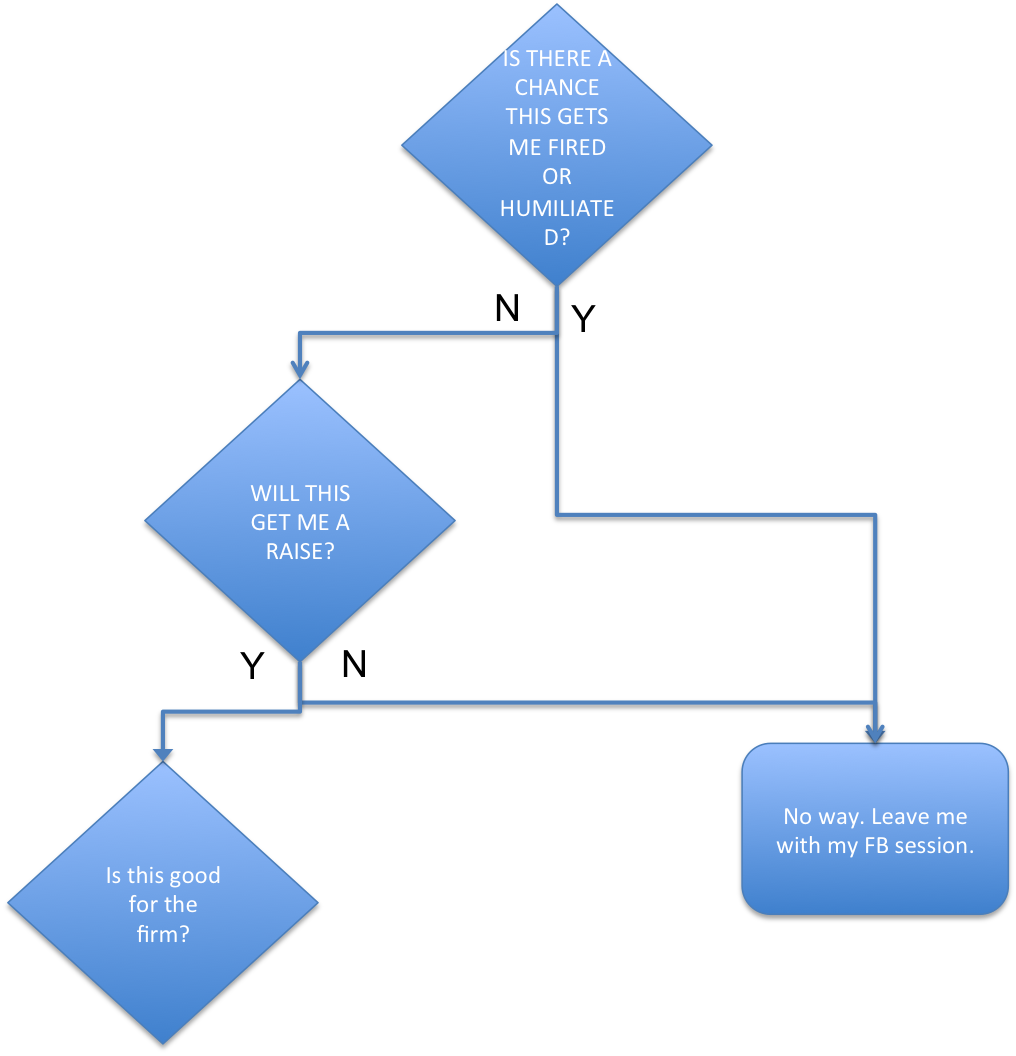
In corporate-land however, I’m suspecting that for a number of people in corporate, the decision making process for innovative actions are HIGHLY DICTATED by the simple diagram below, adding two more questions before one even considers the viability of the option:
Before you say, “That’s not true! That’s a hasty generalization!” Allow me to say that I think those two questions are but NATURAL for us to feel – since most of us don’t actually OWN these large corporations we work in. In your heart of hearts, do you REALLY want the MNC you report to to hit $100,000,000,000 or whatever the target is? Will you be like, all teary eyed and distraught if the target isn’t reached? Hmmm….I’d wager “I want to have a good career here” might just be the more powerful motivator.
Contrast this to a startup, where YOU CAN BE THE OWNER. In this case, your decision -making process will be a bit more robust – as your own motivations will be perfectly aligned with your startup.
Lesson here: do not allow your motivational compass to have “great salary increase” or “I don’t want to ruin this comfortable thing I have now.” as its True North. This will KILL your risk-appetite, not to mention make you very short-sighted, only going after the next salary increase. (and the next, and the next….)
Remember, while some of these things are easily observable, the way they change us is very subtle. Be on your guard and defend your entrepreneurial soul.
Universities Represent! (from L – R) Christian Go (ADMU), Albert Mercado (MAPUA), James Fernando (DLSU), me, Angeli Recella (DLSU), Red Bermejo (ADMU), Quina Baterna (ADMU), Luis Gan (UP)
I had an absolute blast early today with 6 awesome student leaders (sorry Angeli, you don’t count anymore) talk about ideas on how to propagate the startup movement in campuses.
Basically, the group introduced themselves to one another, ate doughnuts, and then the awesome brainstorming happened.
There is one big plan the group is concocting (to be revealed soon). The next step is to get more universities represented in the next meeting, when more concrete details, will be decided on.
The next meeting will be next Thursday (May 23) at 3:00pm (venue still to be decided on). If you are an entrepreneurial student who wants to help out in spreading the startup movement in your school, do send me a message at peter@juangreatleap.com to get a reservation for this next meeting, along with an explanation as to why one of the seats needs to have your name on it!
(the following is a guest post by multi-awarded entrepreneur Maoi Arroyo)
As a junkie of all things startup, I’ve always loved shows like Bloomberg’s TechStars. Whichever season you watch, these entrepreneurship-themed reality shows try to select the best teams as opposed to the best ideas. As Ed Catmull, co-founder of Pixar, famously said:
“The view that good ideas are rarer and more valuable than good people is rooted in a misconception of creativity. If you give a good idea to a mediocre team, they’ll screw it up. But if you give a mediocre idea to a great team, they’ll make it work.”
If there’s one thing I learned in the nine years I’ve helped tech-based startups get off the ground, it’s that business is a team game, and the firm with the best team wins. It’s unavoidable that the media and the public focus on the “front men”. Steve Jobs, Elon Musk, Dado Banatao: the charismatic and slightly kooky guys get the attention. People gravitate to “self-made” men.
Except that there is no such animal.
Show me anyone you think is “self-made” and I will show you at least three other people who helped get them there and are wealthy enough to do anything they want. Larry Page and Sergei Brin founded Google in 1998, and Marisa Mayer was employee #20 in 1999. If her name sounds familiar it’s because she’s now CEO of Yahoo. Why in the world would she want to be in charge of a floundering company like Yahoo? Because after you grow a company from 20 to 30,000 staff; you have enough money to be comfortable and you can do something ludicrously risky.
So the question is: if you want to be the next Google, how do you find a Marisa Mayer? Who do you recruit to your founding team and in what order?
The DOM
Sorry, it doesn’t mean what you think it means. DOM is shorthand for the person with Domain Knowledge. You want to start a restaurant? Makes sense to start with a chef. App Development? A programmer would be useful. Fashion? A thorough examination of the fashion portfolio and comparative analysis of chaka-ness is a must.
Domain knowledge can come from experience, education, or both. Choo Yeang Keat was a Malaysian cobbler who had been making shoes since he was 11. He built a respectable business which exploded when Tamara Mellon, accessories editor from British Vogue, partnered with him. Jimmy Choo’s shoes now sell in 32 countries for prices that regularly give husbands palpitations.
If you are the DOM, you’d better have geek cred and partner with someone who is market savvy and handle all those pesky numbers and “models” that always seems to be encapsulated in PowerPoint Smart Art. If you aren’t the DOM, find one and give them the role of Chief Technology Officer.
The Wizard
Some people call them mentors, but I call them Wizards. Wizards are both mentors and tormentors. It’s Merlin’s job to tell you that this Lancelot guy you’re thinking of hiring is cuter than you and your wife is into him. It’s Gandalf’s job to call you a “Fool of a Took” when you wake up the Balrog. The Wiz is going to provide you insight to the very important baby steps you should take BEFORE you found the company. Things like technology and market validation before you waste your money on a patent. In return for this knowledge, you should give them a part of your company EVEN IF they aren’t going to be involved in running it from day to day. 3% equity up-front or 10% vested over 3 years (translation: “3 gives”); in preferred shares that have no voting rights but get paid FIRST when you issue dividends. Like any RPG, your wizards will stand back from the fray and need time to cast massive spells. Keep them with you and don’t let them get overwhelmed.
The Anti-You
Isolate the key things that are characteristic of you and find someone who is the complete opposite. I’m the kind of person who can come back from the bathroom with 20 new ideas that I want to pursue simultaneously. I have a knack for exaggeration. Math classes gave me PTSD. No one has ever accused me of shyness or humility. So I found a detail-oriented, frighteningly accurate, introverted co-founder who inhales numbers and exhales cash. Naturally you have to have the same vision and integrity, but someone you respect has to stand up to you and pull you back from insanity.
The Spartan
The Spartans embody the philosophy that makes start-ups work. If one Spartan falls, another one takes his place. They work as a single unit. All of them are leaders. Filipinos seem to live in horror of having “too many leaders”. That’s because we misunderstand what leadership is. Being able to lead well is a skill, not inborn ability. You can get people to listen to you by being charismatic; leading them is something you have to learn how to do. It’s essential to be in command of yourself before you try and command others, and you must prove yourself worthy and deserving of your team’s trust in you with your every action. A leader for a startup is not “in the rear, with the gear”. They stand shoulder to shoulder, right up front. They are the tip of the spear. They are the first among equals.
The Spartan is your CEO. On very rare occasions is your DOM a Spartan. That’s because the critical job of a CEO is sales. You know how a Founder-CEO is pitching? His mouth is open. That’s all they do. They have a recruitment pitch, they have a sales pitch, and they have a fund-raising pitch. If your CEO can’t pitch, get another CEO. There will be no cash to manage, no team to enable, no world-changing company if they cannot pitch.
You can call yourself an entrepreneur but until you get a solid team and some cash, you’re just some wannabe with a great idea. Ideas don’t change the world, people do.
Don’t stay a wannabe.
You can learn the fine art of PitchCraft on Saturday, May 25. Karen Hipol, associate director of Carillion Partners, will teach you what to pitch and I’ll teach you how to do it. Attend the event and you get an opportunity in June to get in front of institutional investors, all for one low price! (See I told you all we do is sell). The PhP 500 discount ends on May 15th, and slots are limited. Sign-up today and build your dream team! – Maoi Arroyo
For the content it provides (great speakers, killer panel, chance for real pitches in front of institutional investors), I think this is a greatdeal, so you might want to grab tickets now.














 Reverse Spider Sense
















 JUAN GREAT LEAP