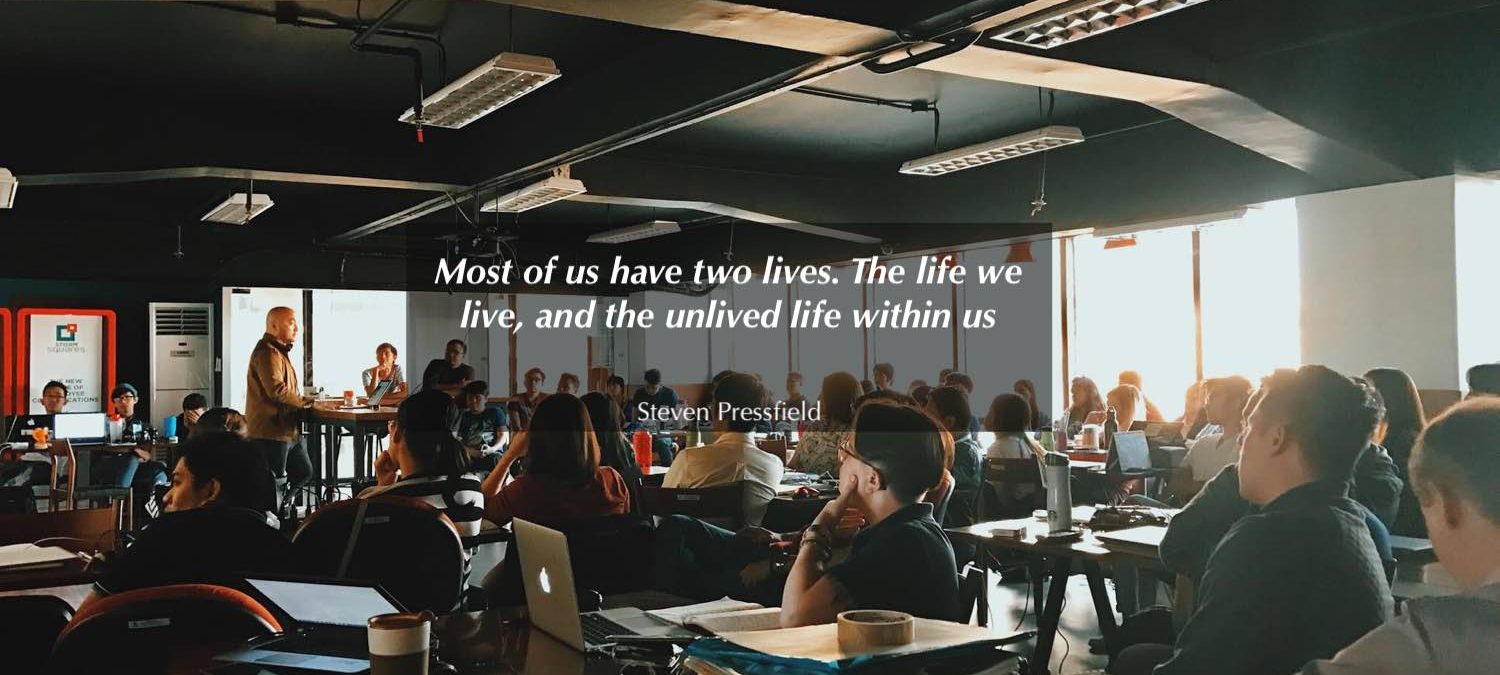
APRIL OPEN COFFEE NOW BREWING – TO BE SERVED ON THE 27th!

WHAT: APRIL OPEN COFFEE

WHEN: Saturday, April 27, 930 AM

WHERE: Bo’s Coffee, Bonifacio High Street

HOW MUCH: Just buy a cup of coffee as a form of thanks to Bo’s for hosting us

For those who missed the last Open Coffee (which included this part), you just HAVE to join us for the next one! As usual, the level of generosity, idea-sharing, energy, learning and overall do-goodery are expected to be at awesome levels.

For the reservations for this one, I’m going back to Googledocs, as it seems to have a lower flaker rate and we can ask for more information from you (to help us improve JGL content).

Do reserve a seat NOW by clicking HERE. Limited seats.

How to take your consulting/freelancing gig to the next level

levelup

I know quite a number of freelancers and consultants, engaged in a variety of services: design, HR Consulting, programming, writing, training, fitness, and so on.

These guys are cool – they are able to live the dream of being their own boss and at the same live comfortably.

Some of them are perfectly content with their lifestyle and current circle of clients. I remember one of them telling me recently:

“Why should I complicate my life getting more clients?”

(For me, this is awesome.)

Some of them though, want to expand and are constantly seeking ways to do so. Some have opted to hire an employee or two to help them grow. Maybe more.

If you are among the latter category, this article is for you.

Most of the freelancers, consultants, and consulting firms I know offer a whole list of services.

For a web design consultant, a typical menu of services would look like this:

Hey guys! I can do all these things for you! One-stop-shop-I-am!

– Website design

– SEO

– Website Management

– UX-UI

– Logo design

– WordPress design

– Marketing paraphernalia

– Print design

– Flash animation

– business card design

Moving onto another field, an HR Consultant’s list of services may look like this:

– Training and Organizational Development Consulting

– Performance Management Consulting

– Recruitment Consulting

– Talent Management Consulting

– Onboarding

– Workforce Planning

– Job Analysis and Design

– Job evaluation

– Salary Scale Development

This is all well and good. The intention and logic of offering many things are clear: more services, more chances of getting clients, right?

Here’s the problem.

Go to Linkedin. Search for “web design freelancer” or “HR consultant.”

(go ahead, I’ll be right here)

See the problem?

EVERYONE’S profile will look like mirror images of what I just typed above.

This strategy will NOT make you stand out and attract a market beyond your friends’ friends.

Here’s one branding strategy you can do.

one thingPick ONE thing in your list.

One thing you know you can do very, very, very well.

Then drop everything else. Build your brand about this ONE singular service. Make it the only thing to appear on your website.

OMG, Who did THAT Video? 

In a time when one-stop-shop wedding services were the rage, Jason Magbanua changed the game by delivering JUST wedding videos. Oh, and during that time, I think he even ultra-focused on just doing videographies of the Church wedding (to be shown a few hours after during the reception – I was just stunned the first time I saw this).

Armed with this intense focus, he managed to create his art – magnificent, awe-inspiring videos with a hip soundtrack.

Now, he’s a household name, and arguably created his own local industry.

I’m sure Jason could have offered the typical menu (photography, the album, stills, video editing, videos of the reception, maybe even the floral arrangements and coordination). But choosing but ONE service made him stand out.

The numerous advantages of ONE THING:

1) You stand out

What’s more memorable, saying:

I do consulting in performance management, recruitment, training, organizational development, job analysis, job evaluation, onboarding, HR policies, and Workforce planning,

or saying:

I am THE onboarding coach?

(onboarding – the process of making sure an employee is oriented properly and completely when he first starts in a job)

You can now name your consulting firm something like ALL ABOARD! and get a memorable url like http://www.allaboard.ph. Your website can contain interesting facts  and tips about onboarding. You can position yourself as THE onboarding expert.

Now, everytime someone thinks, “I’m having trouble with onboarding,” she will now think of YOU, and not think about about the kajillion other generic HR freelancers around.

Even if a couple of people in the kajillion might actually be better than you in onboarding expertise, guess who takes the credit for being the best?

If you were the client and you need onboarding consulting, would you go to a one-stop-shop or an onboarding expert?

If you are a startup and you need a lawyer, woud you go to a typical law firm offering generic “corporate legal consulting?” or a focused “startup lawyer?”

If you wanted to do a video on your website to explain your product, would you go to an all- around production house, or Stream Engine Studios, whose website very prominently states:

Hi. We’re STREAM ENGINE STUDIOS, and we make kickass animated explainer videos.

One thing makes you stand out.

2) You are forced to become great in that one thing

Since you are now focused on a single service, you can rally all your resources around making that one thing great. Yup, there is pressure in doing absolutely GREAT work in doing your one thing – this is how you have chosen to brand yourself.

But you know what? That is good pressure. Doing one thing great gives you a larger chance of recognition and success versus doing 10 “good enough” things.

Instead of keeping up with trends and continuously improving on TEN different things, you can just focus on getting better on one thing – which surely will cause radically faster progress.

3) Better scaling

Generally, consulting doesn’t scale very well – if you plan to grow you would need more and more people. Still, “one-thing-consulting” can still scale so much better than a one-stop-shop, where you need to think about multiple services and processes.

Let’s say you offer 5 different services and you manage to get 50 clients. What will happen is you will have, say, 12 clients you are doing one service for, another service for 8 clients, and so on. Can you imagine growing your company that way? It’s like growing 5 startups.

One service across the same 50 clients? Much easier to digest and build efficient processes for.

One last tip 

Building a brand takes time (and is so much worth it). Once you have an established brand which focuses on one thing? Expect a ton of passive referrals.

But what do you when you are just starting?

You can still offer the long list of services, but offer these privately to your immediate network (friends and friends of friends).

For example, if you were a design consultant, you could still offer the service buffet table to your current clients. Logo design for this client. SEO for this other client. And so on.

Your plan, however, is to be the business card design king.

So what do you do? While doing all your other projects, you have to simultaneously be working on building your brand around your one thing – build the focused website, learn a ton on business card design, survey the business card market, think of the amount of innovation you can do in the business card industry.

Then one day, when your business card profits are enough, you can drop everything else. You can truly focus on being the Jason Magbanua of Business Cards.

Gotta have that one thing.

(apologies – any spontaneous One Direction LSS is unintended)


Forget Your Career And Pursue Your Vocation

discernment

My So-called Career Development

For the most part of my adult life, I thought I knew what I had wanted to do.

I wanted to pursue a career in HR. I wanted to make money. I wanted to make my resume as impressive as I could possible make it.

And so I tried my very best to achieve these. I knew they would make me happy.

At particular points, I would find myself dissatisfied with certain facets. So, I just decided on changing some things along the way.

Not enough money? Join a better-paying firm.

Resume not impressive enough? Get an advanced degree.

Still not happy? Party and go out with friends.

In my fourth company, Chikka, I became extremely confused.

I was doing well.

It was a dynamic firm. I had a great boss. I made key decisions in my function. I was paid well. It was fun.

I SHOULD be happy, I thought. So I pretended a bit, trying to ignore my restlessness.

But I just wasn’t happy.

Almost instinctively, I thought of leaving for another firm. But I knew one thing which bothered me to the core: after 3-4 months, the novelty would fade away in my theoretical new firm, and I would be left with the same dissatisfaction I had wanted to escape from.

Was this how life is? Just trudging from one place to another like a plodding headless chicken? 

Could I start anew in another field?! No! How can I just waste a decade of my life and start from scratch?

This was how effective my “career management” endeavors ended up being. My own decisions brought me to the brink of desperation.

Direction

Finding My Vocation

In How God Founded Our Startup, I talk about how God intervened at this particular point in my life.

It wasn’t an instant thing.

I think I really only found Him around two years before that fateful leap.

Prior to that, I had no prayer life whatsoever (except maybe when I needed something, then I’d say a short prayer), I did what I wanted when I wanted. I would usually skip Mass. In retrospect, I never let Him be a part of my life nor of my decisions.

When I decided to really follow and love God – and get to know Him and talk to Him more consistently in prayer, things slowly started to change. I learned I needed to let go of the wheel and surrender. Very tough for someone as independent as me.

Little did I know that 2 years after, God would ask of me all that I found important in the world – money, titles, security, clarity, control – in making my great leap.

I had never imagined in my wildest dreams that I would be an entrepreneur, much, much, less a helper of entrepreneurs. It was never, ever a career option.

Up until I wrote the first Juan Great Leap post, blogging was something very very foreign for me. I never in my wildest dreams thought: “I want to start an entrepreneurial blog and a build a community of entreps who help one another.”

Yet, this is precisely where God has led me.

Only He could have designed something that fits me perfectly in so many profound ways, I cannot even begin to describe. I have found my vocation, and my soul cannot stop celebrating.

Career versus Vocation

When we speak of “vocation,” it is usually reserved for just describing someone entering the priesthood or the convent.

No way.

All of us are missioned. God has a purpose for EACH one of us, and until we find that purpose, our souls become restless. We may try to numb this restlessness with money, power, control, or even relationships, but until we find that purpose, I believe getting rid of this restlessness will be elusive.

Vocation hails from the latin word vocātiō, meaning a call or a summons. Quite literally, vocation means being were we are called by God.

path

Heeding our vocation  –  which connotes seeking and following what His will is for us – is quite a different process from developing our careers – which frequently involve mental decision making.

The goals of a career are quite different from what the goals of a vocation are as well. The goal of a developing a career will likely revolve around some of the things I mentioned earlier: money, power, security, control.

The goal of a vocation, meanwhile, is to find our place and God’s purpose for us.

Careers are typically goal-based. We try to find jobs that pay us x amount per month let’s say, or will allow us to travel to countries, or will give us a certain title, or a certain type of car. There’s an endgame.

Vocations, on the other hand, to quote Fr. Ramon Bautista, SJ, in a retreat I had earlier today, “are never ‘mission-accomplished'”

Putting it most bluntly: careers don’t usually involve God. It seeks satisfaction in the external, specifically, that which we do not have.

“My dream job is out there. I need to keep looking.”

Vocation, on the other hand, makes you look at your interior self.

How has God moved in my life? What are my deepest desires? What are the gifts God gave me? How and where can I use them best for Him?

These internal questions, which I now so often use when I discern, are so different from the questions I used to ask, when I decided: 

What field will I be happy in? How much will my minimum salary be? Are the benefits comparable? Is my boss cool? What is the salary increase rate here? How fast will I get promoted? 

For lasting happiness and fulfillment, I think it’s pretty easy to see here what to pursue. You’d be glad to know following God has a practical angle as well: God’s plan will surely involve developing the best you that you can possibly be, maximizing your gifts and talents. When this happens, opportunity abounds. (In the end though, the bottom-line is this, if you surrender to God, don’t you think He will be faithful and take care of you?)

My social media spat

I got a note from someone around a year ago who said something like:

“Religious faith has no place business decisions. I would understand things like ‘having faith in the company,’ but religious faith? I fail to see how that can help any business.”

After everything that happened to me, I felt like going nuclear on the guy.

But then I realized that I felt the same way just a couple of years ago. Come to think of it, I NEVER involved God before in my career decisions. In fact, it was a little weird to mix “careers” and “God” in the same sentence for me.

I’m sure a lot of us still feel the same way.

So perhaps its best to start with something most of us can agree with: God loves us so very much.

Incredibly. Uniquely. Infinitely.

If you believe He loves us this much, then surely, You have to believe He must have a unique plan for each of us. A purpose.

If we believe He does have a plan then doesn’t it make sense to begin the process of trying to find out what it is?

JOIN A STARTUP! – I’ve recently updated our jobs page

Updated job openings!

Please do find our updated list of job openings in our startup network!

You can click on the link at the menu above or just click here. 

You can contact either me (at peter@juangreatleap.com) or Angeli (angeli@stormrewards.ph) for queries or to send your resume.

Danny Moynihan’s Brilliant Open Coffee Moment

It was around 11:30 am.

marchopencoffee

I just closed the main pitching activity at the recently-held JGL Open Coffee activity and told everyone to gather at the hallway of 47 East to take a quick group pic.

And so we did.

After that, I told everyone it was free time.

You can probably imagine what happens next.

Wondrous chaos.

People began to just talk with one another. Small groups of 2, 3, and four people began to form.

Energy filled the room.

And then, incoming senior student Danny Moynihan unassumingly enters the room.

He quickly introduced himself to me, and then apologized for being late (he was from the south and got lost).

He then asked:

“Is the pitching done?”

“Yes, it was a few minutes ago.”

“Can I try to pitch?”

“Uhm…alright, let me try gathering them”

I then tried shouting: GUYS! CAN WE JUST GATHER QUICKLY FOR A QUICK PITCH?

I shouted again.

It was no use though.

People were very much INTO their conversations.

So I told Danny: “Sorry bro, it’s going to be tough to gather them like this.”

“Can I try, though?” Danny asked.

“Be my guest.”

Danny M
Danny gathering people at the adjacent room

After around 10 minutes, Danny miraculously got some of the people sitting down in an adjacent room, with half the people still having small conversations in the hallway.

Then, he got up on an elevated part of the room.

Then he proceeded to do what had to be THE LAST THING I’D EVER THOUGHT I’D SEE IN AN OPEN COFFEE EVENT.

You just have to see it for yourself: (go full volume)

Of course, by the time he finished, EVERYONE’S EARS were glued now glued to his every word. He then calmly gave his pitch. (and got more than a few people interested)

Now THAT, I thought, was pretty entrepreneurial!

(Lesson here: NEVER miss a JGL OPEN COFFEE session 🙂

Is There a Superman Your Clark Kent Can Become?

clark kent

In this early 2005 interview with Mark Zuckerberg, the Facebook founder described Facebook as:

“I mean, I just really want to see everyone focus on college and make a really cool college directory product…there doesn’t necessarily have to be more…”

Zuck was intent on just focusing in colleges. He was ecstatic with his 3 million users.

Then, somewhere along the way, he realized he was sitting on a goldmine. Now? He’s just passed his first BILLION users.

Sometimes, all we need is a fresh look at our business to experience an epiphany. 

Pao and I experienced the same thing in STORM around 2 years ago. (at a lesser extent than Zuck, obviously) We were making most of our money off of the monthly retainer we were charging our clients for using our flexible benefits system. It was evergreen. It was paying the bills. We were okay.

Then we that saw our online Flexible Benefits system was enabling a particularly large amount of transactions per annum.

Epiphany.

It was time to change our business model. We wanted to do it fast, so we went for broke and raised investor money (for the first time) to allow us to go after our strategy. Hard.

What is the big-league alter ego of you current startup? Is there a Superman your Clark Kent can become? 

The greatest enemy of a business owner is complacency. Even at the peak of your company’s powers, you should always ask yourself – how can I do things better? These new tools coming out – how can I use them to power my business? How can this idea be BIGGER?

You need to think about it carefully and plan.

Thinking of doing a bakeshop? Perhaps you can be the first social-media powered bakeshop – where you can tweet people that they HAVE to come over – because a fresh batch of pandesal is about to be taken out of the oven. (can someone please do this – freshly baked pandesal is just heaven)

Are you a database programmer who wants to put up a business? Instead of doing database consulting, perhaps you should look at big data opportunities in different industries and try to look for a real-world problem where data can be a solution. (there a lot – recruitment, cellular data, enrollment data, government, etc…)

Think bigGER!

Startups Unplugged – A Video Montage

The moment was captured. So real, honest, and simple. It illustrates the warmth and vibrancy of a growing community that supports and is open to collaboration. To all the leaders and feeders in the startup community, may this video fuel your spirits 🙂

The Software Guru tells the Real Story: On Startups, Bankruptcy, and Attitude (Part 1 of the Joey Gurango Series)

I remember texting Peter right after my interview with Joey Gurango, which was just days before Startups Unplugged. In my text, I asked Peter about what he thought about posting an uncut version of Joey’s interview on JGL. The reason for my suggestion was that after my interview with Joey, I was completely taken aback by the incredible knowledge that he was sharing with me; even though I wasn’t a techie, Joey’s stories resonated with me and schooled the heck out of me. Everything Joey shared with me just seemed so important, so I wanted to post everything that he said. While I must admit, I’ve omitted some parts of the conversation to be practical, this is still a very raw version of what Joey shared with me. I hope this piece will allow Joey’s stories and insights to speak for itself. The other portions of his story will be coming soon! In the meantime, sit tight and allow the sublime to take its course.

Joey Gurango of Gurango Software

When did you start and why? 

Joey: My first business was in 1981. I was at the University of Washington and I did a pizza delivery business. Out of necessity, I figured that most college kids living in dorms were too lazy to go down to the pizza place to get their own pizza, so I just setup a phone and gave out fliers. Then, I waited for people to call me and ask for an order. I had Dominos, Godfather’s, and Pizza Hut menus and they [the customers] would call and tell me what they wanted. I’d put a 15% surcharge on whatever they ordered, but I would get their money first (Joey chuckles). The pizza delivery business was actually my first real business. My first real tech business was in 1984. I had worked for apple computer for a little over 2 years. The Macintosh just launched, and I got this idea to make something called desktop furniture for the Macintosh. So with that I started a company with some money because back then it was really expensive to build injection mold products by the mold. Everything was going great…and then in 18 months we went bankrupt, so that was my first experience.

Why’d you guys go bankrupt?

Joey: ‘Cos we spent more than we made. Real simple. We were making a lot of money. I think the first 6 months, we had over $1 million in revenue. But then the next 6 months, it didn’t quite reach a million dollars. Then after that, I decided that I didn’t want to be in hardware anymore. I started my first software company… that was 1987…Match Data Systems. I started that doing excel custom programming. In 1991, I decided to move the company back here [Philippines]. By then Windows had come out, so we moved from Macintosh to Windows. We were one of the first, as far as I know in Asia, that were doing Windows development work. One thing led to another. In 1999, by then we kind of branched out into ERP software, a company called Great Plains software acquired us, so we become Great Plains Philippines. Two years later, Microsoft acquired Great Plains, so I become a Microsoft employee. Then, I stayed with Microsoft for two years in 2001. I’ve basically had three jobs in my life. My first job was with Apple computer. My second job was with a training company for less than year. My third job was with Microsoft. Then I started my first software company and haven’t really worked for anybody else, until my company was acquired, so technically I was working for a multinational company, but it never really felt that way, which is why I left.

Why did you move back to the Philippines?

Joey: My first company did custom software development. First for the Macintosh. We did a lot of excel work…a lot of data base programming for the mac. The problem was, since we were doing a lot of excel work, I would train these fresh grads on developing for the graphic leisure interface, and then because Microsoft was really heavy into doing Windows development back then, they kept hiring them away from me. Microsoft would give them double the pay. I was getting frustrated because we were losing programmers in the US. Our office was literally a 5 minute drive away from Microsoft headquarters. At the time, my brother was visiting the States from the Philippines. He says, “You know we have programmers in the Philippines?” “Really? Do you even have PCs there [in the Philippines]?” I said. He replied, “Oh yeah! We have dBase programmers.” So that’s when the idea struck me that I could have the company in the Philippines and continue servicing my US customers. And it would be cheaper, and I wouldn’t have to worry about losing these guys because nobody else would hire them because we were doing stuff that nobody else was doing. That’s why I came back. We were doing offshore outsourcing before it was even a term.

What experiences or skills from abroad did you find most valuable for starting up in the Philippines? 

Joey: The one thing I’d say it’s not really a skill or experience, but more of an attitude. Through the years I’ve realized that the only difference, in general, between people in the countries like the US and here, when it comes to things like business and startups, is not knowledge, skills, IQ or EQ, but the big different shader is the willingness to risk and face failure. In the US, it’s not a big deal if you’ve started a company or even failed for that matter. My first real company went bankrupt after 18 months. We raised $250,000 in investor funds to start that company and in 18 months it was all gone. We never gave the investors back a single cent. Nobody was coming after to me trying to have me assassinated. There’s no shame in it. There’s no social stigma with that type of failure in the US. If I were to say what was the most helpful thing was to bring that mentality over here. Compared to most of the local technical guys, I was pretty fearless. I was willing to buy stuff that nobody else would consider. However, I’ve come to learn that taking the entrepreneurial path is not that risky. If you do it in the right way –like all the things I’ve learned just in the last five years- if you know how to do business modeling, practice lean startup and customer discovery, test and validate assumptions, it can be quite low-risk. It’s still not as low-risk as getting a job and a consistent paycheck, but it can get pretty close. I think if I knew what I knew today, it [the business] wouldn’t have gone bankrupt, but I would have shut it down a lot sooner. Now I can say that it’s not really that risky to be an entrepreneur, if you know how to do it right.

LAST CALL! DON’T MISS THE JGL OPEN COFFEE AT 47 EAST THIS SAT!

JGL OPEN COFFEE2

It’s OPEN COFFEE TIME again this March 23, 930 am at the 47 East Facility at Loyola Heights.

We’re inviting all startup-minded folk – veterans, startup newbies, and especially those who wish to take the leap – to drop by this awesome venue to both learn and network!

For those new to this monthly gathering, the format of OPEN COFFEE is pretty unique – everyone will have a strict 2 minutes to make a pitch. A pitch could be ANYTHING – a business idea, a call for advice, a call to partner, a recruitment pitch, etc…

(Well, anything EXCEPT doing a hard sell of an existing product or service)

And as those who’ve been to past sessions can attest – these sessions are AWESOME.

Do reserve your slot by clicking on the Eventbrite button below:

Eventbrite - JGL MARCH OPEN COFFEE

As per tradition, we shall be holding the event in a startup-related venue.

This time, it will be in a newly constructed co-working space near the Katipunan University belt – 47 East. (I was there a couple of days ago – it looks fantastic! Pictures below.)

See you there!

47east1 47east2 47east3

5 Things I’ve Learned from Startups Unplugged

I’ve been trying to push myself to blog Post Startups Unplugged, and share all the instances of serendipity that truly made this miracle happen. However, I thought that it would be more effective if I were to cut to the chase about what I actually learned from it all. Here it goes! These are the 5 things that I’ve learned from Startups Unplugged:

Ask and you shall receive.

I had no shame in asking sponsors to join Startups Unplugged. This is how I usually got in contact with a sponsor:

A kind individual would give me a business card of XYZ individual from XYZ organization, and I’d literally call that person on the spot, even it if was the direct line of the CEO. It might sound too crazy or too bold, but it was a highly effective approach; about 80% of the sponsors that I talked to agreed to sponsoring the event.

Don’t get me wrong, I know that I had a sweet pitch for sponsors because of the incredibly awesome line-up of entrepreneurs that graced us with their presence for Startups Unplugged. The point I’m trying to convey in sharing this experience is to highlight that the simple act of asking makes all the difference in whatever you do. Making that conscious effort to ask is the catalyst to making deals happen.

Set your mind to work with purpose.

As with all startup journeys that start without any capital, it has been a rough and bumpy road. Moreover, as an inexperienced junior entrepreneur, I felt like there were things that I just didn’t think of or understand. I told myself if all else failed in my move to the Philippines, the one thing that I was determined to do was make this event happen. Because I had this mindset, I was able to do things outside of my usual self.

Facebook Ads Work.

On average we would get about 200 views for posts on our FB page. When Peter paid for promotion on FB, the views shot up to as high as 10,000 views. While it’s a big bummer that non-paid posts spark limited visibility, paying a little extra to promote does make a huge difference.

Evenbrite is an awesome tool for event registration! 

I recall getting into a heated discussion with Peter after his recommendation to use Evenbrite for JGL’s Open Coffee. Using a type of registration, in which participants would print-out tickets to attend a coffee chat, just didn’t make sense to me. Eventually, I realized I was wrong about it (Sorry Peter 🙂 )

Eventbrite makes it really easy for event organizers to keep track of attendees. In addition, it allows them to easily communicate with attendees and send attendees updates about the event and post-event activities. Eventbrite is truly a dynamic tool that makes event registration clean, simple, and easy.

Don’t Do it Alone! 

As tempting as it is to play the role of superman, don’t do it!  When there is a strong purpose or cause to what you are doing, people will gravitate towards you. Be open to people’s help and goodwill, and build together!


Justice League by DC Comics