How To Shut Your Way Up To Sales Success

zip itBack around 2007, I remember being thoroughly underwhelmed by the CEO of a multinational company our startup competed with. Our companies were summoned by a client in a joint meeting to compete for a bid.

I distinctly remember telling Pao: “The guy didn’t say anything and just wrote down notes. He was so unimpressive.”

Little did I know that not saying anything and taking down notes were quite strategic in one on one sales, so much so in B2B sales. Stubborn that I was, it took me a year or two to incorporate the same strategies in my own sales meetings.

Back then, whenever we did sales pitches, people would always react at how young we were – and this always felt like a hurdle in the selling process. (as the years went by, losing hair and gaining pounds remedied this – ah, the perks of baldness!) This, plus our being rookies in the industry, made me feel a gap in credibility.

So in the back of my mind, whenever I’d go to pitches, I thought – “I have to prove to this person how capable I am.”

So my pitches early on became exercises in hearing all about how great we and our products were.

One BIG problem: clients don’t care about how great you are. They only care about how you can help them out.

I remember seeing this in their faces before: they WANT to say something but I was so busy wanting to blurt out my “piece” that sometimes I didn’t let them get a chance to.

HUGE mistake.

The whole pitch has to be about the client. How can the product help them out? What’s in it for them? It only becomes a great product if they can see how it helps THEM to be great.

Listening and writing down notes are great visual indicators that the client’s needs are precisely what you are prioritizing. I’m not talking about putting on a show though – you really have to listen. Authenticity is pretty easy to sniff out. The client’s needs HAS to be first.

A client who is excited, talking, and feeling good about herself and her company is a much more likely sale than the one who is repressing herself to listen to someone saying how great they are.

Putting themselves first is a great temptation especially for new entrepreneurs. Entrepreneurs are entrepreneurs precisely because they have a lot of confidence in themselves. They also usually have a chip on their shoulder – a great need to prove something to the world. Inviting them to talk about their passions could easily turn into a couple of hours of monologue.

Overall, this is a good thing. Entrepreneurs need this to go through the roughest cycles of the job.

Just remember to rein it in sales meetings: just give a concise, well-thought pitch…

And then shut the hey up.

Why Slow and Steady WON’T Always Win the Race For You

turtleGrowing up, I was always told that it is through consistent, regular effort that we make great things happen.

Experience has taught me that this isn’t always the case, moreso with a number of “great” things.

For example, the people I know who have undergone uber-dramatic (and lasting) weight loss did it by doing something drastic in the beginning – like a month of little to no carbs coupled with really small portions. For those of us who love eating, you know how difficult this is – a truly supreme effort. In a month, results became obvious and motivated my friends even more to see things through.

For these friends of mine, “slow and steady” efforts over years never yielded the results they wanted.

True progress only started after a relatively short period of intense, concentrated effort. Results are obtained. Maintenance, as everyone reports, is much easier afterwards.

There are examples all around.

I know certain people who have carved out successful careers out of working their tails off in landing ONE humongous account.

Law and medical students studying the lights out for one exam which will dictate the course of the rest of their lives.

Slow and steady doesn’t always apply because life itself isn’t slow and steady, right? Life is composed of seasons -peaks and valleys. Times of abundance. Times of scarcity.

Times of varying degrees of opportunity.

Opportunity doesn’t come from a slow and steady stream, doesn’t it? It just presents itself.

This is where intense bursts of effort trump steady distributed effort nearly every time. When the opportunity comes, you usually have to be able to exert a great, drastic effort to grab it. The great effort will usually allow you to grab a foothold – something that slow and steady effort might not have allowed you to do so. Then, in a lot of ways, it becomes just a bit easier.

This is very very true in startups – especially in the early stages.

Looking back when I was starting, this was so true in so many ways:

Recruiting the right partners – and casting a large enough net to do so – for STORM required me to spend almost all of my weeknights for around a month talking to people.

Landing that first client in as a B2B firm (so crucial to get a first reference) required a great, drastic effort on our part.

Finally leaping from corporate required a great burst of sacrifice, planning, and work. (and prayer)

concentrate

Want to put up a startup? Your slow and steady approach might not cut it (and for some of us, I know it’s been frustrating)

Do something drastic in a short, concentrated burst of great, grand effort. Focus this intense effort on the fulcrum issues which are causing your startup to stall.

Need funding? Reach out to 100 strategic individuals. Give yourself 5 working days to do so.

Need a co-founder? Arrange 8-10 interviews a day for a full week.

Need an idea? Need to validate with the client? Need to build a prototype?

Instead of spreading things out, try bursts.

Oh, you’re doing this part-time? Just take your 5 “vacation” days off and do the exact opposite. Plan these 5 days out carefully – what you’re going to be doing for your startup in every hour.

Try bursts.

How many times have you been called CRAZY?

How many times have you been called crazy? How many times has someone told you that you couldn’t do something? How many times have you had a good idea and let it disappear into nothing? How many times have you despaired? How many times?

190px-Question_mark

I’ve been called crazy for thinking I can change the Philippines, so many times.

I’ve been told that it’d be impossible to start a business at my age, so many times. I’ve let ideas disappear, so many times. I’ve despaired too many times. So many times… and yet I’m here.

Yes I am here, and so many times people have asked me,

“Why are you here?”

What I want to tell them is:

“I am here because I choose and want to be here. I see a brighter future for me in the Philippines. I love the Philippines. I am Filipino and I know God made me Filipino for a reason.”

Ask me how many times I’ve actually articulated this.

Why can’t I say it more times?

It’s a lot to live up to and I see myself as no one to speak in those terms.

But how does a person define one as a nobody? Dapat bang maging sikat before one is recognized for existing? Are one’s thoughts, values, and actions worth more if you are more popular?

Why not be crazy, if you have a persistent itch…be unreasonable, if you have a clear vision..be stellar, if you’re gifted?

No matter what they think of you, why not just be your best self?

Giving it your all is how you’ll see the path that’s truly made for you.

Photo Credits: Tony Wijaya Model: Charis Yue
Photo Credits: Tony Wijaya
Model: Charis Yue

“LET IT SHINE! LET IT SHINE!”

Do you feel me?

The truth is, no matter how many times I fail to articulate with conviction, I know what I want. I want to be a successful entrepreneur, and in my own way, help build the Philippines and its people to new heights.

I’m still finding the exact steps as I work towards my end goal, but the opportunities are endless, I am telling you. The more I am exposed to, the more my horizons are stretched, and the more I see that impossible IS nothing.

It’s just a matter of believing and seeing the light in a bright and beautiful Philippines.

Hope Is the Common Entrepreneurial Thread

I have interacted and talked to a multitude of startup entrepreneurs over the course of these last few years.

You can bet I have tried to figure them out.

What is the common thread?

What makes an entrepreneur?

There are a number of things which stand out: tenacity, hard work, execution, with good doses of people skills and creative problem solving.

You’d probably find these characteristic in a number of entrepreneurial books and blogs.

What I realize now though is that perhaps the most common thread is a bit more rudimentary. It isn’t a skill in as much as it is a paradigm, a state of mind, a way of looking at things.

It’s hope.

sunrise

All startup founders I’ve met are hopeful people.

It sort of comes with the territory.

Lean Startup author Eric Ries describes a startup as:

A startup is a human institution designed to deliver a new product or service under conditions of extreme uncertainty.

If you take this level of uncertainty and couple it with the sobering thought that up to 70%-80% of startups fail?

Well, you sort of NEED to be a hopeful person, right?

But there’s more.

Perhaps the best illustration of hope in the entrepreneur is the way she conquers Hope’s polar opposite – Fear.

“This will never work!”

“This is going to be B-I-G!”

“I will be out in the streets begging for food if I fail!”

“If this doesn’t work, I can just go back to corporate. No problem.”

“I will be laughed at!”

“I will be the next Zuckerberg!”

“It’s a recession. This is a very bad time to startup a company!”

“It’s a recession! There’ll be hundreds of opportunities to start a company!”

How we see what the future holds largely dictates what sort of risks we take.

A hopeful person will take many leaps. Even if some of those leaps fail, they’ll think well enough of the future that they’ll take even more leaps.

A fearful person might not take a single significant leap at all. (not realizing that stagnancy in this new, ultra-dynamic economy is the worst risk of all)

In fact, the very interesting thing is that a hopeful person doesn’t see risk at all. She sees opportunity.

opps

When you attend meetings of entrepreneurs, want-to-preneurs and startup owners, there is a certain energy that fills the room. It is palpable. Get these people together, and almost immediately, discussions about a better future happen – a new business concept, possible partnerships, new ways of working together.

This energy, this hope, is what I love about the startup scene and talking to entrepreneurs. I seldom saw this in my corporate stints. Hope is engrossing, uplifting, and contagious.

Want to put up your own startup someday? Perhaps one stumbling block is your mindset.

You just have to get rid of your dark glasses and look at the world with rosier lens. And you know what?

You CAN change a mindset.

Like love, hope is very much a decision.

For the Young Entrepreneur: Do not Fear the Lingo, Get down with it! (Even more fun with wise friends!)

(Matt Lapid will be regularly posting original articles with me here on JGL, with the perspective of being brand-new entrepreneur. Heres his second article. As usual, please tell us what you think with the content we are pumping out for you. Gracias! – Peter)
256px-Math

“So is it a B2B or B2C…Kasi pwedeng B2C…Pwede rin B2B, but you need to define your niche market and validate…BOOTSTRAP…Looks like you have an MVP!”

This is the lingo that resonates after being with JGL for one week. Initially, I felt like “huh?” all the time.

“What’s a B2B? I never took calculus.”

In spite of my ignorance, I understood that even if I were to attain a tiny bit of knowledge of simple business terms it would give me a deeper understanding of the negotiations being made around me. So I made sure that if I didn’t know a word, I’d jot it down and look it up. That simple act of discovery made all the difference.

As a result, when Peter articulates that tech enterprises can be looked at in terms of both B2B and B2C, I can at least understand that he is saying that their business relationships can be based on a Business to Business or a Business to Consumer interaction. It’s a small feat, but understanding the lingo that’s being used nurtures free-flowing discussion, in which the speaker doesn’t feel confined. In my relatively minimal exposure to entrepreneurship, I’ve observed that the free-flowing, out-of-box thinking is where the best ideas are conceived and the best work is produced. If we do not allow our minds to run free, we will not create our best work.

In addition, if we seek to work efficiently, we must equip ourselves with the right tools to do so. At times, as young and passionate people, we want to do and do out of anxiety, but if we’re doing things on our own without the proper knowledge and guidance, success will be near impossible to attain. There are so many of us who have the passion and allow it to drive us, but that passion will eventually burn out, if we run without an understanding of business.

On a brighter note, there are many seasoned entrepreneurs that would love to teach you. I’m not sure exactly why this is because entrepreneurs are some of the busiest people around, but from what I have inferred it’s a type of pay it forward approach, and perhaps even a little narcissism that goes into play.

Let me explain my hypothesis.

Seasoned entrepreneurs see themselves in us. That entrepreneurial itch that you have is the same type of itch that compels entrepreneurs to move. That passion and tenacity that you possess is the same force that drives entrepreneurs day in and day out. Seasoned entreps can spot that entrepreneurial energy and determination. They see themselves in us young folk, and want to help by sharing their knowledge and experience because it is actually gratifying for them to see us succeed, as so many others have done for them.

For us young and aspiring entrepreneurs let us not fear what we do not know. Let us not act like we have all the answers. Let us be real and learn from one another.

I leave you with this list of common terms I hear on a regular basis, which are simply defined. Taking in consideration that these are the bare bones of rich definitions, let’s spark some discussion and provide some insights! Perhaps, we could even add to the list to gain more knowledge! Anything goes, as we long as we learn together! Do hit the comments!

List of Terms Defined:

1) B2B– Business to Business

2) B2C– Business to Commercial

3) MVP– Minimal Viable Product

4) YTD– Year-to-Date

5) Bootstrap– act of starting your business with the resources you have without any outside funding at all

6) Traction– indicator that tell us if the business has generated revenue

7) Cash Cow-moneymaker but possibly stagnant

8) SRP– Suggested Retail Price

How to Avoid The Marshmallow Career

marshmallow_test

In a landmark study done in 1972 by Stanford psychologist Walter Mischel, hundreds of children were offered a marshmallow. However, each child was told that if they could resist eating the marshmallow for 15 minutes, they would receive a second marshmallow.

Decades after, it was found that the children who delayed gratification (around a third of the 600 students who participated), were described as more competent, had higher SAT scores, and went on to have better careers.

A few days ago an entrepreneurial friend of mine posted a quick “Pera o Passion?” poll on his Facebook page. The last I checked, “pera” was leading.  It was understandable, but I have to admit, I felt a bit disheartened.

Quick money is almost always un-strategic.

Let’s talk about this overused word for a minute. For me, to be “strategic” means that decisions are always made to support a much bigger picture. To be truly strategic almost always means to defer gratification. Think Amazon delaying becoming profitable for so many years (CEO Jeff Bezos was barbecued in the media in those days). They were burning hundreds of millions to acquire customers year after year because they were after the bigger picture (a much larger community). This long-term plan paid off. Amazon is now one of the world’s most admired and successful companies.

I think very few of us  really think about our careers strategically.

Instead, most people eat the marshmallow.

A friend of mine recently reached out to me about career advice. He was explaining that he wanted out of the industry he was in, that he would never go back to it. A few weeks later, a high paying job became available in a company he really admired. I noticed it was in the same industry he was in. In a recent email, he was asking me for tips on how to get into the that firm.

Huh?

He’s eating the marshmallow.

We fall for it early. After years of not earning anything, we finally attend job fairs and get dazzled by the offers we get. Sadly, most people still decide to go to the highest bidder, where the assembly line starts and is built to keep you in.

As we get older, we then feel it:

This money thing isn’t as cool as I thought it would be. 

I’m earning, but I’m not living. 

What field/job can I be truly happy?

or even

Hindi ko natutugunan ang aking pagmemeron.

Quarter life, or even mid-life crisis, at its full hurricane force.

If we ask the people who voted for “pera” in that earlier casual survey 20 years from now, I’m guessing the pendulum would shift to the other side.*

So what am I getting at?

Young people. I’m talking to you. Don’t fall into this trap. Take it from us (slightly) older folks. Think about your careers strategically.

Repeat after me. Big picture. Big picture. Big picture.

Here are some tips on how to avoid the marshmallow career:

1) Take Time to Understand YOUR Big Picture

I think this is where a big chunk of the problem lies. We lack self-awareness. We don’t invest enough time understanding who we are, what we like doing, what our natural gifts are, and what we want to be when we “grow up.”

As some great military people once said “knowing is half the battle.”

Take time to assess. Ask friends about what your strengths and weaknesses are. Take personality tests. Ask people about other careers.

Granted, this won’t be automatic, as “finding out who we are” can take a long process. But I think part of that problem is, we don’t really put enough investment in consciously trying.

Try. Perhaps asking this simple question can help start the process: who am I?

Also, think about YOUR big picture. Not your parent’s. Not anyone else’s.

2) Work Backwards

Once you have a reasonable idea of your Big Picture, do a Covey and try to Begin With The End In Mind.

begin

What career move can you do NOW that will inch you closer to your Big Picture?

Since this is an Startup Blog, here’s my quick tip on what next career steps you can do if you want to own a business someday:

A) Go fulltime and take the leap! Startups are all about learning through doing. Anything else is a bit of a  compromise. Try naming a great startup which was done part-time.

B) Work for a startup. Next best thing.

C) If A & B are too unpalatable, you could: 1) get into sales – it might not be that sexy to some, but selling is an extremely valuable skill to develop in any startup, 2) get into the industry you plan to develop your startup in, the smaller the firm, the better, 3) get into anything which expands your personal network in a hurry.

3) Just Say No

Okay, you’ve got your Big Picture. You’ve got some semblance of a plan on how to get there.

What are you going to do when Company X offers you a big package from out of the blue because your friend gave a good recommendation?

Think Amazon. Think strategic.

If something tempting comes and shows you all the shiny things you can have now if you break your plan, well, just think of all the SHINIER things you could accomplish sticking to the plan.

This is easier said than done, of course. But possible.

4) Pray

By far, my best career advisor has been God. My best career decision-making process has been Discernment. I’ve always maintained that it was He who really pushed me into an entrepreneurial path.

Here’s an interesting thing.

I belong to a Community  which really encourages its constituents to pray, talk to God, and surrender to His will. This group has a disproportionate amount of people who have taken leaps from their long-standing careers into what they truly want to do. A longtime banker who has become a pre-school teacher. An longtime FMCG executive who now works for a foundation. Another longtime marketer who put up her consulting practice. A longtime IT employee who’s put up multiple small businesses. There are more. All of which would tell you they had the courage to take the leap because of prayer.

You should see their faces when they explain how happy they are in their chosen fields. Passion is always evident.

As is the lack of it.

(know anyone who will benefit and resonate from this post? be a blessing and share!)

self-awareness

*The big assumption of course, is that we are earning enough to cover our basic needs. Maslow’s hierarchy in full effect. 

Startup Resources Galore From Steve Blank

Quick one. Just had to repost this. This is a tremendous resource for anyone who wants to know about how modern entrepreneurship and startups work. Assembled by startup guru Steve Blank.

Do enjoy reading it, learning from it, and most importantly, start building something out of it!

Matt Lapid’s Juan Great Leap – All The Way from California!

Matt Lapid is Juan Great Leap’s official first hire. I first got in touch with him when I opened my email account and got to read his very convincing cover letter. It’s quite apt that the hire happens two days before JGL’s first year anniversary. I thought I found a kindred spirit talking with Matt during the interview process: his passion was very evident, he was a God-fearing person, he had this genuine desire to give back, he writes, and he took this great big leap of faith.  Here’s Matt himself  with his story. – Peter

Hi there! My name is Matt Lapid. I am a Fil-Am, born and raised in the States. I’ve decided to take one great leap by working with Juan Great Leap. Pretty direct approach, right?

So this is my story. I graduated from college in 2010 with a BA in English Lit from UCI. I took a life-changing trip to the Philippines right after I graduated. I only planned to stay a few months to learn Tagalog, but I ended up staying for a whole year to help with Gawad Kalinga’s Center for Social Innovation. Work with GK CSI changed me. It opened my eyes to a Philippines in which change could happen and was happening right before my eyes. It was a total immersion that was a challenging experience for a Fil-Am who was in search of his identity and struggling to integrate into the Philippines, but it made me.

After missing my mom’s 60th birthday and my cousin’s wedding, I finally returned to the States. These were the realities of being away, but in spite of all the things I missed, I came back unlike my former self. I felt changed and made for something else, and it was evident in my first full-time job in the US.

As absurd as it may sound, I ended up working as a personal banker for a financial institution. I felt that I could really help people with a very relevant problem crippling Americans: money. While I was working, I felt a void in my heart. During my seventh month with the organization, they gave me the opportunity to become a licensed banker, in which I’d receive training and a sizable bonus. However, if I were to take that offer I’d have to commit to work with the company for another year. It seemed like an eternity for me. I knew how much a year’s worth of work could do in terms of social impact, and I just couldn’t make a change if I stayed, so I put my two weeks and left.

I ended up doing consultancy work for Human Nature USA, the US arm for Human Nature, a social enterprise that offers natural personal care products to help poor farmers in the Philippines. It seemed like the perfect fit for me. I could live out my dream of helping the Philippines while staying in the US with my family. That sense of purpose drove me, but reality sunk in. I was in a position in which I couldn’t sustain myself, and the passion and purpose that drove me collided with the realities of life. As much as I wanted to make my work with the organization work, it unfortunately didn’t.

So I deeply discerned about what I really wanted and what God was calling me to do, and I realized that the mission never changed. The mission was, and is, to make an impact on the poor in the Philippines through entrepreneurship, and for me that change starts in the Philippines and with Filipinos, not abroad.

But after two failed endeavors in social entrepreneurship, I really questioned a lot of things. Was I really supposed to be a social entrepreneur? After all, I graduated in English. Perhaps, it just wasn’t for me. I was scared to move.

With a friend’s recommendation, I discovered Juan Great Leap. I was immediately mesmerized by the wisdom and spirit this Peter Cauton was illuminating. Reading JGL’s posts gave me a sense of validation in what I was doing and where I was being led.

In his blog, entitled, “The One True Risk I faced in taking the Startup Leap,” Peter notes, “If you have that itch, there is no sense stalling. Take that leap now.” It was plain and simple. I’ve had this crazy itch and I knew it would persist. I was so anxious to move, but I just couldn’t because I was over thinking. JGL’s simple words validated everything for me. The vision was clear and all I needed to do was take that Juan Great Leap.

After reading through JGL’s blog, I immediately sent Peter my application attached with a CV full of crazy conviction, a side of me that I don’t readily share due to fear of rejection. Yet something intuitively told me that I could spill out my heart and soul in this correspondence, and, indeed, Peter replied! After that correspondence, I met Peter via Skype for a couple of hours. We scheduled another followup interview via Skype for the following week, but I booked my ticket a couple of days after. Though the future was still uncertain, I took my first leap in flying to the Philippines without that crippling fear of the unknown.

And now I am here in Manila taking the leap to urgently move for myself and others. It’s a big move but it’s Juan Great Leap that I have to take!

@ LAX airport…getting ready to take my Juan Great Leap!

Saturday Night Gimmick!

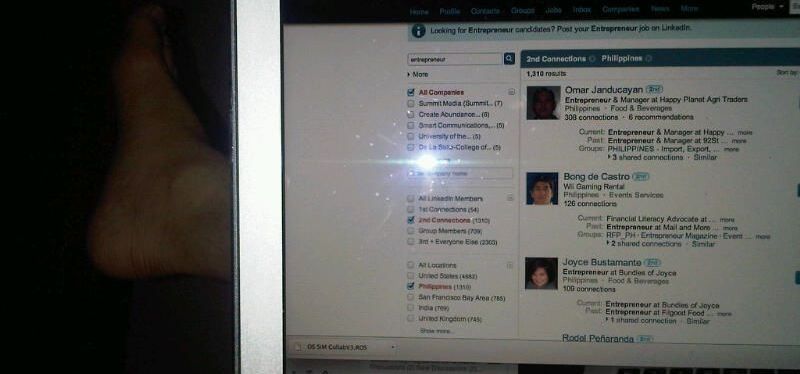
It’s a Saturday night. I’m a bit tired coming from a party. The kids are asleep. Pauline’s on TV. After a full week, I’m on my bed wanting to relax and have my me-time.

Three things to choose from: a book to read, NBA 2k13, or surfing the web.

I choose to surf the web.

What do I end up doing? Going to Linkedin to recruit for some startup openings we have.

One way to look at it: that’s pretty sad, man! 

Another way to look at it: I find work fun, and I’m not trying to escape it. 

Work on something you love. It’s becomes a virtuous circle.

Yep, that’s my foot!

5 Things I Learned in Raising Investment Money

You guys know that I’ve always advocated bootstrapping.

I will ALWAYS advocate bootstrapping as the way to go. But when someone asks me if she should raise money though, I never ever blurt out a “you should always bootstrap first.”

The real (sometimes frustrating) answer is of course, “it depends.”

It depends on whether your idea needs a lot of capital to begin with. It depends on the market. It depends on how defensible your position is to new entrants. It depends on your market adaptability rate.

Sometimes, it also depends on where you want to take your startup.

Our first bootstrapped startup, STORM, became profitable on around its 3rd year, then it just grew pretty fast during the next 4 years, all organically.

Then, my business partner Pao and I saw a new business opportunity for STORM, a new strategy dripping with potential, but one which  required a sizeable capital investment – a bit more than what the company could afford using its own funds.

So Pao and I talked about it. We came up with two initial plans:

Plan A: Go on our current organic trajectory (which wasn’t bad)

or

Plan B: Go for the new strategy by raising money and sacrificing equity.

Being the entrepreneurs that we were, of course we went for Plan B. BUT, we said that if we didn’t like the terms, or if we didn’t feel fully confident with the would-be investor, then we would do a Plan C and try to make it work ourselves. (nope, plan A was never considered)

So around a month ago, we began the process of raising money for our company. It was our second time to do so.

The very first time we tried raising money was back in 2004 when we started STORM. We failed to raise a centavo and resorted to try doing it ourselves (which in retrospect, was a blessing).

Around a week ago, we got the verbal go for a substantial sum – exactly what we needed to shore up operations in line with our new strategy.  More than that, we partnered with a great investor whom we felt could help us take the company to the next level.

Here’s what I learned from the whole process:

1) Traction Reigns Supreme

Traction can be defined as the startup’s history of actually making money. Which, you know, is what companies are supposed to do.

Traction means everything on the entrepreneur-investor negotiation table. Without traction, the negotiating power of the entrepreneur falls considerably.

The best asset any negotiator has in any negotiation process is the ability to walk away from the deal. Traction gives the entrepreneur the much-needed leverage to say no and find the best deal available. When we did our pitches to investors, we were able to show them 5 years of increasing profitability and a host of longterm relationships with substantial clients. We had no problem finding people interested in investing, our problem then became choosing who to partner with.

This is a much better problem than the former.

2) The Founding Team Counts

We’ve always heard investors say, “we bet on the jockey, not the horse.”

This is true. Investors will not merely give their time and money to anyone with a grand idea. The idea is secondary. Who the entrepreneur is is primary.

So you can bet investors will do their due diligence with you. They will check with their network for references. They will look at your past work. They will schedule multiple meetings with you to ascertain comfortability and working style.

In a very real way, the process is much like job-hunting. You and your founder team will need to be impressive.

3) Cast a Wide Net

I can’t think of any reason why your startup should not let as many people as possible know that it is raising money. Again this process is like recruitment. In recruitment, if you want to be able to get the BEST PERSON possible, you cast a wide net and consider as many qualified people as possible.

During the STORM process, we talked to VC’s, angels, friends, family, and went deep into our network for other connections. We presented in PhilVenCap (they meet in AIM every third Thursday of the month), posted on startup-related FB groups, talked to high net worth friends abroad, and told everyone we thought MIGHT be helpful that we were raising money.

The result? We were able to pool a relatively large number of investors of different backgrounds and strengths and get them to be interested with our cause. We also learned a lot, got a large number of useful contacts, and even potential clients. Oh, and in the end, we were also able to partner with someone whom we thought fit our needs to a T.

4) Look for Much More Than The Capital

Essentially, looking for an investor means looking for another founder. It’s important to remember this and not be consumed solely on raising the fund.

I’ve done numerous posts in this blog on why and how founder recruitment is crucial to the success of a startup. Partnering with the wrong investor can very easily doom your startup.

You HAVE to look at what the investor brings to the table. Will the investor be a meddlesome sort who will want to monthly reports and meetings (this can be CRIPPLING for a startup for the sole reason that these meetings end up being a distraction more than anything). Or on the other hand, will the investor just give you the money and contribute nothing else to the cause? A good investor choice is someone who will be there when you need her and not be there when you don’t need her.

Aside from the money, you have got to consider how else will a potential investor help grow the pie. This was the clincher with our own process in STORM. The investor we partnered with had much more to offer than just the funding.

When choosing an investor, you ALSO have to require multiple meetings to properly ascertain comfortability and fit.  Moreover, observe carefully at how interested the investor is with the business concept, NOT MERELY the ROI potential. This is crucial. If the investor is genuinely interested in the business concept (she comes up with new ideas, she gets palpably excited talking to you about the idea), then thats a good sign she will render real support when you need it.

5) Have a Plan, Then Execute Fast

Remember, the most important element a startup needs is not money, but TIME. (when you think about it, the money usually just pays for the time).

I can see how fundraising can prove to be quite the distraction, especially since you are talking about money and essentially selling kool-aid about how great your company is. It can be tempting to try and extend the process to try to see if you can get a better deal than what you have. An investor can also lengthen the process by dangling more money in return for a bigger pie piece. All this results in one thing: less time for your startup.

You have to be very clear on how much money you will need, how much equity you are ready to sacrifice, and who you are looking for in an investor. Then cast a wide net, talk to as many people as possible and then decide fast so you can go back to working on your startup.